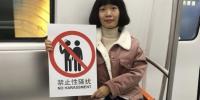
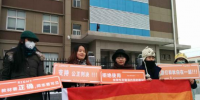
Zheng Xi 郑熹, a Ph.D. candidate with a focus on gender studies at Zhejiang University in Hangzhou. Zheng has launched a campaign asking city governments around China to display anti-sexual-harassment logos, complete with a groper’s “salty-pig hand” visual (etymological context here), alongside other commonly displayed public safety logos on places like subway trains and buses.
A minibus is parked on the side of the road with a series of pipelines wrapped around it. One end of the pipeline is connected to the exhaust port of the minibus, and the other end is put into the car, so that the exhaust gas can be directly introduced into the car, forming a " Street gas chamber".
Pneumoconiosis has become the most serious occupational disease in China, and the vast majority of sufferers, nearly 6 million, are migrant workers. Because of the long-term inhalation of dust caused by pulmonary fibrosis, they usually breathing if not oxygen machine help, easy to suffocate.
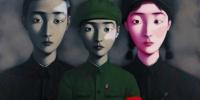
The immediate prototypes of Zhang Xiaogang’s Big Family series are formal group photographic portraits from the 1950’s and 60’s, including those of Zhang’s own family, a source of the painter’s “endless reveries.” From these old black-and-white pictures Zhang Xiaogang derived the series’ paradigmatic features: a subdued, nearly monochromatic palette; a thickly layered but flat surface, without overt evidence of brushwork; a general compositional restric
The world is shocked by China’s dog meat festival and by videos showing that animals are eaten alive in restaurants in Guangdong. But in that country of 1.3 billon people, a massive shift in ideology is happening. Our friends at PETA Asia are helping millions of people see that animals are not ours to eat, wear, experiment on, use for entertainment, or abuse in any other way.
A toothless garbageman who once wandered Hong Kong’s streets with dingy bags of ink and brushes tied to his crutches is now the subject of a major retrospective. About 300 calligraphic works by the late Tsang Tsou-choi — who is best known by his self-dubbed title, the King of Kowloon — are showing at the ArtisTree art space in a high glass tower.
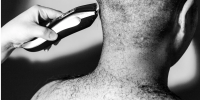
In this black-and-white image, there are no strands of hair or remnants of makeup to be found, except a shaved head belonging to a South Korean. Jeon photographed this image in 2019 for her exhibition that aimed to "destroy the socially defined idea of a woman” (Kuhn 1). The visuals in this image is a brazen response to the conventional beauty standards that has been gripping South Korean women.
Slippery When Wet proposes a wet ontology of Hong Kong—a city in ongoing transfiguration shifting into an uncanny vision of itself. Hong Kong secretes, leaving a trail of ink, tears, humidity, logistic flows, and leaks.
Nanjing, a picturesque city lying by the Yangtze River, owes its fame to its favorable geographic position, galaxy of talents and profound historical background. Having served as the capital of ten dynasties in ancient China, its splendour has remained and even enlarged with an extended population up to 600,000 when the government of the Republic of China set up its capital there in 1927.
Lu Yang attempts to bring the negative notion of Cancer cell into a “Kimo Kawa” object of love and/or pain and hopes to open a dialogue that brings awareness to the acceptance and tolerance of living with cancer cells.
Young Japan: For too long, Japan's youth have been a silent minority. Now, on the eve of a crucially important general election, they seek a bigger voice in forging the future of their aging nation
If there’s one thing we know for certain about China in 2019, it’s that people there love their apps. They use WeChat to talk with friends; they spend hours battling virtual enemies on PUBG; they binge-watch short videos on Douyin. And so why shouldn’t the Communist Party get in on the action?
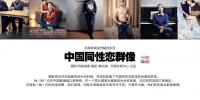
A Straight Journey is a documentary of Chinese homosexual people. It is the first time for Chinese gays and lesbians to make their debut and speak out via one of the largest Chinese Internet service providers. Two Chinese photographers Masa and Mojo took a journey across 11 China's cities making portraits of 48 gays, lesbians and their families from 2014-2015.
This is a series of paintings reflecting the struggle and sacrifices made by the Tibetan people for independence. The author is Tenzing Rigdol, who is a Tibetan and influenced a lot by the Dalai Lama and traditional Tibetan culture. The paintings are full of Tibetan cultural elements. For instance, the characters created in the paintings are Tibetan monks, who are the typical representatives of their culture.
“I am a silkworm.” Liang Shaoji has repeatedly used this phrase to describe his work, underscoring his preoccupation with the materiality of silk and the technology of sericulture, or silk farming. For more than twenty-five years, Liang Shaoji has raised silkworms and trained them to spin silk onto different objects in his Nature series.
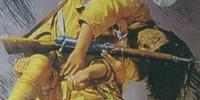
Chen Boer's first heroine film, which she co-wrote and directed, was "Daughter of China," about female soldiers in the Northeast Anti-Japanese United Army. They didn't have much filmed material at the time, but as a feminist, Chen Boer clearly wanted to record the sacrifices and contributions of Chinese women in the War of Resistance against Japanese Aggression.
In a gallery in Hong Kong’s Chai Wan district last week, during the city’s third annual installment of the international Art Basel fair, the Beijing-based artist Huang Rui introduced a new live work called “Red Black White Grey.” At the start of the performance, four affectless women walked onstage wearing trench coats, then disrobed one by one as Huang, who is sixty-three, slathered their bodies with black and then white paint.
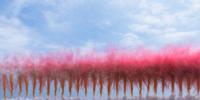
On June 26, contemporary artist Cai Guo-Qiang released the daytime firework display ‘When the Sky Blooms with Sakura’ at Yotsukura Beach in Iwaki City, as commissioned by Saint Laurent’s creative director Anthony Vaccarello.
In November 2015, Chinese LGBT activist Chen Qiuyan met with government officials in Beijing after months of campaigning to have the Ministry of Education remove textbooks which identify homosexuality as a mental disorder.
In 2001, the Chinese Society of Psychiatry removed homosexuality from its list of recognized mental disorders, after the Chinese government decriminalized consensual homosexual acts in 1997.
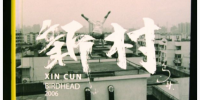
Song Tao and Ji Weiyu, established their collaborative named Birdhead in 2004. Both natives of Shanghai, their work is deeply rooted in their hometown and its evolution amid China’s growth into a global power. The duo takes diaristic snapshots, highlighting their everyday lives in the quickly changing city.
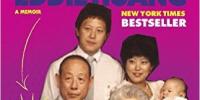
Fresh off the Boat examines the immigrant struggle told from the perspective of Eddie Huang, a modern day chef and video entrepreneur who has found a way to use food to explore culture, diaspora, and more through food, television, and the book that I am discussing now.
This book serves as an important storytelling experience of the immigrant and helps bridge the generational struggles often seen in these stories.
Photo taken on Oct. 15, 2020 shows a "comfort women" statue in Berlin, capital of Germany. The statue was built to commemorate the more than 200,000 girls and women from 14 countries and regions, so-called "comfort women," who were sexually enslaved by the Japanese military during World War II. (Xinhua/Shan Yuqi)
Many girls in China may have seen the advertisements of egg donation as a surrogate, in hospitals, schools, public toilets, shared bikes, ATMs...... They are everywhere and the number of this kind of advertisements is large. Though there are lots of girls who have never seen such advertisements or would never believe in them, there would still be some girls who would dial the numbers on the advertisements.