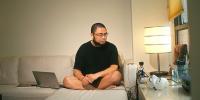
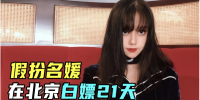
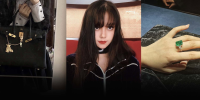
In her 2021 graduation project from the Central Academy of Fine Arts (CAFA), Chinese performance artist Zou Yaqi staged a provocative social experiment titled “21-Day Survival Challenge.” For three weeks, Zou assumed the persona of a wealthy socialite, using counterfeit luxury items, strategic self-presentation, and social engineering to access elite spaces in Beijing—such as five-star hotel lobbies, first-class airport lounges, and high-end restaurants
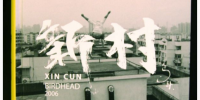
Song Tao and Ji Weiyu, established their collaborative named Birdhead in 2004. Both natives of Shanghai, their work is deeply rooted in their hometown and its evolution amid China’s growth into a global power. The duo takes diaristic snapshots, highlighting their everyday lives in the quickly changing city.
By NAZANIN LANKARANI
PARIS — Five years after his rise to the top of the Chinese contemporary art market, Yue Minjun has something new to smile about.
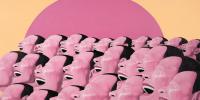
Best known for his large-scale paintings depicting his own smiling face, Mr. Yue, who is based in Beijing, has long been a star of the Chinese contemporary art scene, having achieved commercial success through a highly singular aesthetic.
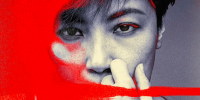
“I performed at Tiananmen Square in 1989, 15 days before the crackdown. I sang A Piece of Red Cloth (一块红布), a tune about alienation. I covered my eyes with a red cloth to symbolize my feelings. The students were heroes. They needed me, and I needed them. After Tiananmen, however, authorities banned concerts. We performed instead at “parties,” unofficial shows in hotels and restaurants”.
On Sept 21, 2017, the professional committee of dementia and related diseases of China geriatric health association, together with many caring enterprises, jointly launched a public welfare activity entitled "no longer forget", hoping to call on the public to pay attention to Alzheimer's disease and promote early screening.
Since the 1980s, revitalizing the economy has always been the country's development strategy. Although China's economy has grown rapidly in just twenty years, attracting worldwide attention, environmental destruction has also become a problem. For example, the Fu Nan River in Chengdu, like many rivers nationwide, is severely polluted.
The Xuzhou chained woman incident, also known as the Xuzhou eight-child mother incident, is a case of human trafficking, false imprisonment, sexual assault, severe mistreatment, and subsequent events that came to light in late January 2022 in Xuzhou's Feng County, Jiangsu, People's Republic of China.
In Hong Kong in 2014 the song Raise Your Umbrella by Denise Ho and Anthong Wong became an anthem for the pro-democracy movement known as the Umbrella Revolution. The song was written after police fired tear gas into the crowds when protestors filled the streets.
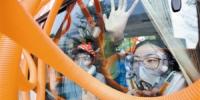
A minibus is parked on the side of the road with a series of pipelines wrapped around it. One end of the pipeline is connected to the exhaust port of the minibus, and the other end is put into the car, so that the exhaust gas can be directly introduced into the car, forming a " Street gas chamber".
By Steven Jiang, CNN
https://www.cnn.com/2018/03/14/asia/china-viral-eye-roll-intl/index.html
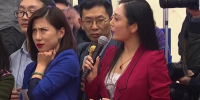
(CNN)It was the eye roll that resonated with millions -- and broke the internet in China.
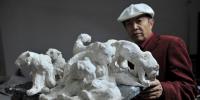
By a pond inside one of the entrances to Beijing’s Chaoyang Park lies a cluster of one and two storey red pyramid-shaped buildings. Sculptures of Gandhi and Lincoln and other famous figures sit in the quiet woods nearby. This is Yuan Xikun’s Jin Tai Art Museum.
It can be important to reflect on the artistic recounts of activists experiences under state imprisonment. In a revealing interview with Artspace, Chinese artist and dissident Ai Weiwei reflects on his 81-day secret detention in 2011 and the psychological strategies used to dismantle identity and autonomy.
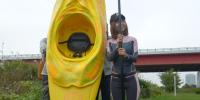
Megumi Igarashi—who goes by the name Rokudenashiko, or "good-for-nothing" in Japanese—is known as a "vagina artist" in her native Japan. Among the pieces she's created are a vagina chandelier, a remote-controlled vagina car, and a 3-D-printed kayak modeled after her vulva, which she actually rowed in 2014 "as a metaphorical image of life springing from it," she told Glamour through a translator.
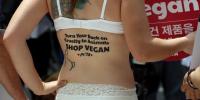
An animal rights activist sporting only a white bikini, bunny ears and tail has been spotted protesting against fur in Pyeongchang, South Korea, which is hosting the Winter Olympics 2018.
Ashley Fruno discussed the People for the Ethical Treatment of Animals' (Peta) stance on fur in front of the Olympic rings at the Alpensia Resort.
A toothless garbageman who once wandered Hong Kong’s streets with dingy bags of ink and brushes tied to his crutches is now the subject of a major retrospective. About 300 calligraphic works by the late Tsang Tsou-choi — who is best known by his self-dubbed title, the King of Kowloon — are showing at the ArtisTree art space in a high glass tower.
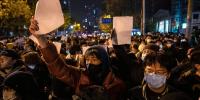
In Shanghai, a vigil grew into a street protest where many held blank sheets of white paper in a symbol of tacit defiance.
In Beijing, students at Tsinghua University raised signs showing a math equation devised by the Russian physicist Alexander Friedmann, whose surname in Chinese is a homonym for “free man.”
"Why should I play a celebrity and live in Beijing for 21 days without spending money?"
From May 1st to May 21st, 2021, I spent 21 days in Beijing without spending money, and I was as elegant as a celebrity. I recorded this behavior through video.
Video "Instant Ownership" 28-minute graduation exhibition version of the Central Academy of Fine Arts (click to watch)
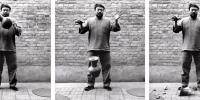
Dropping a Han Dynasty Urn (1995) by Ai Weiwei is a highly provocative work of art. This series of three black and white photographs portray the artist holding a 2,000-year-old Han dynasty urn that, frame by frame, he drops, it falls, and shatters. As much a work of photography as a work of performance art, in each still an unaffected Ai looks directly at the camera aware of his destructiveness.
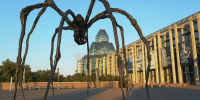
Through the use of mythical and archetypal iconography, Bourgeois translated her encounters into a very individualized symbolic imagery, employing things such as swirls, arachnids, cages, surgical equipment, and sewed appendages to represent the feminine mind, beauty, and mental agony.
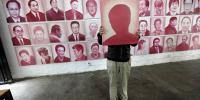
Chinese Artist Zhang Bingjian has embarked on an artistic project to promote transparency in China and Chinese government. His motivation? Discovering the extent of the corruption going on in his country. Zhang told the Toronto Star: “The chief prosecutor announced that 3,000 officials had been convicted for corruption in a single year. I remember being shocked, a little angry and then confused.”
In 2009, the dissident artist created a work to honour the thousands of children who died in the Sichuan earthquake. He recalls how the project, Remembering, angered China’s rulers – and changed his career for ever
This is an edited extract from The Start podcast
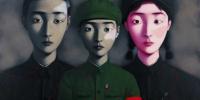
The immediate prototypes of Zhang Xiaogang’s Big Family series are formal group photographic portraits from the 1950’s and 60’s, including those of Zhang’s own family, a source of the painter’s “endless reveries.” From these old black-and-white pictures Zhang Xiaogang derived the series’ paradigmatic features: a subdued, nearly monochromatic palette; a thickly layered but flat surface, without overt evidence of brushwork; a general compositional restric
“There are many problems in rural areas. For example, agriculture is declining, no one is farming, traditional things are falling apart, farmers are brainwashed by the idea of urbanization, and they don’t like their hometown. They all want to move to the city.”Activist Ou Ning said. Rural construction is an important issue. As an activist, he chose Bishan village in Anhui, China as the field to start his experiment, which is “Bishan Project”.