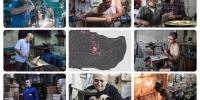
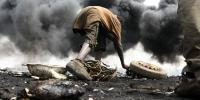
Craftsmanship in Istanbul is under the danger of extinction with all the knowledge accumulated with generations of masters and apprentices. After visiting some workshops in the city, craftsmen shared with the initiators how their condition and businesses have changed since they started working.
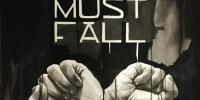
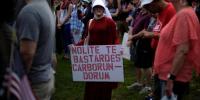
Daniel Hewson describes the use of protest posters and the work of collective, Burning Museum, and artist, Faith47, in the Fees Must Fall movement taking place in South Africa:
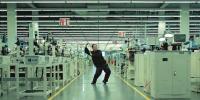
Whose Utopia? is a color film which is 19 minutes 58 seconds long. It was originally commissioned by the Siemens Arts Program back in 2005. The projector-style video is based on the work and social lives of assembly line workers at OSRAM’s light bulb factory in the Pearl River Delta in China. This area has received huge numbers of immigrants from inland provinces seeking work and better lives in the wake of Beijing’s booming economy.
Omelia Contadina was born out of the concern of JR and director Alice Rohrwacher for the difficulties encountered by many small farmers and inhabitants of the Alfina plateau, in Italy.
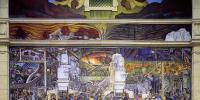
Almost all of Rivera's art told a story, many of which depicted Mexican society, the Mexican Revolution, or reflected his own personal social and political beliefs, and In the Arsenal is no different. The woman on the right side of this painting in Tina Modotti, an Italian photographer and revolutionary political activist, who is holding ammunition for Julio Antonio Mella, a founder of the internationalized Cuban communist party.
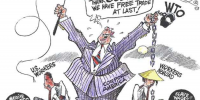
Khalil Bandib is a Berkeley-based, award-winning editorial cartoonist with a unique perspective. He critiques a myriad of topics, from racism and homophobia to foreign policy and the Patriot Act. Bandib was born in North Africa under a French colonist regime; he brings a non-Eurocentric perspective not typically visible in large corporate media.
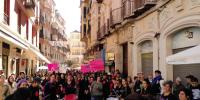
La Casa Invisible project was started in 2007 in Malaga, Spain, when a group of socially involved participants squatted in a run-down building, aiming to eventually claim the legal rights to the property (Moor & Smart, 2016). The space was opened to local artists and creators, quickly becoming a hub for free local music, performances, and seminars as well as creating an important meeting space for social groups (Moor & Smart, 2016).
In state capitals and street protests, women’s rights activists have been wearing red robes and white bonnets based on “The Handmaid's Tale,” the 1985 novel that is now a series on Hulu.
Silent, heads bowed, the activists in crimson robes and white bonnets have been appearing at demonstrations against gender discrimination and the infringement of reproductive and civil rights.
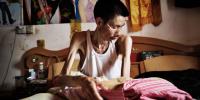
Photographer Sim Chi Yin spent more than three years documenting a Chinese gold miner who is suffering from the deadly lung disease silicosis. Despite the odds, his loving relationship with his wife has kept him alive much longer than anyone expected.
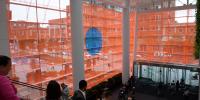
UNLESS by Stephanie Cardon is a vibrant floor-to-ceiling installation that fills the main entryway of Boston’s landmark Prudential Center. Commissioned by Boston Properties and curated and produced by Now + There, UNLESS explores sustainability, climate justice, and how taking action together can create positive change.
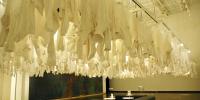
NORTHFIELD, Minn. — Exactly 1,281 white garments hang from the ceiling of the Perlman Teaching Museum’s Braucher Gallery. The collared shirts, knit sweaters, tights, and other items of clothing glow with an eerie luminosity.
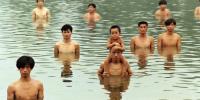
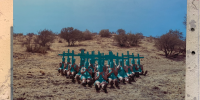
Zhuang Huan invited more than 40 men - laborers, fishermen, construction workers––who had recently migrated to Beijing from other areas of China to participate. Zhang Huan said, “In order to find these workers, I visited many of the shacks where they live.”
Cheril Linett is a female artist from Chile, with a background in performance art and stage performance, who primarily focuses her artwork on feminist issues in Chile, especially ones involving violence, murder, hate crime and different kinds of oppression and assault, but also creates artwork reflecting issues in other parts of Latin America.
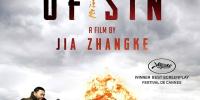
"May you live in interesting times" is the familiar Chinese saying, usually spat out as a curse. You can see why in "A Touch of Sin," a film by renowned director Jia Zhang-ke. That kind of time is now, in the history of his country. With four vignettes inspired by real-life "ripped from the headline" events, he shows what the great economic expansion of China is doing to the majority of its people.
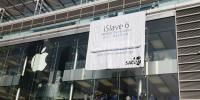
Apple implemented improved reservation procedures and policies for employees dealing with the iPhone 6 launch at retail stores on September 19th, 2014, but the launch at the company’s Hong Kong store hadn't gone quite as smooth as elsewhere. The store was hit by protesters from the Students and Scholars Against Corporate Misbehavior (SACOM) and also required police to help disperse customers that had waited in line without reservations.
Better Cotton Initiative (BCI) was registered in 2009 and headquartered in Geneva, Switzerland. It is a non-profit international membership organization with representative offices in China, India, Pakistan, and London. It has more than 400 member organizations around the world, mainly including cotton growers, cotton textile enterprises, and retail brands. The group aims to promote what it calls "Better Cotton" around the world.
Work ideology centers around sustainable work. Through fifteen interviews, workers and prospective workers were interviewed about their experiences with work and the job search. Those interviews are analyzed and compiled on work ideology. However, work ideology goes further than showcasing the interview results, it allows for anonymous responses to be entered as well, expanding the research’s accessibility to every worker.
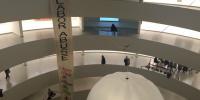
A thirty-nine-foot banner was unfurled in the rotunda of a sparsely-attended Guggenheim Museum this evening, the latest action carried out by the Gulf Ultra Luxury Front (G.U.L.F.) activist group. Decrying labor abuse at the museum’s planned Abu Dhabi outpost, the banner announced the forthcoming “Countdown” campaign by Gulf Labor, the larger collective of artists and activists of which G.U.L.F. is an offshoot.
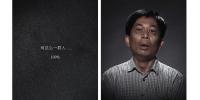
Pneumoconiosis has become the most serious occupational disease in China, and the vast majority of sufferers, nearly 6 million, are migrant workers. Because of the long-term inhalation of dust caused by pulmonary fibrosis, they usually breathing if not oxygen machine help, easy to suffocate.
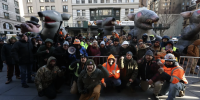
A fat cat, a pig wearing a top hat and five rats. All seven inflatables faced the 34th Street entrance of the Empire State Building last Thursday, two weeks into a protest by members of Laborers Local 79 who rallied, hundreds strong, in the afternoon shadow of the props.
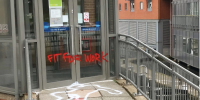
Graffiti art is particularly viewed as a powerful form of social protest, and the (illegal) act of defacing can be as important as the message itself. Artist Void One has been arrested on numerous occasions for his politically-charged interventions.
“I didn’t set out to make political art but art is a platform where I can vent my frustrations” – Void One.
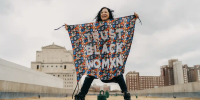
Sewing and textiles have always been a part of the artist Aram Han Sifuentes’ life. Her South Korean immigrant parents operated a dry cleaning business, and she mended her own clothing from a young age.
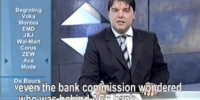
ACE Bank was a hoax bank developed as part of a bigger campaign by Netwerk Vlaanderen, a Belgian organization concerned with banks’ responsibilities for what they invest in. ACE bank was an elaborate deception, with a headquarters in central Brussels, parodying other banks. It claimed to be investigating whether there was a market for its special way of doing business.
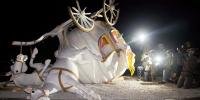
“He describes it as a “family theme park unsuitable for small children” – and with the Grim Reaper whooping it up on the dodgems and Cinderella horribly mangled in a pumpkin carriage crash, it is easy to see why.
Banksy’s new show, Dismaland, which opened on Thursday on the Weston-super-Mare seafront, is sometimes hilarious, sometimes eye-opening and occasionally breathtakingly shocking.