change
issue
region
medium
despondent apostate
This is the sixth piece of the series Tatlin’s Whisper which examines the relationship between apathy and anaesthetization of the images in the mass media. This series intends to activate images, well-known because of having been repeatedly seen in the press, but are here decontextualized from the original event that gave way to the news and staged as realistically as possible in an art institution. The most important element in this series is the participation of spectators who may determine the course the piece will take. The idea is that next time spectators face a piece of news using similar images to those they experienced, they may feel an individual empathy with that distant event towards which they will normally have an attitude of emotional disconnection or informative saturation. The experience of the audience within the piece may allow them to understand information in a different way and appropriate it because of having lived through it.
On the other hand, the title of the series, Tatlin’s Whisper, evokes the present weakening of the impact a moment of Western history in which great transformations took place as the result of social revolutions originally had. A symbolic reference is made to Russian artist and architect Vladimir Tatlin, who created the Tower Monument, foreseen as the seat for the Third Communist International, an icon of the enthusiasm and grandiosity of the Bolshevik Revolution. The intensity, credibility and exaltation of socialist revolutions, just as Tatlin’s Tower, which was never built, were frustrated and utopia is rethought with the effort implied in a weak whisper. This series reevaluates the desire for moments of active citizenry commiment in the construction of a political reality, while ideologies transform and circulate today as pieces of news.
Tatlin’s Whisper # 6 (Havana Version) was held in the central patio of the Wifredo Lam Center, the institution in charge of organizing and holding the Havana Biennials.
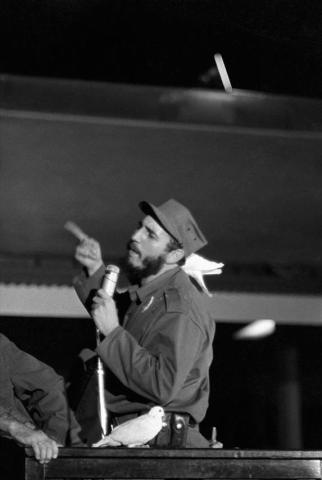
The audience was handed two hundred disposable cameras with flash to document the performance and told that they could freely express their thoughts for a minute through the microphone in the podium. There was a long silence. The first person took the podium guarded by two persons in military uniform (a woman and a man). They put a white dove on the speaker’s shoulder, an allusion to the emblematic image of Fidel Castro when delivering his first speech on January 8th in Havana after the Triumph of the Revolution, an image that ratified his absolute leadership in a generalized consensus which worked for those who wanted to see in this image either the peace guaranteed in the lives of the citizens, the Messiah or the aesthetics of the future to be built.
In Tatlin’s Whisper # 6 (Havana version) there is no censorship during the minute a member of the audience is at the mike. When the time assigned for freedom of expression ends, the persons in military uniform that until then had been at each side of the speakers – to defend their right to talk or to control it – take the dove from their shoulder making them leave the podium and the dais and they become once more part of the audience. This action was repeated with each speaker. They were all treated in the same way. A total of 39 persons made use of the mike to express their affinity with the Cuban political system or criticize it in the 41 minutes the work lasted, after which Tania Brugera took the podium to thank the Cubans for their courage and their exercise of freedom of expression.
Several reactions were exhibited, all with respect and all accepted, those who offered reasons to continue the path of Fidel Castro’s Revolution and those who asked for elections with nobody in that family as a candidate. It went from a person whose only reaction was to cry because she had had no other option than migrating because of her political differences, to declarations of members of the blogger movement in Cuba who have contributed when dissenting in virtual public spaces in the net. Some demanded those who were part of the secret police to come to the mike, others asked for a day when freedom of speech did not have to be a performance.
The loudspeakers within and without the building made more than one of those not involved in the Havana Biennial approach as spectators.
The work functions like a projection for the future when people use this chance to express through a mike and as a monument when the empty podium is an image reminding us of the absence of the leader who for 49 years (1959-2008 1) led the life of the Cuban people.
While the cameras with flash made documentation in real time they were also a protection device for those who had taken the floor. This piece yields to the audience responsibility, authorship and the ownership of its documentation.
The impact of this piece made the Organizing Committee of the Tenth Biennial issue a denunciation against the comments of the participants branding their authors as manipulators of the artistic event with the purpose of expressing their political platforms and discrediting the Cuban Revolution. On the other hand, rumors on the performance swept the city and reached sectors of the population that did not belong to the artistic elite, disseminating the event in the media abroad, mainly through Miami TV stations 2 that Cubans inside the country can see through popular – and illegal – access to cable TV. The following day some people visited the place to see if the mikes were still open; the Damas de Blanco (Ladies in White, a pacifist group claiming for the release from prison of their husbands, political prisoners in Cuba) were among them. The emergence in the following months of performance strategies by art groups and bloggers who took the streets with demands or spoke to audiences denied to them is attributed to this piece.
The piece, endowed with an acute political impact, was conceived as an open structure pressing the limits of the institutions in power, where the responsibility rests with the audience that, to participate, must assume their role as citizens actively integrated to the political process. The privilege of expression, with limitations, artists have in Cuba is transferred to spectators who enjoy a sort of momentary democracy, almost as a rehearsal of what a plural society tolerating discrepancy as part of a project for civil society would be.
This piece, with its situationist and hyperrealist notions, can go beyond representation spaces to work directly in and with reality.