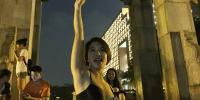
In a gallery in Hong Kong’s Chai Wan district last week, during the city’s third annual installment of the international Art Basel fair, the Beijing-based artist Huang Rui introduced a new live work called “Red Black White Grey.” At the start of the performance, four affectless women walked onstage wearing trench coats, then disrobed one by one as Huang, who is sixty-three, slathered their bodies with black and then white paint.
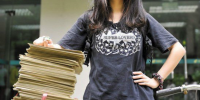
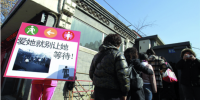
On April 26th, 2012, Zheng Churan, a feminist activist who was a senior at Zhongshan University at the time, brought 500 letters of advocacy to the school post office on a bicycle.
In 2011, nine local artists staged a performance called “Let’s Add 1 Meter to Taipa Pequena (Sio Tam Hill)” in Macau, protesting against the controversial attempted rezoning of the mountain for high-rise construction by the developers. They lied on top of each other with their naked bodies, forming a one-meter-high pile of human nudity on the Taipa Pequena.
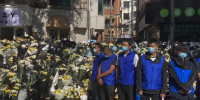
HEFEI, China (AP) — Hundreds, possibly thousands, of people gathered Thursday near a state funeral home in Beijing as China’s former second-ranking leader, Li Keqiang, was put to rest, while a steady stream of mourners showed their respects at the ex-premier’s childhood home in central China.
Li, who was China’s top economic official for a decade, died last Friday of a heart attack at age 68.
China's "Punchline Queen" Yang Li is no stranger to controversy.
The 29-year-old is now one of the country's most well-known comedians, having risen to fame in recent months on a Chinese television show called "Rock and Roast".
Every week, in front of a national audience of millions, she addresses controversial gender issues using a style unfamiliar to many Chinese viewers - stand-up comedy.
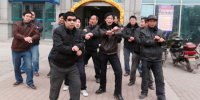
In early January, constructions workers in Wuhan, China staged a Gangnam Style protest in front of their employer's building. Using the Gangnam Style dance, the men sought to bring media attention to their mounting unpaid wages.
If there’s one thing we know for certain about China in 2019, it’s that people there love their apps. They use WeChat to talk with friends; they spend hours battling virtual enemies on PUBG; they binge-watch short videos on Douyin. And so why shouldn’t the Communist Party get in on the action?
Institute of psychology in Shenyang, a major city of China, recently reveals 6 most frequently used utterances in verbal abuse of children among local parents: “Garbage”, “You know nothing but eating”, “Pig head”, “Shame on you”, “Why don’t you die”, “No one else is lamer than you”.
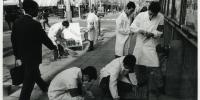
On October 16, 1964, the artist collective Hi Red Center, clad in sanitation masks and white uniforms and wielding small brooms and toothbrushes, spent several hours meticulously cleaning the streets of the Tokyo district of Ginza, amid the hustle and bustle of a “normal” day.
As the No. 59 bus hurtled down Ratchadamnoen Klang road in Bangkok's Old Town, its passengers diverted their attention from the intense midday heat to a small crowd on the concrete below. About 25 people were marching and chanting, photographers scuttling in front of them.
Shu Yong is an artist who has been passionate about environmental protection in recent years. "The Earth Is Bleeding" was created in 1998. The creation was carried out in a studio of more than ten square meters.
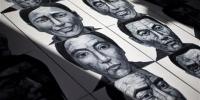
Beijing-based artist Liu Yi is working on a series of black-and-white portraits he knows will never be shown in a Chinese gallery. His varied subjects — men and women, young and old, smiling and pensive — have one thing in common: They are Tibetans who have set themselves on fire to protest repressive Chinese rule.
On the afternoon of September 11th, nearly a hundred people hugged each other to feel the beauty of the hug on the Paris Square in front of the Brandenburg Gate in Berlin, under the leadership of the Chinese artist Gao Brothers. At the beginning of the event, the Germans have not yet adapted to the behavior of embracing strangers, but encouraged by Gao brothers, people have opened their arms and gave the strangers around them a warm hug.
On Sept 21, 2017, the professional committee of dementia and related diseases of China geriatric health association, together with many caring enterprises, jointly launched a public welfare activity entitled "no longer forget", hoping to call on the public to pay attention to Alzheimer's disease and promote early screening.
The pro-democracy protests in Hong Kong have a new mascot: a roughly 12-foot-high figure of wood blocks holding a bright yellow umbrella in its outstretched right hand. The students call it Umbrella Man.
Umbrellas emerged as a symbol of the demonstrations after dozens of students wielded them on the night of Sept. 28 to fend off pepper spray as they jostled with the police.
WeiweiCam is a self-surveillance project by artist Ai Weiwei that went live on April 3, 2012, exactly one year after the artist's detention by Chinese officials at Beijing Airport.[1] At least fifteen surveillance cameras monitor his house in Beijing[2] which, according to Ai, makes it the most-watched spot of the city.[3] He described his decision to put himself under further surveillance as a symbolic way to increase transparency in the Chinese g
In 2016, Zhou Zhenfeng, who was a student at a college in Hebei at the time, discovered that there were a lot of waste tires in the streets and alleys. Zhou Zhenfeng learned that tires are made of infusible or refractory polymer elastic materials. It takes hundreds of years for these materials to decompose in the soil to the extent that they do not affect the growth of plants.
As the summer warms up, bringing with it sleeveless tops, Xiao Meili, a women’s rights advocate, is collecting photos of women’s armpits. Her goal: to challenge a growing belief in China that a woman must have hair-free armpits to be attractive.
'Jealousy Ms. Vy' is a creative project of the Institute of Occupational and Environmental Health, in collaboration with musician Khac Hung, singer Min and singer Erik.
Through this project, we look forward to empowering and trusting the community, so that we can join hands to combat COVID-19 (aka nCoV-2019).
The “Occupy Men’s Toilets” movement, initiated by Chinese feminist activists including Li Tingting (Li Maizi) and Wu Rongrong, emerged in 2012 as a creative, non-violent protest against gender inequality in access to public facilities.
Chen Boer's first heroine film, which she co-wrote and directed, was "Daughter of China," about female soldiers in the Northeast Anti-Japanese United Army. They didn't have much filmed material at the time, but as a feminist, Chen Boer clearly wanted to record the sacrifices and contributions of Chinese women in the War of Resistance against Japanese Aggression.
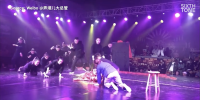
A viral video of a student dance performance in southern China’s Guangxi Zhuang Autonomous Region has won praise for speaking out against so-called ghost marriages, which many today see as an archaic and even dangerous tradition.
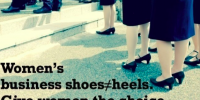
Yumi Ishikawa, a Japanese actress, freelance writer, and part-time funeral parlor worker, started the #KuToo Movement because she feels it’s unfair she has to wear heels at work. She also feels that being required to wear heels is rooted in a cultural problem, one much deeper than physical discomfort.