Sunaura Taylor is an artist, writer and activist. Through painting, printmaking, writing and other forms of political and artistic engagement her work intervenes with dominant historical narratives of disability and animal oppression. Taylor's artworks have been exhibited at venues across the country, including the CUE Art Foundation, the Smithsonian Institution and the Berkeley Art Museum.
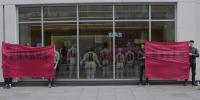
April 2nd, 2016, organized by members of the Aids Coalition to Unleash Power faction in London, five activists stormed London's Gilead Pharmaceutical offices and frantically disrobed to reveal painted backs spelling out the word 'Greed." About 30 other activists rallied outside the building.
This afternoon, in the Sackler Wing of the Metropolitan Museum of Art in New York, a mother and daughter threw coins into its reflecting pool while a couple posed for engagement photos in front of the Temple of Dendur, the man in red pants and a gray blazer, the woman in a black jumpsuit. A long line snaked out of the temple. It was tranquil, most people speaking in a whisper. That grand space has such an effect on people.
This weekend marks the one-year anniversary of Donald Trump's inauguration. It also marks the one-year anniversary of the Women's March his election inspired, the largest single-day protest in the nation's history.
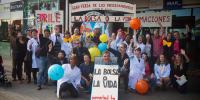
On Thursday 18th December 2014, dozens of leading international health activists staged a colorful protest in front of Hospital del Mar in Barcelona, Spain - highlighting the high prices of Gilead's new hepatitis C treatment, Sovaldi. The medicine costs approximately 40,000 euros in Spain, and $84,000 in the United States, leading to the exclusion from treatment of the majority of patients.
Mary Fisher wears many hats: Artist, author, and HIV/AIDS activist are just a few. The latter is perhaps what she's known best for—her influential speech at the 1992 Republication National Convention is regarded as one of the greatest American speeches of the century, spurring a push toward treatment and compassion towards those who are HIV-positive.
The Kodaikanal Won't video by Chennai artist Sofia Ashraf, asking Unilver to 'clean up their mess' in connection with the Kodaikanal mercury dumping, has gone viral with over 783,533 views at the time of writing this, in just over two days. It has been shared on social media by prominent personalities such as Nandita Das, Varun Grover, Vishal Dadlani and was even praised by Nicki Minaj, on whose song Anaconda, the rap is based on.
Gao Yaojie (Chinese: 高耀潔, Gao Yaojie; 19 December 1927 – 10 December 2023) was a Chinese gynecologist, academic, and AIDS activist based in Zhengzhou, Henan, China. Gao was honoured for her work by the United Nations and Western organizations whilst spending time under house arrest.
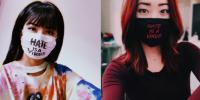
Activists fighting coronavirus-driven hate crimes are rallying on social media to turn masks into a symbol, rather than a target in racist attacks
Jeff Elder Apr 6, 2020, 2:03 PM
Activists against COVID-19-related hate crimes are leading a social media campaign using images of people in masks to fight back against attacks on Asian-Americans, which Congress and the FBI say are increasing.
Animal Collective, Mumford and Sons and Duran Duran among performers who have turned concerts in state into fundraisers as part of NC Needs You movement
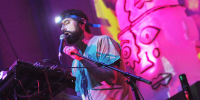
Even as North Carolina’s governor, Pat McCrory, refused to comply with federal officials over his state’s so-called “bathroom bill”, experimental pop group Animal Collective went forward with its scheduled show in the state over the weekend.
With the support of the Amy Rossborough Foundation and several other Yale University affiliated departments, Tamara Leacock, while a senior at Yale University, designed a collection and produced a fashion show that explored through fashion, dance, and carnival an intimate portrait of HIV. The goal of the production was to display HIV in a setting that was intimate, personalized, and displayed with a human face.
We were ‘Superheroes’ and had fun, colourful, engaging activities which had a high visual impact with a purpose to engage the head, hand and heart. We believe that everyone has superpowers within and they just need to be released but that all superheroes need a rest in order be at their best for themselves and others.
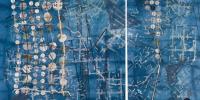
"Intrabody Wireless Network" is a show of eighteen drawings and collages by Dmitry Borshch, in which he shows the architecture of such networks, their components referred to as nanomachines (biological, physical, chemical sensors, routers, antennas, interface devices), options for communicating (molecular, electromagnetic – in the terahertz band, acoustic, nanomechanical), and this type of network's applications (human, plant, industrial)
Gran Fury was an AIDS activist artist collective from New York City consisting of 11 members, all artists - but action, not art, was the aim of the collective. Gran Fury member Loring McAlpin described the collective's mass-market ambition to “...fight for attention as hard as Coca-Cola fights for attention.”
Glowing softly in the West Texas desert night, artist Guadalupe Maravilla’s Mariposa Relámpago, was once an ordinary school bus but is now a richly decorated, mobile site for remembrance and healing. Like much of the artist’s work, this piece commemorates and confronts the artist’s journey to the United States as an unaccompanied, undocumented minor fleeing civil war in El Salvador in the 1980s.
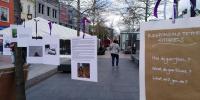
‘In Her Shoes’ was a street exhibition of stories from women and men affected by the 8th Amendment of the Irish Constitution. These stories were selected from the ‘In Her Shoes’ project Facebook page. We hung copies of the stories on ribbon between trees and provided pens, paper and a seating area for people to sit down and write a response to the stories if they chose.
Social distancing guidelines didn’t stop members of Refuse Fascism Philly from criticizing President Donald Trump’s response to the coronavirus pandemic on Saturday.
Rather than march as a crowd through Center City, a handful of protesters from the group, which has repeatedly called for Trump’s removal, drove their cars through Philadelphia before arriving at the Trump National Golf Club in Pine Hill, N.J.
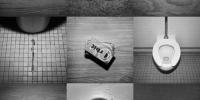
Exposing Disordered Eating is a photographic exhibition intended to show us the images we rarely see. In American media, representations of disordered eating are conditioned and controlled; all we are shown is the crumpled, emaciated anorexic figure with sunken eyes and cheekbones. This image is both unrelatable and othered, and it fails to capture the reality of modern eating disorders: they are omnipresent, multifaceted, and sneaky.
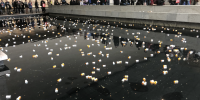
In May 2020, a team of artists, activists, folklorists, and people who lost loved ones to Covid-19 came together to make monthly memorial sites in New York City to remember victims of the Covid-19 pandemic. They continued installing memorials around New York City every month during the summer of 2020.
Donald Trump has been accused of personally causing the deaths of 40,000 Americans through his “reckless” handling of the Covid-19 pandemic, in a new website launched on Wednesday under the provocative title Trump Death Clock.
On September 5th, 1991, I put a giant condom over Jesse Helms’ house. Why? Because, as the condom said, “Helms is deadlier than a virus.” Senator Jesse Helms was one of the chief architects of AIDS-related stigma in the U.S. He fought against any federal spending on HIV research, treatment or prevention.
The American rapper’s performance of 'Stand Up for Something' with singer Andra Day has gone down as one of the highlights of this year’s Academy Awards.
Common used his Oscars performance to condemn Donald Trump’s “hate” and the National Rifle Association.
The American rapper’s performance of “Stand Up for Something” with singer Andra Day has been held up by many as one of the highlights of this year’s Academy Awards.
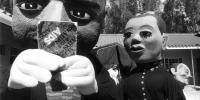
"Puppets Against Aids was launched by Gary Friedman on 1st December 1988 in time for 'World Aids Day' in Johannesburg, South Africa. During 1987, Friedman had been studying with Muppet master, Jim Henson, in Charleville-Mézières, France. Henson provided the initial financial contribution to launch the African Research and Educational Puppetry Programme 'Puppets Against Aids'.