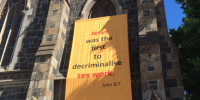
A big yellow banner hangs off the Central Methodist Church in Cape Town, South Africa proclaiming that *"Jesus was the first to decriminalise sex work - John 8:7"*
The US-Mexico border wall has become a battleground for political theater, but also various artistic interventions. One of these outstanding artworks is the pink seesaws. They went viral after they were installed by the two creative architects Ronald Rael and Virginia San Fratello. Between the erect giant steel posts of the border fence lie small gaps a couple of inches apart. It is this space where they installed the seesaws.
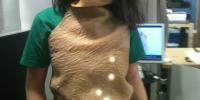
Female students from the Guangdong University of Technology in Guangzhou called for equal job opportunities and for people to "pay attention to the value of women" while protesting on the school's campus, shirtless and covered in body paint.
The photos, taken by ogling passersby, have been circulating on Weibo and naturally netizens stand divided on whether the semi-naked protests were empowering or counterproductive...
Alex King describes Project Ukko in detail for Huck Magazine (March 17, 2016):
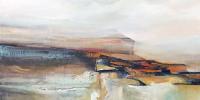
"Moritz Stefaner’s Project Ukko turns climate and wind data into an immersive art installation that allows viewers to explore the future of the planet."
We Animals is an ambitious project which documents, through photography, animals in the human environment. Humans are as much animal as the sentient beings we use for food, clothing, research, experimentation, work, entertainment, slavery and companionship. With this as its premise, We Animals aims to break down the barriers that humans have built which allow us to treat nonhuman animals as objects and not as beings with moral significance.
The Declaration of Sentiments, also known as the Declaration of Rights and Sentiments, is a document signed in 1848 at the first women's rights convention to be organized by women. Held in Seneca Falls, New York, the convention is now known as the Seneca Falls Convention. The principal author of the Declaration was Elizabeth Cady Stanton, who modeled it upon the United States Declaration of Independence.
It has been a long and exhausting battle for the bike activists in Puebla one of the cities in Mexico. Collectives and activist groups have long pushed for including bike infrastructure around the city, in a horizontal, democratic way.
Simple Wedding Movie is an organization in China that cares about love and marriage and offer marriage service. It made a short video with the theme: experience getting old before getting married. Most people would get married in a young and beautiful age. During that time, they are young and beautiful. Because of that, young couple may more likely to have passion and love for each other.
Covenant House has started a ‘Sleep Out’ movement that shines light on the youth homelessness crisis and raises funds for young people who seek shelter. "Covenant House empowers young people to overcome homelessness and trafficking by providing them with safe housing, food and clothing, and relentless support. Sleep Out events are held for people who want to join the movement as they give up their bed for one night in NYC.
Sara Hendren is an Enabler. Hendren's writing, research, and "knowledge-building" propels conversations of ability and disability in such a way that activates a creative dialogue as well as provides a scholarly basis for cultural critique.
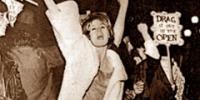
Compton's Cafeteria, 24 hour diner in S.F.'s Tenderloin was a hang out spot for trans women, drag queens, and sex workers. It was a place for the community to meet up for an expensive meal, a place to chit chat, and let each other know they made it through the night alive. They were often harassed by police and arrested for female impersonation. Finally one night in August the Compton's costumers weren't going to take it anymore.
The work of a radical theater and puppetry collective, known as Papel Machete, produces and performs throughout Puerto Rico and the United States. Papel Machete was established on May 1, 2006 during protests responding to the government shutdown and political and economic crisis prompted by Puerto Rico’s status as a United States colony.
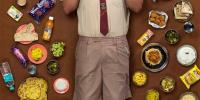
Gregg Segal -- a California-based artist who is known for using the medium of photography to explore culture with the "sensibility of a sociologist" -- travelled around the world asking kids to keep a journal of everything they ate in a week. Once the week was up, Segal made a portrait of the child with the food arranged around them:
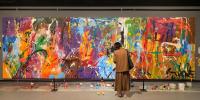
At a gallery within a shopping complex in the South Korean capital, a couple saw paint cans and brushes at their reach and use next to what was actually a finished portrait worth hundreds of thousands of dollars. Thinking the available paint and brushes was a signal to be a part of the art, they ended up technically vandalizing the artists' work.
A project as expansive as the Guerrilla Girls Twin Cities Takeover is a first for them. Kicking off on January 21, the festival will comprise a series of events by 30 different groups, which will take place until March 6 at more than 20 arts and cultural organizations in and around Minneapolis/St. Paul. A network of local art activists will be mobilized, and the Guerrilla Girls have been working in tandem with the area’s youth groups to prepare.
Sarcastic delivery spoken to black people talking about issues regarding black "progress" , media, consumption among other things
https://www.instagram.com/jillisblack/?hl=en
https://www.instagram.com/p/Bb3Y-bQFc2a/?hl=en&taken-by=jillisblack
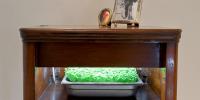
"Jenna has designed an efficient, sub-irrigated system for growing
energy-packed plants (microgreens) in small, urban spaces. Her aim: to
provide healthy greens to extraordinary people with ordinary incomes.
As an urban agricultural design project, she envisions a way to
grow food in an anthropogenic landscape for all strata of citizens, but
as an art project, she hopes to facilitate conversations about
A young and beautiful girl posted a piece of paper selfie every day on Instagram, the most popular social network at the moment. In just over 4 months, with 184 selfies, her fans quickly rose to 90,000. In the photo, she is sometimes sweet and lovely, sometimes sexy and attractive, and sometimes turned into a healthy and positive "organic girl"... Now there are nearly 150,000 people around the world who follow her every day.