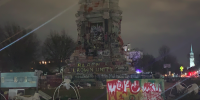
Over the winter break, I was actually able to see the recently re-decorated Robert E. Lee statue in Richmond, Virginia. After the height of the Black Lives Matter Protests over the past summer, it couldn’t be torn down, but it was fully wrapped with protest art. All phrases and slogans (such as Black Trans Lives Matter, ACAB, Etc.) were in full display over the statue of the infamous Confederate General.
The “Occupy Men’s Toilets” movement, initiated by Chinese feminist activists including Li Tingting (Li Maizi) and Wu Rongrong, emerged in 2012 as a creative, non-violent protest against gender inequality in access to public facilities.
People with disabilities often suffer a ‘civil death’ due to exclusion primarily related to physical barriers of the built environment. AXS Map is building a social movement around inclusion for people with physical disabilities. AXS Map is a crowd-sourced platform for mapping wheelchair accessibility of buildings and places, and sharing that information across a network.
An erroneous tip called into law enforcement authorities in 2002 subjected Hasan Elahi to an intensive investigation by the FBI and after undergoing months of interrogations, he was finally cleared of suspicions. After this harrowing experience, Elahi conceived “Tracking Transience” and opened just about every aspect of his life to the public.
On Tuesday morning, when Google CEO Sundar Pichai testified before the House Judiciary Committee about his company’s data collection practices, there was a familiar mustachioed face in the crowd. To most people, this person — also wearing a monocle and toting a bag of cash — is none other than the famous board game character most commonly known as Monopoly Man.
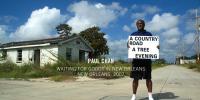
“Artist Andrea Bowers creates powerful works addressing immigration, gender violence, and environmental justice. Her large-scale drawing ‘No Olvidado’ memorializes migrants who died crossing the U.S.-Mexico border, calling attention to the human cost of border policies.”
In February 2017, authorities in Chechnya -- a republic of Russia located in the North Caucasus -- arrested a man they suspected to be under the influence of a controlled substance. As is procedure, they searched his phone. According to a report from the Human Rights Watch, they found “explicit material” (most likely shared nude photos and gay pornography), and the contact details of dozens of gay men.
South Korean artist Do Ho Suh is internationally known for his ghostly, diaphanous architecture and fabric-made objects, which create imaginary spaces that are physically present yet impossible to inhabit. His large-scale, immersive, but impermanent installations serve as “acts of memorialization,” exploring themes of identity, home, and the tension between personal and public space.
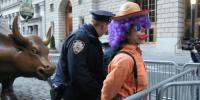
The incident began when two clowns, Hannah Morgan and Louis Jargow, scaled the steel barricades protecting the landmark. The clowns began spanking and climbing the beast, traditional ways of coaxing a bull into anger in preparation for a Castilian corrida, or bullfight.
As the world watches Cairo burn, I can’t help but think that the flames of protest engulfing Egypt were sparked by Mohamed Bouazizi, the Tunisian street vendor who set himself on fire on December 17 after police confiscated his vegetable cart. The desperation that he expressed through his act of self-immolation caught on, literally, and spread across the country, into Algeria, and now to Egypt.
The incident began when two clowns, Hannah Morgan and Louis Jargow, scaled the steel barricades protecting the landmark. The clowns began spanking and climbing the beast, traditional ways of coaxing a bull into anger in preparation for a Castilian corrida, or bullfight.
An intervention created by the April 25 2015 Queer Crisis Collective organized by the Helix Queer Performance Network (HQPN), and part of an ongoing queer resistance project mentored by Avram Finkelstein. Over a period of 2 weekends, 8 artists met at the Hemispheric Institute of Performance & Politics to design a creative intervention during Pride month in NYC.
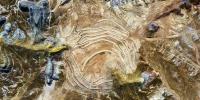
At first, you don’t know what you’re looking at. A gray expanse of uneven geometry surrounded by undulating brown. Shift your perspective a bit and it might be a close-up of a distressed textile, with subtle hues and textures surfacing as your eyes adjust.
And then the horizon comes into focus. Now you know where you are. In the distance are the classic jutting buttes of Monument Valley, familiar to anyone who’s ever seen a John Ford Western.
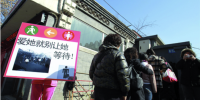
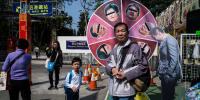
Hong Kong’s Lunar New Year fairs draw thousands of visitors who stroll past stalls of potted narcissus, snack on fish balls and snap up the latest plush toys. In recent years, the largest of the fairs, at Victoria Park, has also become a prime site for political expression.
Mis(s)placed Women? (2009-2022), is a collaborative art project, consisting of performances, performance series, performance art workshops and delegated performances, including contributions by over 180 individuals from six continents. Many of them are artists, mainly identifying themselves as women from diverse backgrounds. Mis(s)placed Women?
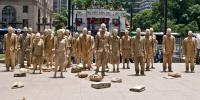
A troupe of approximately thirty women and men of various ages, sizes, ethnicities and performance backgrounds marched through the performance art space of SESC-Vila Mariana in Sao Paulo and then through the streets of downtown Sao Paulo, silent, blind folded, dressed in business attire, and covered completely with a gray mud. The performances walked slowly in unison at turtle's pace.
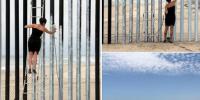
In Borrando la Frontera (Erasing the Border)", Ana Teresa confronted the fence between the United States and Mexico by putting on her black dress and heels and painting the fence sky blue.
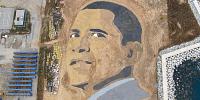
Jorge Rodríguez-Gerarda is a cuban Artist that was born in 1966. One of his projects was naed Expectations in which he did with sand and grave a massive image of Barack Obama, as a way to reflect all what this presidential candidate representated in terms of change.