On a recent eight-hour shift at a McDonald’s in Hong Kong, Luke Ching, 52, wiped tables, cleared trays of half-eaten fries, emptied cups of soda and milk tea and lugged bulging trash bags to the dumpster.
For him, the main goal of the part-time work was not making ends meet. It was research for his main pursuit: using art to advocate for better treatment of people in menial jobs in a city with one of the widest income gaps in the world.
Festival “WakEUp!” (organized by “Heartefact”) happened at several locations, and included film and exhibition program. Festival originated from the need for a reaction to the present moment refugee crisis and the situation in the world, began on the 7 th of December at Gallery “G12 Hub” in Belgrade with two days performance that was dedicated to the current problem of refugees and their historical destinies.
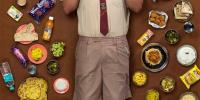
Gregg Segal -- a California-based artist who is known for using the medium of photography to explore culture with the "sensibility of a sociologist" -- travelled around the world asking kids to keep a journal of everything they ate in a week. Once the week was up, Segal made a portrait of the child with the food arranged around them:
Created a platform to showcase disparities that are therein in public basic schools verses the private schools.
Simple a call to duty bearers to act on the deplorable physical learning environment existing in the public schools , because the environment impacts teaching and learning.
Seventeen editor Ann Shoket met yesterday with Julia Bluhm, the 14-year-old reader who started an online petition to ask the magazine to curb its use of Photoshop.
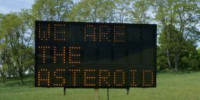
Justin Brice Guariglia’s We Are the Asteroid employs a highway message sign to bring attention to how anthropocentric, or human-centered, attitudes have allowed for unsustainable systems that contribute to climate change. The artist generated the slogan for this work with eco-critic and professor Timothy Morton.
Media artist Joseph DeLappe announces the completion of “The Drone Project: A Participatory Memorial” on the campus of Fresno State University in California.
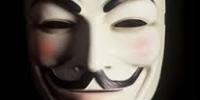
Anonymous (used as a mass noun) is a loosely associated hacktivist group. It originated in 2003 on the imageboard 4chan, representing the concept of many online and offline community users simultaneously existing as an anarchic, digitized global brain.
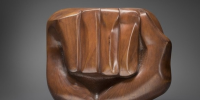
Sculptor and printmaker Elizabeth Catlett (1915-2012) used her art to advocate for social change in both the U.S. and her adopted country of Mexico. Much of her work focuses on the experience of African American life and political struggle during the middle of the 20th century. Her posters of well-known activists, including Angela Davis and Malcolm X, were widely circulated at the time.
An anti-Nazi organization called Exit-Deutschland targeted a right-wing Rock Festival in a city called Gera. They got in contact to the festival organizers by using a fictitious name, and they distributed 250 trojan t-shirts with a writing “Hardcore Rebels” during the festival. When the recipients of the shirts went back home and washed them.
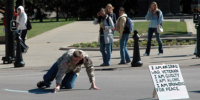
Aaron Hughes, an artist-activist and Iraq War veteran walked into the middle of a busy intersection in Champaign, Il. where he was then going to college, and propped up a signboard that read:
“I am an Iraq War Veteran.
I am guilty. I am alone.
I am drawing for peace.”
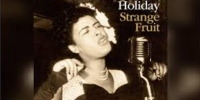
Many may not realize, but legendary jazz singer Billie Holiday was a big part of the Civil Rights Movement. In fact, her 1939 song about lynching, “Strange Fruit,” made her a target of the FBI.
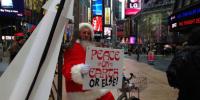
On November 13, 2012, Joey Skaggs dressed up as Santa Claus and rode a three-wheeler to the United Nations in New York, NY. Skaggs’ bike was equipped with a fake mobile rocket launcher and a sign that read “ Peace on earth, or else!” A group of elves also accompanied Santa to the UN, and they alternated between handing out green toy soldiers to bystanders and singing their altered version of Jingle Bells, as seen below:
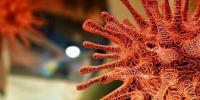
The signature angst of our time was profoundly expressed in the poems submitted for WOMAWORDS Literary Press June 2020 edition, Imaging Life After COVID-19, offering women poets an opportunity to write about their experience of the pandemic and their vision of or for the future. The universal trauma wrought by this virus, invisible and silent and pouncing with madness and mendacity, brings us to a place we’d like to forget but never will.
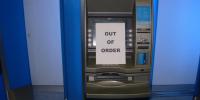
On the 6th February 2013, 40 activists across 6 states plastered 110 ANZ ATMs with 'Out of Order' notices, sharing them on social media the following day. The objective was to use a hoax style action to exploit mainstream media sensitivity around ANZ Bank's unethical funding of fossil fuel projects that had been generated by Jonathan Moylan's Whitehaven Hoax a week earlier.
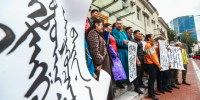
Thousands of ethnic Mongolians have protested across northern China in opposition to Beijing plans to replace the Mongolian language with Chinese in some school subjects.
The 2013 protests in Turkey started on 28 May 2013, initially to contest the urban development plan for Istanbul's Taksim Gezi Park. The protests were sparked by outrage at the violent eviction of a sit-in at the park protesting the plan.
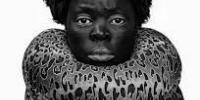
Zanele Muholi, the self-proclaimed visual activist and photographer, investigates the fraught relationship between post-apartheid South Africa and its queer community, who, despite being constitutionally protected since 1996, remain a constant target of abuse and discrimination.