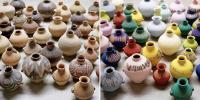
Exhibition visitors have expressed feelings of uneasiness or even pain and nostalgia when seeing Colored Vases by Ai Weiwei1. The 51 vases that make up the artwork are originally treasures from the Neolithic Age (5000–3000 BCE) and the artist has dunked them in common industrial paint.
Why did Ai Weiwei do it?
Shortly after the close of this year’s International Women’s Day, China’s Twitter-like service Sina Weibo shut down Feminist Voices. With 180,000 followers, the group’s social media account was one of the most important advocacy channels for spreading information about women’s issues in China, but in an instant, it was gone. A few hours later, the private messaging app WeChat also shuttered an account for the group.
The “Occupy Men’s Toilets” movement, initiated by Chinese feminist activists including Li Tingting (Li Maizi) and Wu Rongrong, emerged in 2012 as a creative, non-violent protest against gender inequality in access to public facilities.
Leilei Zhang was harassed on a public bus when a man gripped her hand, glared at her and refused to let go. With the determination to raise public awareness, Leilei began a crowd-funding campaign to raise money for what could have been China's first public anti-sexual harassment advertisement. She approached the authorities of her home city, Guangzhou, but it did not want to take on the advertising for fear it would panic the public.
Yu Hong’s Female Writer, a painted and photographic portrait of the writer Zhao Bo 趙波 (b. 1971), recalls courtly images of idealized beauties. Yu, however, deliberately complicates the perspective in her composition: she asked the sitters for her She series to select photographs of themselves that could be paired with her paintings, meaning that the images together convey dual female perspectives, both the artist’s and the subject’s.
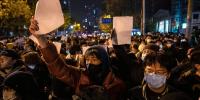
Late last month, Chinese citizens took up a creative means of protest over the nation’s strict “zero-COVID” policy. In a place with little tolerance for large public demonstrations, protesters have been holding up blank pieces of paper. Their ingenuity inspired a local artist Yolanda He Yang to stage a public art demonstration to subtly communicate their dissent.
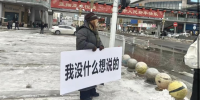
Feb 23 2024, on the streets in Henan, China, a girl holds a big sign with the black text "I've got nothing to say" on a white background, walking around in city center and malls. She live-streamed her walk and her account was banned after a few hours.
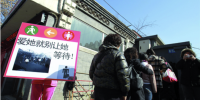
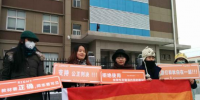
In November 2015, Chinese LGBT activist Chen Qiuyan met with government officials in Beijing after months of campaigning to have the Ministry of Education remove textbooks which identify homosexuality as a mental disorder.
In 2001, the Chinese Society of Psychiatry removed homosexuality from its list of recognized mental disorders, after the Chinese government decriminalized consensual homosexual acts in 1997.
In 2016, Zhou Zhenfeng, who was a student at a college in Hebei at the time, discovered that there were a lot of waste tires in the streets and alleys. Zhou Zhenfeng learned that tires are made of infusible or refractory polymer elastic materials. It takes hundreds of years for these materials to decompose in the soil to the extent that they do not affect the growth of plants.
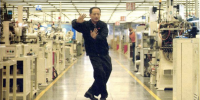
Whose Utopia? was made by the Chinese artist Cao Fei and filmed at the OSRAM lighting factory in Foshan in the Pearl River Delta in southern China during 2005 and 2006. It was commissioned as part of a project entitled ‘What Are They Doing Here?’ that was run by the Siemens Art Program from 2000 to 2006 and involved Chinese artists undertaking six-month-long residencies at industrial facilities across the country.
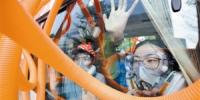
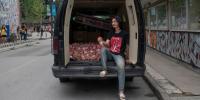
A minibus is parked on the side of the road with a series of pipelines wrapped around it. One end of the pipeline is connected to the exhaust port of the minibus, and the other end is put into the car, so that the exhaust gas can be directly introduced into the car, forming a " Street gas chamber".
In Shanghai, a vigil grew into a street protest where many held blank sheets of white paper in a symbol of tacit defiance.
In Beijing, students at Tsinghua University raised signs showing a math equation devised by the Russian physicist Alexander Friedmann, whose surname in Chinese is a homonym for “free man.”
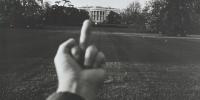
The son of an exiled political dissident, Chinese artist and activist Ai Weiwei’s work is inherently political. Since 1995 Ai Weiwei has been traveling the world, photographing himself flipping off iconic monuments of power in his Study of Perspective series.
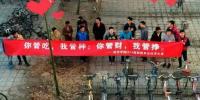
“Girl’s Day” in China was supposed to be a way for boys on college campuses to show the girls how much they care. This year it went too far.
Have you heard about “Girl’s Day?” It’s a big holiday for Chinese college students. Every year on March 7, students throughout the country celebrate the day as a campus version of International Women’s Day.
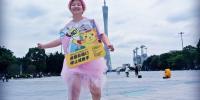
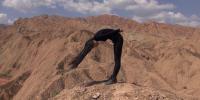
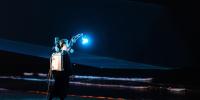
Tong Wenmin is a Chinese performance artist affiliated with works exploring movement, interaction, and humanity. Her art is a relationship between human behavior and the natural world, a round dynamic between physicality and environmental elements. One of her most compelling works, "FLYING THE WIND," is outstanding in merging performance art with a deeper exploration of the interaction between humans and nature.
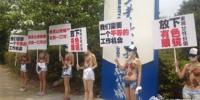
Female students from the Guangdong University of Technology in Guangzhou called for equal job opportunities and for people to "pay attention to the value of women" while protesting on the school's campus, shirtless and covered in body paint.
The photos, taken by ogling passersby, have been circulating on Weibo and naturally netizens stand divided on whether the semi-naked protests were empowering or counterproductive...
With delicate composition, striking details and strong emotion, five editorial posters drawn by Wuheqilin have attracted some half million followers to his account on Sina Weibo, China's Twitter-like social media platform. His political views expressed in his art have led to some netizens dubbing him the "Wolf Worrier artist."
"100 Questions About Sex from Children" is an annual touring sex education exhibition founded and curated by Se A, a leading advocate of inclusive sex education in China. Since its launch in 2021, the exhibition has been held in major cities such as Shenzhen and Guiyang, with plans to expand into regions where sex education and gender awareness remain underdeveloped.
The screen portrayal of a cancer sufferer whose illegal import of foreign medicines into China spurred national policy changes has become a box-office smash as audiences flock to a rare Chinese film on a hot-button issue.
Dying To Survive is based on Lu Yong, who was arrested in 2013 after illegally importing a generic cancer drug in a case that sparked public debate about high medical costs.
The outbreak of the coronavirus has brought international scrutiny down on China’s political system. Again. A few commentators have applauded the efficiency of the Chinese Communist Party’s response, but most have zoomed in on its weaknesses. Some have even blamed the party itself for the outbreak, calling the disease a “Communist coronavirus” or “the Belt and Road Pandemic.”
China's only seaside theater festival has been held in the resort town of Aranya in north China's Hebei Province. Artists from around the world traveled there to take deep dive into the world of dramatic performance. For theatergoers, there were interactive activities including cross-border installations such as seaside talks, environmental drama readings, screenings, theater houses, parades and bonfires by the sea.
Women in China are covertly resisting government crackdowns on discussions over their Me Too movement with a clever workaround.
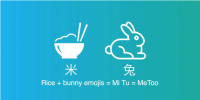
The phrase “rice bunny” (米兔), pronounced as “mi tu,” has popped up on social media networks after censors removed posts that mentioned sexual harassment or the hashtag #MeToo. While those phrases are heavily monitored, Rice Bunny isn’t.
A social experiment testing the public’s reaction to gay people in China has gone viral.
The blindfolded activists stood in public wearing T-shirts that said “I’m gay would you hug me?” and video of the protest then spread rapidly on Weibo, a hugely popular social media platform in China.
The social experiment follows a recent announcement by Weibo to ban gay content on its platform of 400 million active users.
The 9,000 bottles of water on display at an art gallery in Beijing last month appeared identical to those of Nongfu Spring, one of China’s most popular spring water brands, with one jarring difference. Inside each bottle was brown, murky groundwater collected from a Chinese village.
Many girls in China may have seen the advertisements of egg donation as a surrogate, in hospitals, schools, public toilets, shared bikes, ATMs...... They are everywhere and the number of this kind of advertisements is large. Though there are lots of girls who have never seen such advertisements or would never believe in them, there would still be some girls who would dial the numbers on the advertisements.