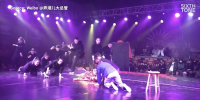
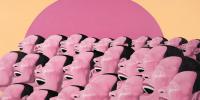
A viral video of a student dance performance in southern China’s Guangxi Zhuang Autonomous Region has won praise for speaking out against so-called ghost marriages, which many today see as an archaic and even dangerous tradition.
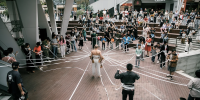
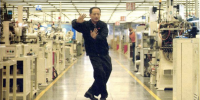
Whose Utopia? was made by the Chinese artist Cao Fei and filmed at the OSRAM lighting factory in Foshan in the Pearl River Delta in southern China during 2005 and 2006. It was commissioned as part of a project entitled ‘What Are They Doing Here?’ that was run by the Siemens Art Program from 2000 to 2006 and involved Chinese artists undertaking six-month-long residencies at industrial facilities across the country.
Sebastián Mahaluf stands out as an artist deeply engaged in weaving the complex threads of human connection, community, and the interplay of personal and collective experiences. His notable work, "CONTRADICTION AND TENSION," showcases his approach to art as a participatory experience that bridges individual perceptions with communal narratives.
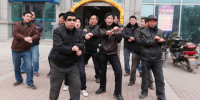
In early January, constructions workers in Wuhan, China staged a Gangnam Style protest in front of their employer's building. Using the Gangnam Style dance, the men sought to bring media attention to their mounting unpaid wages.
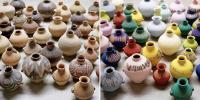
Exhibition visitors have expressed feelings of uneasiness or even pain and nostalgia when seeing Colored Vases by Ai Weiwei1. The 51 vases that make up the artwork are originally treasures from the Neolithic Age (5000–3000 BCE) and the artist has dunked them in common industrial paint.
Why did Ai Weiwei do it?
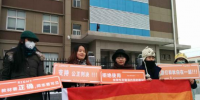
In November 2015, Chinese LGBT activist Chen Qiuyan met with government officials in Beijing after months of campaigning to have the Ministry of Education remove textbooks which identify homosexuality as a mental disorder.
In 2001, the Chinese Society of Psychiatry removed homosexuality from its list of recognized mental disorders, after the Chinese government decriminalized consensual homosexual acts in 1997.
China's "Punchline Queen" Yang Li is no stranger to controversy.
The 29-year-old is now one of the country's most well-known comedians, having risen to fame in recent months on a Chinese television show called "Rock and Roast".
Every week, in front of a national audience of millions, she addresses controversial gender issues using a style unfamiliar to many Chinese viewers - stand-up comedy.
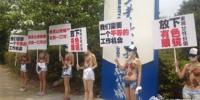
Female students from the Guangdong University of Technology in Guangzhou called for equal job opportunities and for people to "pay attention to the value of women" while protesting on the school's campus, shirtless and covered in body paint.
The photos, taken by ogling passersby, have been circulating on Weibo and naturally netizens stand divided on whether the semi-naked protests were empowering or counterproductive...
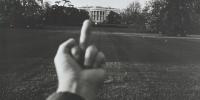
The son of an exiled political dissident, Chinese artist and activist Ai Weiwei’s work is inherently political. Since 1995 Ai Weiwei has been traveling the world, photographing himself flipping off iconic monuments of power in his Study of Perspective series.
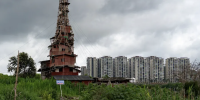
The structure teeters over fields of knee-high grass, looking like a cross between a camping tent and a giant wedding cake. Eleven stories of dark red wooden rooms, diminishing in size as they ascend, balance atop one another, seemingly held together by only the thicket of cords that stretches from the peak to the ground.
A social experiment testing the public’s reaction to gay people in China has gone viral.
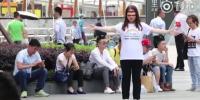
The blindfolded activists stood in public wearing T-shirts that said “I’m gay would you hug me?” and video of the protest then spread rapidly on Weibo, a hugely popular social media platform in China.
The social experiment follows a recent announcement by Weibo to ban gay content on its platform of 400 million active users.
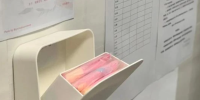
From October to December 2020, Chinese university students nationwide launched a viral movement to install “menstrual pad mutual aid boxes” in women’s restrooms—free, wall-mounted containers stocked with disposable pads on a take-one, replace-one basis. Nearly 250 campuses joined within weeks. Some sustained their boxes for over a year, while others saw them vanish after bureaucratic pushback, logistical hurdles, or dwindling volunteer resources.
"100 Questions About Sex from Children" is an annual touring sex education exhibition founded and curated by Se A, a leading advocate of inclusive sex education in China. Since its launch in 2021, the exhibition has been held in major cities such as Shenzhen and Guiyang, with plans to expand into regions where sex education and gender awareness remain underdeveloped.
They are disparaged as “free-willed” women, “stubborn,” “picky,” “incomplete.”
But a video by an East Asian beauty brand that went viral over the past week has upended the conversation on China’s sheng nu, which translates literally into “leftover women” — those who happen to be over 27 and unmarried.
“People think that in Chinese society an unmarried woman is incomplete. You feel like an outsider,” says one young woman.
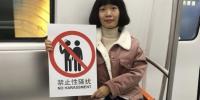
Zheng Xi 郑熹, a Ph.D. candidate with a focus on gender studies at Zhejiang University in Hangzhou. Zheng has launched a campaign asking city governments around China to display anti-sexual-harassment logos, complete with a groper’s “salty-pig hand” visual (etymological context here), alongside other commonly displayed public safety logos on places like subway trains and buses.
Ahead of a recent exhibition at the prestigious modern art museum OCAT Shanghai, the artist Song Ta described the process of creating his multimedia piece “Uglier and Uglier.” After secretly filming thousands of unsuspecting female college students, Song and three assistants painstakingly ranked them by their perceived attractiveness; those deemed most appealing featured early in the show, with the women on display getting progressively “uglier” as the
By NAZANIN LANKARANI
PARIS — Five years after his rise to the top of the Chinese contemporary art market, Yue Minjun has something new to smile about.
Best known for his large-scale paintings depicting his own smiling face, Mr. Yue, who is based in Beijing, has long been a star of the Chinese contemporary art scene, having achieved commercial success through a highly singular aesthetic.
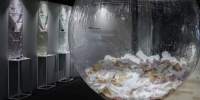
Song Dong's Waste Not consisted of a single installation comprising over 10,000 commonplace, domestic items of daily life that had been used and amassed by the artist’s mother (Zhao Xiangyuan) over fifty years.
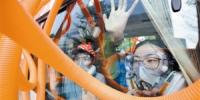
A minibus is parked on the side of the road with a series of pipelines wrapped around it. One end of the pipeline is connected to the exhaust port of the minibus, and the other end is put into the car, so that the exhaust gas can be directly introduced into the car, forming a " Street gas chamber".
Many girls in China may have seen the advertisements of egg donation as a surrogate, in hospitals, schools, public toilets, shared bikes, ATMs...... They are everywhere and the number of this kind of advertisements is large. Though there are lots of girls who have never seen such advertisements or would never believe in them, there would still be some girls who would dial the numbers on the advertisements.
Just the other day, we were hearing about Samsung getting in legal trouble over patent violations with Apple. A federal court decision ruled that Samsung owes Apple more than $1 billion in restitution.
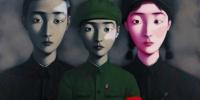
The immediate prototypes of Zhang Xiaogang’s Big Family series are formal group photographic portraits from the 1950’s and 60’s, including those of Zhang’s own family, a source of the painter’s “endless reveries.” From these old black-and-white pictures Zhang Xiaogang derived the series’ paradigmatic features: a subdued, nearly monochromatic palette; a thickly layered but flat surface, without overt evidence of brushwork; a general compositional restric
The world is shocked by China’s dog meat festival and by videos showing that animals are eaten alive in restaurants in Guangdong. But in that country of 1.3 billon people, a massive shift in ideology is happening. Our friends at PETA Asia are helping millions of people see that animals are not ours to eat, wear, experiment on, use for entertainment, or abuse in any other way.
The New Culture Movement was initiated by Chen Duxiu, Li Dazhao, Lu Xun, Hu Shi, Cai Yuanpei, Qian Xuan and other writers who had received Western education (called the new-style education at the time). It is an ideological and cultural innovation and literary revolutionary movement.