Many girls in China may have seen the advertisements of egg donation as a surrogate, in hospitals, schools, public toilets, shared bikes, ATMs...... They are everywhere and the number of this kind of advertisements is large. Though there are lots of girls who have never seen such advertisements or would never believe in them, there would still be some girls who would dial the numbers on the advertisements.
Since 1991, approximately 1,700 organizations in 130 countries have participated in the 16 Days Campaign, which originated from the first Women's Global Leadership Institute sponsored by the Center for Women's Global Leadership. During 16 days, participators are encouraged to organize events and act in their local communities to:
On March 24, 1992, a fake inter-office memorandum from the then Mayor of the City of New York, David Dinkins, was leaked to the press. A handwritten Post-it note was attached which read "Thought you might be interested in seeing what the Mayor's up to! 'Mayor to Sell the Brooklyn Bridge!' Think this will fly?? I love New York!!!"
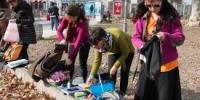
We built a conversation space where members of the public were invited to enjoy a free cup of tea. We used a vertical garden which spelled out the word 'TEA' in easily available plants and herbs that can be used to make tea.
“Hello,” says the news presenter, as she effortlessly switches from Spanish to English to give her audience a summary of the day’s biggest stories. With her clear intonation, smart appearance, and friendly-yet-serious expression, she seems the very image of a news anchor. Except, perhaps, for her name.
“Misplaced Women?” is an art project-workshop by Tanja Ostojic in which she and project`s participants – artists , art students , cultural workers and activists: Nela Antonovic, Gorana Bacevac, Nadezda Kircanski, Tatjana Beljinac, Milica Jankovic, Tamara Bijelic, Irena Djukanovic, Bojana Radenovic, Marija Jevtic, Irena Mirkovic, Jelena Dinic, Sanja Solunac and Suncica Sido showed the everyday life activities that are characteristic for migrants, refugee
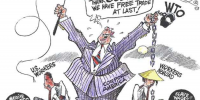
Khalil Bandib is a Berkeley-based, award-winning editorial cartoonist with a unique perspective. He critiques a myriad of topics, from racism and homophobia to foreign policy and the Patriot Act. Bandib was born in North Africa under a French colonist regime; he brings a non-Eurocentric perspective not typically visible in large corporate media.
Dove's "Real Beauty Sketches" campaign is the new face of viral marketing success. The uplifting promotional video generated record-breaking online interest, yielding more than 114 million views the first month. This was thanks in part to the Unilever brand's efforts to spread its message worldwide: Dove uploaded the video in 25 languages to 33 of its official YouTube channels, reaching consumers in more than 110 countries.
The initiators collaborated with the Street Vendor Project (SVP) of the Urban Justice Center to campaign against New York City Council Member Jessica Lappin’s 2010 law project. The bill, intended to revoke permits issued to street vendor trucks if they got parking tickets, was so restrictive that it threatened to put most food trucks out of business.
Local artist fnnch wants San Francisco to decriminalize certain types of art.
You’re not seeing things: A whopping 450 “honey bears”—variations on the immediately recognizable and widely imitated bear-shaped honey bottles sold in seemingly every store in America--appeared all over SoMa late Sunday night, from the Embarcadero to Fifth Street.
Two reflective stickers in a bathroom stall. When you sit down you can see your face in the bottom one. When you stand you can see your face in the top one, your groin in the bottom one. The top one says "Public", the bottom one says "Private". Or maybe the top one says "Private", and the bottom one says "Public". Which one is correct?
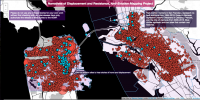
The project consists of a website for data-visualization, data analysis, and storytelling collective formed to document and make visible the dispossession of San Francisco Bay Area residents and to facilitate and organized collective resistance. The project studies the displacement of people and the way in which evictions and gentrification target specific communities in the Bay Area.
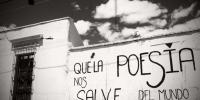
The Acción Poética movement is a literary phenomenon that began in Monterrey, Mexico in 1996. It was founded by Mexican poet Armando Alanis Pulido and involves painting and intervening abandoned walls in cities with fragments of poetry. The content is usually love poems or optimistic phrases. Also, some phrases refer to the current situation in the cities (though one of their rules is to not talk about politics or religious beliefs).
What would a chemical attack on NYC look like? How would poisonous gases spread, through the lines of the subway and above ground? These are some of the questions the NYPD and a team of researchers hope to answer this July, when they’ll disperse colorless, odorless, and apparently harmless gases called perflourocarbons around the city and track their movement.
"May you live in interesting times" is the familiar Chinese saying, usually spat out as a curse. You can see why in "A Touch of Sin," a film by renowned director Jia Zhang-ke. That kind of time is now, in the history of his country. With four vignettes inspired by real-life "ripped from the headline" events, he shows what the great economic expansion of China is doing to the majority of its people.
Drake has released an emotional video for "God's Plan" in which he donates the music video budget to people in need.
Shot in Miami and directed by Toronto's Karena Evans and Jordan Oram, the video features a bunch of generous, grand gestures.
In the country formerly known as Burma, these free thinkers are a force in the struggle for democracy.
By Joshua Hammer
Photographs by Adam Dean
Smithsonian Magazine, March 2011
Ghana ThinkTank is an international collective that “develops the first world” by flipping traditional power dynamics, asking the “third world” to intervene into the lives of the people living in the so-called “developed” world.
During the 1600’s the Iroquois Indian Nations, a group of several indigenous tribes in North America, engaged in warfare with many other tribes. The men controlled when and against whom they declared a war.
Tribal Iroquois women decided that they wanted to stop unregulated warfare, and thought of a way to convince the Iroquois men to give them more power in deciding issues of war and peace.