Essential workers at major companies like Amazon, Instacart, and Target across the United States on Friday protested for better safety protections, working conditions, and pay during the coronavirus pandemic.
Cassils has used clay, fire, photography, urine and the musculature of their own body as mediums to provoke, challenge and excite whoever experiences their singular creations.
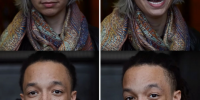
Shea Glover, age 18, began a senior project that became an activist/social campaign. Shea approached people throughout her high school and asked them if they would pose for her senior project. To each person she would say, I'm taking pictures of things I find beautiful". Recording the entire encounter revealed the diverse reactions of each student and teacher. Some erupted with laughter, others a huge grin, while some embarrassment.
"CITIZENFOUR is a real life thriller, unfolding by the minute, giving audiences unprecedented access to filmmaker Laura Poitras and journalist Glenn Greenwald’s encounters with Edward Snowden in Hong Kong, as he hands over classified documents providing evidence of mass indiscriminate and illegal invasions of privacy by the National Security Agency (NSA).
The frontier between the United States and Mexico is the busiest land border in the world. It is also among one of the world’s most heavily regulated and policed border zones—the arid climate of which is responsible for many migrant deaths each year.
Jes Baker, 26, created a campaign called Abercrombie and Fat in response to the CEO of Abercrombie and Fitch. In 2006, the CEO released a statement that his target consumer is the cool, All American kid who has a lot of friends. He continues to say that his business is exclusive and a lot of people do not belong in his clothes.
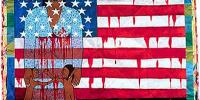
Faith Ringgold is a successful painter, sculptor, mixed-media artist, author, feminist, and political activist. She is particularly known for her narrative quilts, as she explores identity, race, family ties, as well as cultural and political topics through her many different forms of storytelling.
“I have always wanted to tell my story or, more to the point, my side of the story” - Faith Ringgold
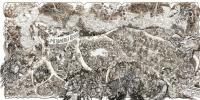
The Beehive Design Collective is a wildly motivated, all-volunteer, activist arts collective dedicated to “cross-pollinating the grassroots” by creating collaborative, anti-copyright images for use as educational and organizing tools. We work as word-to-image translators of complex global stories, shared with us through conversations with affected communities.
The AIDS pandemic began in the early 1980s and brought with it a surge of emotions from the public: they were afraid, angry, fearful and defiant. The arrival of AIDS also brought with it a condemnation of the LGBT community. These emotions, along with the view on the LGBT community, paved the way for a new generation of artists.
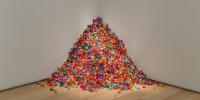
Felix Gonzalez-Torres produced meaningful and restrained sculptural forms out of common materials. “Untitled” (Portrait of Ross in L.A.) consists of an ideal weight of 175 pounds of shiny, commercially distributed candy. The work’s physical form and scale change with each display, affected by its placement in the gallery as well as audience interactions.
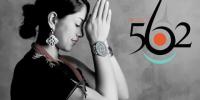
Matika Willbur was given a grant by Kickstarter (the worlds largest funding platform for creative projects) to travel around the U.S. for a year and photograph Native America. The goal of the 562 project is to change the way we think of the Native American race, by shifting our collective consciousness and creating a positive lasting legacy of Native America.
On July 2nd, 2013, after attending the Gas Exporting Countries Forum (GECF) conference, Bolivian President Evo Morales departed Russia from Vnukovo Airport in Moscow aboard his presidential plane. However, a "leak" suggested that Edward Snowden was aboard, which led Spain, France, and Portugal to close their airspace to the aircraft, to then be grounded in Austria.
Camp Mossandsticks, named after moss and sticks--two of the most rudimentary tools with which one can spark fire--is a site for young women and girls to become resourceful, defiant, and self-sufficient revolutionaries of today. Started on November 6, 2012, the camp hosts workshops to spark the attendees’ inner political flames, challenging them to confront disenfranchisement created by the status quo and to take matters into their own hands.
"The Red Power Movement of the 1960s and 70s was a time of profound social change and progress for American Indians in the United States and Canada. In her outspokenness about the injustices facing Indigenous people, Buffy Sainte-Marie also sang for peace, the environment, women and children—believing that art can have impact and make a difference.
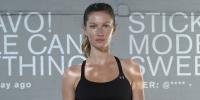
I Will What I Want is a campaign launched by Under Armour which speaks to women who do not wait for permission or affirmation in order to go after what they want. The campaign highlights various models and athletes who encourage women to tune out society's standards and pursue their dreams. The campaign began by highlighting Misty Copeland, a soloist at the American Ballet Theater.
The #LikeAGirl campaign was aired as a commercial during the 2015 SuperBowl. In the commercial, young girls were asked to act out certain phrases. They were told to "fight like girl", "throw a ball like a girl", "run like and girl", and so on. As an adolescent or an adult, these phrases carry a negative connotation. Girls are seen as weak, frilly, and inferior.
Glowing softly in the West Texas desert night, artist Guadalupe Maravilla’s Mariposa Relámpago, was once an ordinary school bus but is now a richly decorated, mobile site for remembrance and healing. Like much of the artist’s work, this piece commemorates and confronts the artist’s journey to the United States as an unaccompanied, undocumented minor fleeing civil war in El Salvador in the 1980s.
MISSION
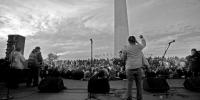
The mission of the Hip Hop Caucus is to organize young people to be active in elections, policymaking and service projects. We mobilize, educate, and engage young people, ages 14 to 40, on the social, issues that directly impact their lives and communities.
COMPANY OVERVIEW
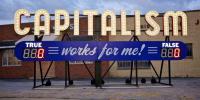
A 20ft by 9ft scoreboard that reads "Capitalism Works For Me!" and allows visitors to vote on whether Capitalism works in their lives by pressing a button for True or False.
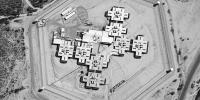
In September 1971, after years of mistreatment and months of simmering tensions, more than 1,200 of the 2,200 inmates at the Attica Correctional Facility in upstate New York took control of the prison in protest of its substandard conditions and openly racist corrections officers.
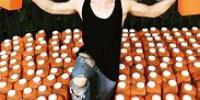
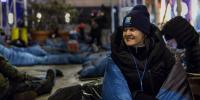
Covenant House has started a ‘Sleep Out’ movement that shines light on the youth homelessness crisis and raises funds for young people who seek shelter. "Covenant House empowers young people to overcome homelessness and trafficking by providing them with safe housing, food and clothing, and relentless support. Sleep Out events are held for people who want to join the movement as they give up their bed for one night in NYC.
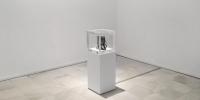
Pursuing the possibility of emancipatory use of technology, Paglen, together with Jacob Appelbaum, developed Autonomy Cube (2014). Autonomy Cube is a sculpture and internet router designed to be housed in civic spaces. The sculpture is meant to be both “seen” and “used.” Formally it references Hans Haacke's 'Condensation Cube' (1963-65).
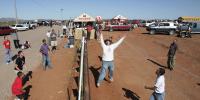
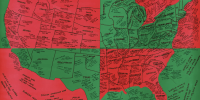
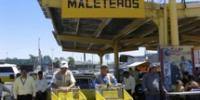
Malteros are the porters who transport luggage and goods between the border of the US and Mexico. Working with a group of maleteros in 2005, artist Mark Bradford collaborated on a system of maps and signs that placed the marginalized work of the unofficial maleteros alongside that of the sanctioned labor of policemen and taxi drivers.