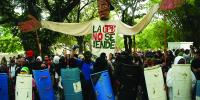
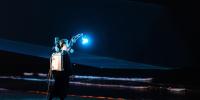
El Estudiante Militante is a giant puppet built by the members of Papel Machete and students of the University of Puerto Rico during the first three days of the 2010 student strike at a cultural camp established by the theater group in solidarity with the striking students. The puppet was built with materials inside the campus of the University.
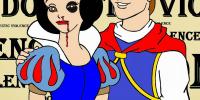
The series "No Violence Against Women" depicts famous cartoon couples transformed into victims of abuse. The women are left bloodied and with black eyes with the slogan "What Kind of Man are You?" above. The images are a commentary on domestic violence and were released in honor of International Women's Day
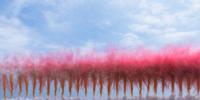
On June 26, contemporary artist Cai Guo-Qiang released the daytime firework display ‘When the Sky Blooms with Sakura’ at Yotsukura Beach in Iwaki City, as commissioned by Saint Laurent’s creative director Anthony Vaccarello.
Iva Hladis was born in Czechoslovakia in 1965.
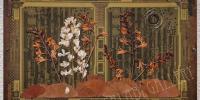
In 2005 her attention turned to the issue of global warming and world destruction with a new series of artworks titled “Origins Extinct”; assemblages of used computer chipboards, real botanicals, bugs, Czech glass beads, found objects, wires and pearls.
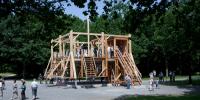
Sam Durant is an LA based artist who engages in social, cultural and political issues through his interactive public sculptures. Durant is interested in investigating historical narratives and their contemporary communities. From 2005-2010 Durant was part of the collective Transforma Projects, a grassroots cultural rebuilding initiative in New Orleans. One of his most recent interactive public sculptures Scaffold is on view at the Hague.
China's only seaside theater festival has been held in the resort town of Aranya in north China's Hebei Province. Artists from around the world traveled there to take deep dive into the world of dramatic performance. For theatergoers, there were interactive activities including cross-border installations such as seaside talks, environmental drama readings, screenings, theater houses, parades and bonfires by the sea.
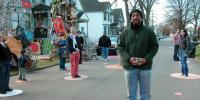
The Heidelberg Project is an outdoor art project in Detroit, Michigan. It was created in 1986 by artist Tyree Guyton and his grandfather Sam Mackey ("Grandpa Sam") as an outdoor art environment in the McDougall-Hunt neighborhood on the city's east side, just north of the city's historically African-American Black Bottom area.
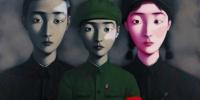
The immediate prototypes of Zhang Xiaogang’s Big Family series are formal group photographic portraits from the 1950’s and 60’s, including those of Zhang’s own family, a source of the painter’s “endless reveries.” From these old black-and-white pictures Zhang Xiaogang derived the series’ paradigmatic features: a subdued, nearly monochromatic palette; a thickly layered but flat surface, without overt evidence of brushwork; a general compositional restric
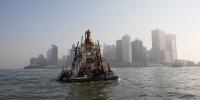
TROY, N.Y. Three loud blasts from a steam whistle screamed out as the rain drizzled on the riverbank here. And the fleet of seven eclectic handmade ships slowly moved away.
Creative activism and the remaking of Palestine
While policy wonks and media pundits wallow in endless debates about Jewish settlements and the threat of terror, Palestinian groups are creatively exploring alternative ways to realise their national aspirations.
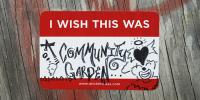
I Wish This Was began in New Orleans in November 2010. It was inspired by vacant storefronts. There are a lot of them where Candy lives in New Orleans. There are also a lot of people who need and want things. What if we could easily voice what we want, where we want it? How can we influence the businesses and services in our neighborhoods?
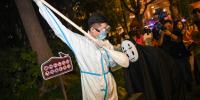
#thisisnotamask
Covid-19 Pandemic Rubber Stamp Currency Intervention
Website: https://thisisnotamask.tumblr.com/
For more information:
Joseph DeLappe artist/activist – j.delappe@abertay.ac.uk
Brent Richardson media artist – brent@BrentRich.com
Let’s mask the presidents!
Alex King describes Project Ukko in detail for Huck Magazine (March 17, 2016):
"Moritz Stefaner’s Project Ukko turns climate and wind data into an immersive art installation that allows viewers to explore the future of the planet."
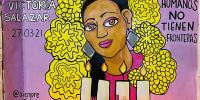
Siempre Unidas is a feminist collective in the state of Quintana Roo (Mexico) that works partly through street art. In 2021, in response to the femicide of Victoria Salazar – a refugee from El Salvador who died in police custody – the collective began an anti-femicide mural project called RestaurAmoras.
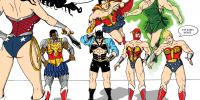
Submission for The Line is Drawn, theme "Male superheroes see how the other side lives".
Wonder Woman makes the rest of the JLA wear various costumes she's had over the years.
Filip Custic (Santa Cruz de Tenerife, Spain 1993) works across photography, performance and video to address themes around identity, body and our relationship with technology. Mirrors and screens are a recurring features, a reference to our age of image-obsession and selfies, and Custic also uses symbols, references to science, and art-historical borrowings in his art.
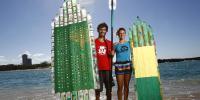
All those who practice surfing know firsthand the serious problem our beaches face: pollution. While some only complain, others do something about it. Two Brazilian surfers decided they could help raise public awareness of the need to protect nature of the proliferation of plastics used in the oceans through a novel idea: create surfboards plastic bottles.
Several nights of Halloween celebration in Shanghai provided a vivid, if indirect, commentary this week on the malaise gripping the world’s second-largest economy.
Legendary activist and artist Ed Bereal will be able to have his work displayed again in the newly reopened Portland Art Museum. He is a complex figure, gaining fame in LA in the 1960s for his abstract works and radical performances. His work also includes critiquing politicians in a satirical way.
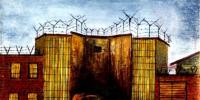
Charged with participating in demonstrations against the Islamic Republic of Iran, Soudabeh Ardavan was held for eight years (1981-1989) in Iran’s notorious Evin Prison. She found sanity and solace through the forbidden activities of drawing and painting, secretly producing paint from flower petals and tea, using brushes made from toothpicks and human hair.
Rufina Bazlova is not afraid to surrender her art to activism. Born in Belarus, a former Soviet republic ruled by the authoritarian leader Aleksandr Lukashenko for 29 years now, Bazlova knows all too well that being apolitical is a privilege many Eastern Europeans cannot afford. 2020 was a pivotal year for Belarus, not only because of the COVID-19 pandemic but also the presidential elections, which declared Lukashenko president for the sixth time.
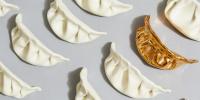
Stephanie H. Shih is a Brooklyn-based ceramist who explores Asian American identity through clay interpretations of grocery items. The ceramicist has created life-size painted clay Sriracha bottles, Pocky cartons, soy sauce gallons, and instant ramen as part of a series Shih conceived in 2018 called Oriental Grocery, to explore nostalgic foods of the Chinese American diaspora.