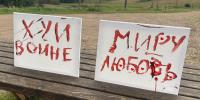
A town in northwestern Syria has become the creative center of the revolt against President Bashar al-Assad. Since the beginning of the uprising, the residents of Kafr Anbel have drawn signs that skewer the Assad regime and express outrage that the world has not done more to stop the killing in Syria.
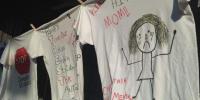
“Stop hitting me,” “Please help,” and “Abuse is wrong” were just a few phrases painted and scribbled onto T-shirts by victims of sexual and domestic abuse to express how it felt to go through that pain.
The shirts are part of the Clothesline Project and were on display at Lane College on Wednesday.
The user muchachafanzine on instagram is an activist who writes a "decolonial native xicana feminist fanzine". They are an online activist and they spread their message through their page, the zine, and through merchandise. Daisy Salinas began Muchacha Fanzine as a feminist punk zine in 2011. Over the years, Muchacha has grown into a larger, submission-based compilation of work by marginalized voices from around the world.
The U.S./Iraq War Memorial is an augmented reality public art project and memorial, dedicated to the thousands of individuals who have died on both sides of the conflict.
Frank Waln, a 25 year old Native American hip hop artist, tours the country and Canada performing and teaching motivational workshops to students across the country. He took to rap at a young age when he found a cd (Eminem's The Marshall Mathers LP) on the side of the road. Growing up on the Rosebud Sioux Reservation of South Dakota, he realized that the hip hop music genre was an outlet for expressing pain and frustration.
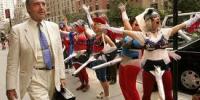
Shortly after the events of 9/11, a group of NYC women came together in protest of the Bush Administration's use of the terror attacks to justify war. Seeking out a new form of political protest, the women decided to respond to what they believed were the absurd reactions of Bush by attaching paper maché missile "dicks" and demonstrating in public.
The exhibition "Unpacking the 21st Century: Artists Engaging the World" included work by five New York City area artists that examined a range of social and political issues and offered companion special events.
MOTHER EARTH is broken from incessant decadent wars carelessly perpetuated by mindless ,vicious political imbeciles. Our natural wealth plundered by greedy ,gluttonous economic dare-devils, imbibing crude oil and fresh blood . Warlord-ism set the suns of our freedom, our earth is torn naked . War is ravaging the beauty of African diamond fields ,We are now Wretched Vagabonds . Warlords are frying peace in oil springs of the Gulf.
These two works on canvas were made with my own blood, using the severed distal phalanx of my index finger as the painting instrument. They are connected to my solo anti-war action in Copenhagen in September 2026.
Their central messages are “No to War!” and “Peace & Love!” The index finger—the finger used to pull a trigger—became the central symbol of my refusal to participate in aggression and the killing of other people.
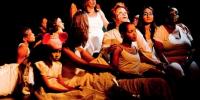
Creative Time, Social Practice Archive: In 1989 actress/writer Rhodessa Jones was conducting classes at the San Francisco County Jail. Working with female inmates, she developed material for a performance piece called Big Butt Girls, Hard-Headed Women based on their lives and shared experiences.
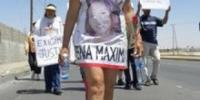
Marisela Escobedo was 52 when she was shot dead on a sidewalk outside of the Government Palace of Chihuahua City, northern Mexico. She had set up camp in one of Mexico’s most dangerous cities – a place where people won’t leave their homes at night to protest day and night against corruption and impunity in her daughter’s murder case.
The installation consists on providing postcards to gallery visitors that they can use to mail their Elected Officials to advocate for gun control. The front of the postcard shows the photograph “Mommy, what is this?” (2018), which is the hand of Ileana's son, Lucca, holding a toy bullet while making the peace sign. The back of the postcard contains a short letter with the phrase “No more children should die from gun violence.
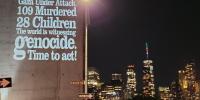
As the death toll from Israel’s attacks on the besieged Gaza Strip continues to rise, a guerrilla projection on May 13, 2021 illuminated a building in Brooklyn’s Dumbo neighborhood with messages of solidarity with Palestinians.
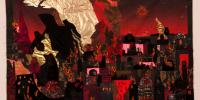
Mending Baghdad is a four-and-a-half-by-six-and-a-half-foot quilt memorializing Baghdad as it looked during the American bombing on the first nights of the Iraq war. The purpose of the project is to bring people together to do something symbolically curative for Iraq. The artist, Clare Wainwright, worked up the image in about two days, but left it deliberately unfinished.
In an effort to provide abused children with a safe way to reach out for help, a Spanish organization called the Aid to Children and Adolescents at Risk Foundation, or ANAR for short, created an ad that displays a different message for adults and children at the same time.
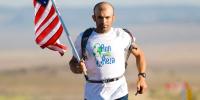
"He's been running all his life, running for freedom, running for peace.It started when he ran away from home at the age of eight. Later he ran away from his homeland, Iran, and spent seven years on a bicycle, pedaling 49,700 miles across 55 countries. In 2002, he reached America. He now lives in a tent in Death Valley. It's been nearly 10 years since Reza Baluchi escaped from Iran.
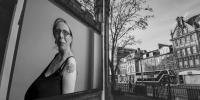
UK photographer Alicia Bruce collaborated with Zero Tolerance, a Scottish non-profit to end GBV, to produce a new version of the Violence Unseen campaign, launched for the first time in the 1990s and created by Franki Raffles. The new one was launched in 2018, 25 years after the original iconic Zero Tolerance campaign, shot by the late Franki Raffles.
The Protest Mask Project was co-organized by Maggie Thompson and Jaida Grey Eagle. During the George Floyd protests, the artists' studio, Makwa Studio, created hundreds of masks to give to protestors in the city of Minneapolis where the demonstrations began.
In Cut Piece—one of Yoko Ono’s early performance works—the artist sat alone on a stage, dressed in her best suit, with a pair of scissors in front of her. The audience had been instructed that they could take turns approaching her and use the scissors to cut off a small piece of her clothing, which was theirs to keep. Some people approached hesitantly, cutting a small square of fabric from her sleeve or the hem of her skirt.
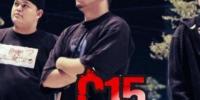
The Colombian hip hop had an outstanding representation with the C15 group in the Fabrica of Rimas International Festival, a gathering of urban cultures, sponsored by Morocco, Colombia and Spain.
On Sunday, September 16th at around 1am, a white van—labelled with “Van Wagner’s” blue logo and topped by a yellow strobe light—circled through permanently lit Times Square. Inside the vehicle, the driver and passenger, both dressed as construction workers, were nervous. They had just vandalized one kiosk a few yards away from an NYPD tower, now they were about to hit another one right underneath the nose of a large white NYPD security camera.
In 1988, rap group the N.W.A from Compton, California released their second album, “Straight Outta Compton”. Without any radio play or media coverage, the album still managed to become an underground hit, and the notorious rap group successfully introduced socially conscious gangsta rap into the mainstream.
It was 1974 when Beuys arrived in New York City, ready to tackle a whole new challenge and create what was to become one of the most famous works of art of the time. Upon arrival, his assistants wrapped him in a large piece of felt and transported him, by ambulance, to the René Block Gallery in SoHo. There, awaiting the artist, was a live coyote. Beuys spent three consecutive days, eight hours at a time, locked up with the wild animal.
Adrian Piper disguised her identity, changing her race, sex, and social class in order to experiment in public situations and gauge people’s reactions. She investigated how outwardly visible identity markers (like skin color) impacted others’ perceptions of her character. By manipulating her (apparent) identity to produce reactions, she demonstrated the power and influence of stereotypes (Piper, 1996).
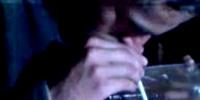
Renowned Cuban artist Tania Bruguera surprised a Bogota audience in September when she lined up three people directly involved in the Colombian conflict for a chat. The real performance however, started when a waitress emerged with a tray of neatly organised lines of cocaine, and began offering them to members of the audience.