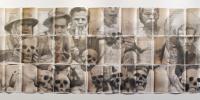
This is the sixth piece of the series Tatlin’s Whisper which examines the relationship between apathy and anaesthetization of the images in the mass media. This series intends to activate images, well-known because of having been repeatedly seen in the press, but are here decontextualized from the original event that gave way to the news and staged as realistically as possible in an art institution.
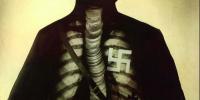
John Heartfield began to make photomontages as a member of the Berlin branch of international Dada around 1920. Schooled in graphic arts and having worked briefly in animated film, Heartfield (who had anglicized his given name, Helmut Herzfeld, in 1917 as a protest against wartime nationalism) subsequently developed a cinematic effect in montages that he made for book illustration.
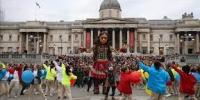
Little Amal is the 12 foot puppet of a 10 year old Syrian refugee child at the heart of The Walk. Over the last year she has become a global symbol of human rights, especially those of refugees.
Since July 2021, Amal has travelled over 9,000km and been welcomed by more than a million people on the street, including hundreds of artists and civil society and faith leaders, as well as by tens of millions online.
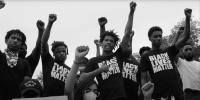
Lil Baby, a popular American rapper, released a song titled "The Bigger Picture" in 2020 in response to the Black Lives Matter movement and the protests that took place following the murder of George Floyd by a police officer.
The Guggenheim Museum in New York City temporarily closed off its entrance on Saturday afternoon, November 11, after eight artists and cultural workers took to the institution’s iconic spiral ramp to denounce the Israeli military’s ongoing killing of Palestinian children in Gaza.
CORPUS CHRISTI — Many Flour Bluff ISD students have developed an extracurricular activity that takes their education to the streets, to social media and toward a path of change: activism.Much of the students' passion stems from the April 1 suicide of 16-year-old Ted "Teddy" Molina, a former Flour Bluff Independent School District student.Ted's family has attributed his death to bullying.
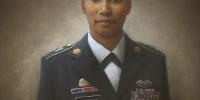
On completion the 100 Faces project will consist of 100 Portraits of Americans who have been to the theaters of war in Iraq or Afghanistan (OEF,OIF). Each portrait is accompanied by a placard featuring a statement written by the person pictured and a brief biography of the person pictured. The biographical information and the statement reflect the person at the time of the creation of the portrait.
Colombian ad agency Lowe SSP3 is starting a Christmas-themed campaign to entice guerrilla fighters out of the jungle to turn themselves in. The agency may have created an advertising-to-guerrillas award category after winning a gold Cannes Lion in the outdoor category and half a dozen Grand Prix awards at other shows this year for its first holiday effort, last December.
The internet has reshaped the ways we learn and communicate. Information becomes heuristic, concomitantly - knowledge becomes protean. If you dedicate enough time to any particular platform, you are likely to acquire a community with congenial individuals. Social media’s proliferation has obfuscated the lines between reality and fiction. Embraced as a tool for many, these digital spaces typically have no monitoring process.
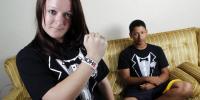
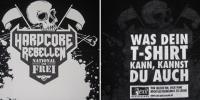
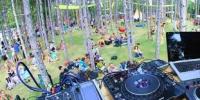
An anti-Nazi organization called Exit-Deutschland targeted a right-wing Rock Festival in a city called Gera. They got in contact to the festival organizers by using a fictitious name, and they distributed 250 trojan t-shirts with a writing “Hardcore Rebels” during the festival. When the recipients of the shirts went back home and washed them.
For FX Harsono, art is activism. Over the past four decades, performance, sculpture, and painting have become his means of nonviolent protest against government autocracy and ethnic strife in Indonesia.
Festival “WakEUp!” (organized by “Heartefact”) happened at several locations, and included film and exhibition program. Festival originated from the need for a reaction to the present moment refugee crisis and the situation in the world, began on the 7 th of December at Gallery “G12 Hub” in Belgrade with two days performance that was dedicated to the current problem of refugees and their historical destinies.
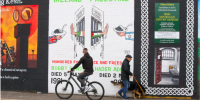
Palestinian and Israeli flags flutter in pro-Irish and pro-UK neighbourhoods in Northern Ireland, tapping into its own history of conflict and division that still affects everyday life despite a 1998 peace deal that largely ended violence.
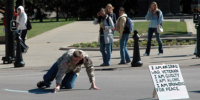
Aaron Hughes, an artist-activist and Iraq War veteran walked into the middle of a busy intersection in Champaign, Il. where he was then going to college, and propped up a signboard that read:
“I am an Iraq War Veteran.
I am guilty. I am alone.
I am drawing for peace.”
The snapshots are thrust at us urgently, as if they were passports being shown at a border crossing, official proofs of national identity. Mostly, they are prosaic pictures of family members or houses. Sometimes a diploma will be offered up instead, or theater reviews clipped from newspapers or a membership card to a duck-hunting club. Later, other, more frightening, pictures will be shown, but they all serve the same function.
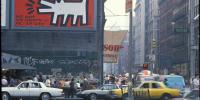
It’s the radiant baby, the barking dog and the dancing man; the badges and the t-shirts; the unmissable mural spelling out CRACK IS WACK. Keith Haring’s career was short but spectacular, and he leaves behind a lasting legacy. From his chalk drawings in city-wide subway stations, to his collaborations with the superstars of his day, Haring’s life was founded on a belief in the power of people to change the world.
About us
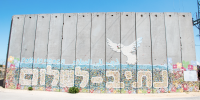
"Path to Peace" - is a joint mosaic creation, by thousands of people, towards hope, love, and happiness among all people. The creation is placed upon the border wall that divides the Gaza Strip and Israel, adjacent to the homes of Moshav Netiv HaAsara.
The creation is seen from both sides of the wall, spreads on the gray security wall and completely changes the place's atmosphere.
Our NGO “Voices from the Conflict” seeks to open a conversation about the Israel-Palestine conflict through the lens of activist art. The history of the conflict dates back to the UN partition plan in 1947, followed by Israel’s independence in 1948. Since then, there have been several armed engagements between the two actors- causing massive civilian casualties and terrorism.
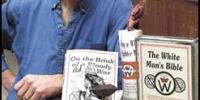
The Creativity Movement (formerly known as the World Church of the Creater) is a self proclaimed white supremacist organization with factions across the United States. In 2004, a high ranking leader of the Montana based faction defected from the group, but not before donating over 4,000 of the group's bibles called the 'RAHOWA' (acronym for racial holy war) to the Montana Human Rights Network.
Republic of Moldova – “Before the war, Eva was a happy, carefree little girl, a first-grader full of joy who loved going to school, practicing taekwondo and drawing,” Olga recalls. Determined for her six-year-old daughter to have a joyful, stable childhood, Olga did all she could to help Eva thrive.
February 24, 2023 will mark one year since the Russian invasion and occupation of Ukraine began. Russia is attempting to take over Ukrainian territory and destroy its rich, vibrant culture. Ukrainians are fighting for their country and right to exist as free, independent people. For months, Ukrainians have endured relentless bombardment, destruction, and hardship.
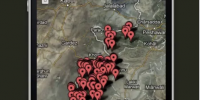
Josh Begley, a Data Artist and NYU Student, took publicly available information on recorded drone strikes and designed an interface for people to connect and sympathize with the reality of U.S. drone attacks.
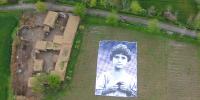
A giant art installation targets predator drone operators
In military slang, Predator drone operators often refer to kills as ‘bug splats’, since viewing the body through a grainy video image gives the sense of an insect being crushed.
A popular theme throughout media is the relationship between technology and art. While art is often bolstered and disseminated through technology, discussions arise of how technology both positively and negatively affects content. Caroline Sinders’ exhibition Within the Terms and Conditions explores the way content has been spread online.