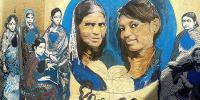
Hok Kolorob. Let there be noise.
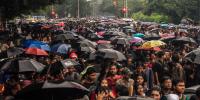
It was perhaps these two words of protest that eventually led to the arrest of two engineering students for allegedly molesting a fellow student at Kolkata’s Jadavpur University last month.
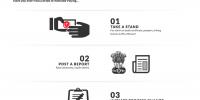
ipaidabribe.com is an online tool that allows the users to report when they pay bribes, are asked to pay and refuse, and when they find an honest officer.
They have a well designed site with apps for mobile phones, and although it started in India it has now grown and you can select multiple countries on different continents.
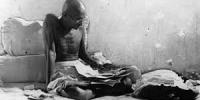
On September 16, 1932, in his cell at Yerwada Jail in Pune, Mohandas Karamchand Gandhi begins a hunger strike in protest of the British government’s decision to separate India’s electoral system by caste.
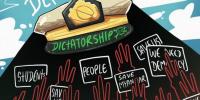
Cartoons Against Corruption is a cartoon based campaign by political cartoonist Aseem Trivedi to support anti corruption movement in India, best known for sharp hard hitting anti corruption cartoons. Using national emblems and current political news, Trivedi creates cartoons that don't attempt to skirt the issues at hand, but portrays his political stance straightforwardly.
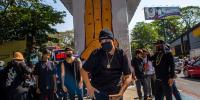
There are no whistles, no loud speakers, and no placards held up high in this quiet act of subversion. Pimsiri Petchnamrob stands silently in a mass of sharply dressed Bangkok commuters, her hands clutched around a copy of George Orwell's 1984.
Next to her a small group of young men and women, their faces sombre and their heads bowed low, also read books about fictional and real totalitarian worlds in silence.
Most nights since a coup returned Myanmar to military rule on Feb. 1, a spectral symbol of protest has glowed on a mildewed side of a building.
Where the next illumination will appear in Yangon, the country’s biggest city, is a mystery. But, suddenly, a projected image appears in the dark. Three fingers raised in a rebellious pose. A dove of peace. The smiling face of Daw Aung San Suu Kyi, whose government was ousted in the army putsch.
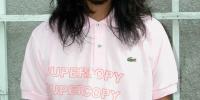
By adding screen print with the wording ‘SUPERCOPY’ on to copies of LaCoste polo shirts bought at a street market in Thailand SUPERFLEX turns a copy product into a Supercopy – a new original. As a result, LaCoste took legal action against SUPERFLEX.
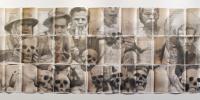
For FX Harsono, art is activism. Over the past four decades, performance, sculpture, and painting have become his means of nonviolent protest against government autocracy and ethnic strife in Indonesia.
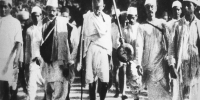
In 1930, the Indian National Congress adopted satyagraha (essentially, nonviolent protest) as their main tactic in their campaign for independence. Mahatma Gandhi was appointed to develop a plan of action; he proposed marching to the sea to make salt in defiance of the Salt Act of 1882.
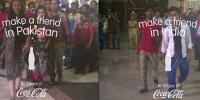
A new, three-minute ad by Coca-Cola, "Small World Machines," starts with a relatively straightforward premise: India and Pakistan do not get along so well. It ends with the promise of peace: "Togetherness, humanity, this is what we all want, more and more exchange," a woman, either Indian or Pakistani, narrates as the music swells. Sounds great. How do we get there? By buying Coke, of course.
Zubair Magray, who goes by the stage name Haze Kay, raps about the conflict in Indian-administered Kashmir. The 23-year-old, one of the first rappers to emerge from the valley, blames the Indian military for "ruining" his homeland.
"An atmosphere of fear and anger spread across Myanmar this week as millions of people awoke to find out the military had taken control, ousting the elected government.
But how do you fight back in a country where protests have been violently suppressed before?
For some, it has meant putting pen to paper and taking the battle online.
Seeking to use war-time waste for social good, Saught was set up by Pamela Yeo, Adeline Heng and Ng Sook Zhen in December 2010. Based in Singapore, the company uses the metal from de-activated landmines to create pieces of jewellery. The organisation employs citizens from conflict-ravaged regions, offering a source of employment for those who may have lost as a result of the fighting in their nation.
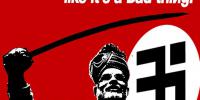
Namo Nazi
Namo Nazi is a group which is dedicated to the cause of spreading awareness about fascism. They create anti-fascist T-Shirts and say this about themselves:
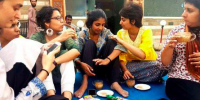
We are sitting at a dhaba – a roadside tea-shop in Pakistan often frequented by lower-to-middle income men. At our table: four women and camera crew. The reporter from ‘one of the most globally viewed’ [read: western], mainstream British outlets looks me in the eye: “So, how safe do you feel at the moment? We were just surrounded by a group of little boys [because of the cameras], do you think the situation can ever turn on you?"
She seeks to utilize her feminist art to spread awareness on mental health issues. Sravy is a nomad in her own right, and throughout her experiences in Asia she has noticed that there are stimas surrounding women's autonomy and how they handle mental health struggles.
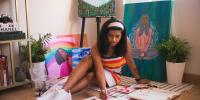
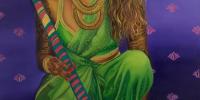
“Badass Indian Pinups” is a series of paintings by Indo-Canadian artist Nimisha Bhanot, that features paintings of Indian women being confident and sexually liberated.
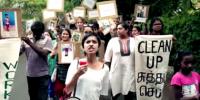
The Kodaikanal Won't video by Chennai artist Sofia Ashraf, asking Unilver to 'clean up their mess' in connection with the Kodaikanal mercury dumping, has gone viral with over 783,533 views at the time of writing this, in just over two days. It has been shared on social media by prominent personalities such as Nandita Das, Varun Grover, Vishal Dadlani and was even praised by Nicki Minaj, on whose song Anaconda, the rap is based on.
Alokananda Roy walked into Calcutta's Presidency Jail on International Women's Day, 2007. The Indian classical dancer had been invited to watch female inmates perform, but it was the men who caught her eye.
"They shook me," she says. "Their body language — it was as though they had no future, nothing to look forward to."