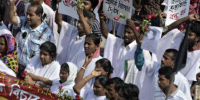
Opponents of military rule in Myanmar have marched, observed "flower strikes" and sought alternative ways to communicate after most users were cut off from the internet, undaunted by the bloody suppression of protests during the past two months.
Myanmar has been engulfed in protest since February 1, when Burmese army general Min Aung Hlaing seized control of the government in a military coup, refusing to accept the landslide election victory of the National League for Democracy and its leader, Aung San Suu Kyi.
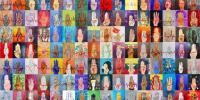
She seeks to utilize her feminist art to spread awareness on mental health issues. Sravy is a nomad in her own right, and throughout her experiences in Asia she has noticed that there are stimas surrounding women's autonomy and how they handle mental health struggles.
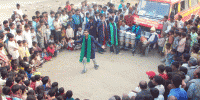
Mukti Caravan, the Campaign on Wheels, is a mobile cultural group of former child bonded labourers. Started by the Bachpan Bachao Andolan (Save Childhood Movement), a movement started by now Nobel laureate Kailash Satyarthi, it involves activists visiting villages to create awareness about need for education, emphasizing on the need for improving access to education and quality of education, to completely eradicate child labour from the society.
Members of Greenpeace together with environmental advocates dressed as zombies attend a creative protest against water pollution in Manila on September 27, 2012. The protesters delivered a petition urging the establishment of a “Right-To-Know” system for chemicals and the adoption of a policy to eliminate hazardous chemicals released by factories into freshwater bodies.
Shake Girl is a massive collaborative effort between fifteen students and two instructors over the course of one quarter (Winter 2008). These students comprise the first edition of the Stanford Graphic Novel Project -- a group dedicated to acheiving this monumental task on an annual basis.
In her peppy and helpful online video tutorial, Reshma Bano Quereshi promises to teach her viewers “how to get perfect red lips.”
But unlike the more than 200,000 other online videos dedicated to the application of lipstick, this one goes beyond plumping and priming.
There are no whistles, no loud speakers, and no placards held up high in this quiet act of subversion. Pimsiri Petchnamrob stands silently in a mass of sharply dressed Bangkok commuters, her hands clutched around a copy of George Orwell's 1984.
Next to her a small group of young men and women, their faces sombre and their heads bowed low, also read books about fictional and real totalitarian worlds in silence.
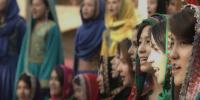
In response to a memo from Afghanistan's education ministry, Ahmad Sarmast, the founder of Afghanistan's Institute of Music, began a Twitter campaign with the hashtag #IAmMySong. In response to the hashtag, Afghan girls have taken to Twitter with videos of themselves singing tagged with Sarmast's hashtag and spreading petitions against the ban. The ministry memo banned girls 12 years old and older from singing at school functions.
Singaporean artist Lee Wen’s series Journey of a Yellow Man (1992–2012), one of his most famous and long-standing performances, was not simply a personal affront, it was a political affront. At the intersection of Asian art history, critical race theory, and migration and diasporic studies, one is never far (enough away) from the chromatic framing of race and ethnicity: yellow race, yellow peril, yellow face, the forever foreigner.
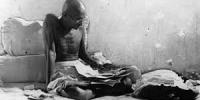
On September 16, 1932, in his cell at Yerwada Jail in Pune, Mohandas Karamchand Gandhi begins a hunger strike in protest of the British government’s decision to separate India’s electoral system by caste.
In 1989, playwright, actor, and activist Safdar Hashmi was fatally attacked by political thugs while performing a street play outside of Delhi. His death led to the founding of Sahmat, an influential artist collective that has taken a consistent stance against the threats of religious fundamentalism and sectarianism in India through a vibrant mix of high art and street culture.
New Delhi: With his ‘climate fast’ entering its fourth day at Khardungla pass (18,000 ft) at -40 °C, Sonam Wangchuk — the renowned engineer, educationist and reformer from Ladakh took to Twitter, urging the people of India to join him on the last day of his fast in support of Ladakh.
Dear Team
Please find below the links of the video and detail of Kind Coins Pakistan, Kids for Peace Pakistan School
and Peace Centre, hope you will publish it on your website and circulate it at large,
your this publication and circulation can change the lives of Pakistani kids and children
Kind Coins for Pakistan
"Thousands of people, some wearing funeral shrouds, staged demonstrations at the site of the Rana Plaza factory complex on Thursday on the one-year anniversary of the Bangladesh disaster that claimed 1,138 lives.
Maria was psyched to travel to the Philippines where her hand-made basketball nets were well received. Invited with the Institute for Infinitely Small Things (Boston/Mass based) by Clara Balaguer and the Office of Culture and Design (Manila) she worked in Zamboanga City with students of Western Mindanao State University to carry out a 6 day arts and activism workshop.
In 1989, playwright, actor, and activist Safdar Hashmi was fatally attacked by political thugs while performing a street play outside of Delhi. His death led to the founding of Sahmat, an influential artist collective that has taken a consistent stance against the threats of religious fundamentalism and sectarianism in India through a vibrant mix of high art and street culture.
The Propaganda Machine is a battle cry delivered in the language of extreme metal. On Sahil Makhija’s fourth solo album as Demonstealer, he takes aim at the right-wing politicians, racist nationalists, disinformation artists, and religious extremists who manipulate and exploit the masses, in his native India and all over the world. He doesn’t mince his words; just about every lyric on the album could easily be printed on a protest sign.
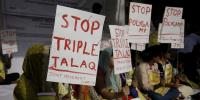
The egregious practice that some Muslim men employ to divorce their wives instantaneously and without their consent, merely by uttering the word talaq (divorce) three times, has finally been declared unconstitutional and illegal by the Indian Supreme Court. The country’s ruling Bhartiya Janata Party (BJP) party claims that the ban is a victory for its administration, which had been advocating its abolition since it came to power in 2014.
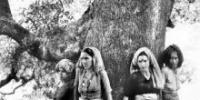
The forests of India are a critical resource for the subsistence of rural peoples throughout the country, but especially in hill and mountain areas, both because of their direct provision of food, fuel and fodder and because of their role in stabilising soil and water resources.
Brother Gao are two China artists. Their works are aims at reflecting the reality of Chinese society in an artistic and critical view. In 2003, the brothers held an event to invite many strangers for a dinner.