To call attention to bullying, the Singapore Coalition Against Bullying for Children and Youth has released a video that gets shorter each time it is viewed.
Hosted on a site called Share It To The End, the short animated video depicts a boy getting bullied at school and telling us he always feels alone and doesn’t feel safe anywhere.
Chuu Wai Nyein felt an overwhelming sense of guilt when she first arrived in Paris from Myanmar at the end of April. “I was pushed to leave the country, but it was not how I wanted to leave,” says the 28-year old. As an artist working for the last ten years, mostly in the central city of Mandalay, Chuu built up an international reputation for her expressive paintings of women.
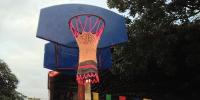
Maria was psyched to travel to the Philippines where her hand-made basketball nets were well received. Invited with the Institute for Infinitely Small Things (Boston/Mass based) by Clara Balaguer and the Office of Culture and Design (Manila) she worked in Zamboanga City with students of Western Mindanao State University to carry out a 6 day arts and activism workshop.
Namo Nazi
Namo Nazi is a group which is dedicated to the cause of spreading awareness about fascism. They create anti-fascist T-Shirts and say this about themselves:
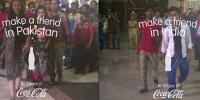
A new, three-minute ad by Coca-Cola, "Small World Machines," starts with a relatively straightforward premise: India and Pakistan do not get along so well. It ends with the promise of peace: "Togetherness, humanity, this is what we all want, more and more exchange," a woman, either Indian or Pakistani, narrates as the music swells. Sounds great. How do we get there? By buying Coke, of course.
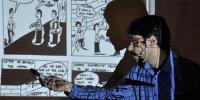
With World Comics India, the organization he started, Sharad has pioneered a cheap and easy medium for poor people to communicate meaningfully on issues that are neglected by the conventional media. While the urban elite dominates public media, the grinding day-to-day concerns of millions are rarely heard. Layers of discrimination and abuse heaped on huge numbers of people keep their problems out of sight and out of mind.
We are sitting at a dhaba – a roadside tea-shop in Pakistan often frequented by lower-to-middle income men. At our table: four women and camera crew. The reporter from ‘one of the most globally viewed’ [read: western], mainstream British outlets looks me in the eye: “So, how safe do you feel at the moment? We were just surrounded by a group of little boys [because of the cameras], do you think the situation can ever turn on you?"
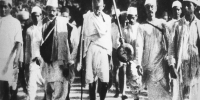
In 1930, the Indian National Congress adopted satyagraha (essentially, nonviolent protest) as their main tactic in their campaign for independence. Mahatma Gandhi was appointed to develop a plan of action; he proposed marching to the sea to make salt in defiance of the Salt Act of 1882.
Members of Greenpeace together with environmental advocates dressed as zombies attend a creative protest against water pollution in Manila on September 27, 2012. The protesters delivered a petition urging the establishment of a “Right-To-Know” system for chemicals and the adoption of a policy to eliminate hazardous chemicals released by factories into freshwater bodies.
By adding screen print with the wording ‘SUPERCOPY’ on to copies of LaCoste polo shirts bought at a street market in Thailand SUPERFLEX turns a copy product into a Supercopy – a new original. As a result, LaCoste took legal action against SUPERFLEX.
Singaporean artist Lee Wen’s series Journey of a Yellow Man (1992–2012), one of his most famous and long-standing performances, was not simply a personal affront, it was a political affront. At the intersection of Asian art history, critical race theory, and migration and diasporic studies, one is never far (enough away) from the chromatic framing of race and ethnicity: yellow race, yellow peril, yellow face, the forever foreigner.