The New Culture Movement was initiated by Chen Duxiu, Li Dazhao, Lu Xun, Hu Shi, Cai Yuanpei, Qian Xuan and other writers who had received Western education (called the new-style education at the time). It is an ideological and cultural innovation and literary revolutionary movement.
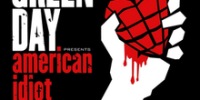
Mass media using propaganda to brainwash citizens. Confusion and ignorance causing a divide. People rising up against an oppressive government. Humans being torn between rage and love. These are the themes of Green Day’s widely successful 2004 album, “American Idiot.” These themes still sound familiar. Nearly two decades later, the world, especially the United States, faces these same issues.
Presaged by shimmering spin-off hits “Dreams” and “Linger,” The Cranberries’ landmark debut album, Everybody Else Is Doing It, So Why Can’t We?, suggested its creators had taken up the baton handed down by jangly indie-pop classicists The Smiths and The Sundays.
Dan Perjovschi is one of Romania’s foremost artistic voices. Although known as a talented multi-disciplinary artist in his home country, particularly for his early performance work, he is most widely known internationally for his massive drawing installations.
Join acclaimed director Velcrow Ripper (Scared Sacred, Fierce Light) on a journey deep inside the revolution of the heart that is erupting around the planet, as he asks the question, “How could the crisis we are facing become a love story?”
In December 2008, Tim DeChristopher, along with his church group, was protesting outside a Bureau of Land Management oil and gas lease auction of 116 parcels of public land in Utah's red rock country. Tim decided to take his protest inside and disrupt the auction itself. Instead, at the door, he was offered a bidder's paddle — which, after a split second of hesitation, he accepted.
I was 24 years old. We were in danger. The Israeli planes were flying raids overhead. And I was designing posters." Hosni Radwan won't easily forget the conditions in the Beirut offices of the PLO Information Department, as an exhibition of the work it produced opens in London.
from ahramonlineby Sara ElkamelAn indelible link has materialised between artistic expression and
revolution. Maybe it is the features they share: freedom, deviance and
fluidity, which bring them so close together.
In any case, Egypt’s January 25 Revolution undeniably led to a
surge of creativity across the country; a rebel’s passion merges with an
A rescue drone for refugees in danger whilst traveling across the Mediterranean Sea.
Last year alone, 3,500 refugees perished attempting to cross the Mediterranean Sea. The Avy Search and Rescue Drone is specifically designed to help refugee boats. The drone is capable of flying long distances, detecting vessels, and can drop life jackets, life buoys, food supplies, medication and communication devices.
Drones for Good Competition
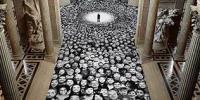
After winning the TED Prize on March 2, 2011, the French-artist JR launched the Inside Out Project, in his first TED Talk. Using his own artistic practice as inspiration, this participatory platform helps individuals and communities to make a statement by displaying large-scale black and white portraits in public spaces. Through their “Actions,” communities around the world have sparked collaborations and conversations.
#NYTIMES Why are there no U.S. anti-slavery monuments? http://antislaverymonument.org project is an answer.
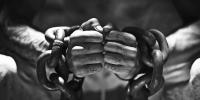
Standing 60 feet tall, corten steel of two hollow chain links the upper one broken.
Counterspace is an independent curatorial platform functioning as the first decolonial thinktank mapping cultural activism worldwide. It shapes collectively decolonial toolkits with common tools and resources, and a global directory browsable by continent, praxis, and social construct, as a Beuys-inspired ‘social sculpture’ revisited, and an alternative map of the universe.
To state or chant ‘BLACK LIFE’S MATTER’ is not to say other lives don’t matter, it’s a reminder that four hundred years and counting, black lives didn’t matter enough. Not during the dark era of slave trade and its horrors on the African, not after slavery ended and blacks were left holding the short end of the stick.
This is the sixth piece of the series Tatlin’s Whisper which examines the relationship between apathy and anaesthetization of the images in the mass media. This series intends to activate images, well-known because of having been repeatedly seen in the press, but are here decontextualized from the original event that gave way to the news and staged as realistically as possible in an art institution.
"SOA Cycle, and what it later became, which is called the Democracy Cycle, is a group of seven large works that approach the question of democracy. What is democracy? How is it constructed? How is it implemented? Is it something that is to be thought of in relation to its political influence? Or is it something that plays out in terms of cultural and social, and even emotional terms, for instance?
A town in northwestern Syria has become the creative center of the revolt against President Bashar al-Assad. Since the beginning of the uprising, the residents of Kafr Anbel have drawn signs that skewer the Assad regime and express outrage that the world has not done more to stop the killing in Syria.
The Spanish artist Santiago Sierra is planning to immerse a British flag in blood donated by indigenous peoples from countries colonised by the British Empire.
The resulting artwork, titled Union Flag, is intended to be an “acknowledgement of the pain and destruction colonialism has caused First Nations peoples, devastating entire cultures and civilisations,” the artist said in a statement.
"Thai artists and art students are on the frontline of their country’s swelling pro-democracy movement, calling for reforms of Thailand’s military-backed government, and breaking both taboo and national law to criticise the nation’s monarchy.
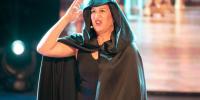
Wajiha Jendoubi is an actress and one of Tunisia's best-known comedians. To be a woman comedian in this North African nation can be a challenge, but the country's gender gap is narrowing for the first time in almost a decade and Wajiha sees Tunisia as a country that stands for women's rights and supports it.
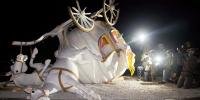
“He describes it as a “family theme park unsuitable for small children” – and with the Grim Reaper whooping it up on the dodgems and Cinderella horribly mangled in a pumpkin carriage crash, it is easy to see why.
Banksy’s new show, Dismaland, which opened on Thursday on the Weston-super-Mare seafront, is sometimes hilarious, sometimes eye-opening and occasionally breathtakingly shocking.
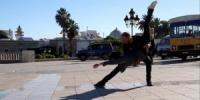
The flashmob ‘’I will dance despite everything’’ was organized in Tunis's old medina on December 2012 by “Art Solution", a Tunisian group aiming to promote street art as a form of resistance.
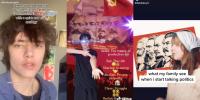
20-year-old Ilyssa, from New York, sees communism as the only viable alternative, one that will improve the societal issues we currently face. “From a young age, I was very aware of the stark class differences that existed,” she says. “I grew up with a single mother in a very poor family.
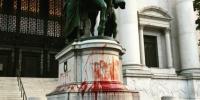
Just weeks after activists staged an alternative tour of the American Museum of Natural History to call for its removal, among other things, the equestrian statue of Teddy Roosevelt was vandalized early Thursday morning.