"Divided we are weak. Together we are strong."
Those were the words tweeted by openly gay football star Michael Sam, thanking his University of Missouri family for their support. He posted the message after arriving at the school and seeing a group of Mizzou students surrounding the perimeter in order to block out a Westboro Baptist Church protest.
It's an evocative image — and it was intended to be: Diana, Princess of Wales, wearing a protective visor and flak jacket, walking through a live minefield in Huambo, Angola. The image of the princess, at the time one of most famous women in the world, surrounded by danger, made headlines across the world.
Uncle Sam's Cultural Dissonance looks at the issues facing The United States, including Canada and Mexico. In countries like the United States, where some states are dotted with countless lakes and many people live within easy reach of an ocean, it may be easy to assume that drinking and recreational waters are limitless. This is absurd. This series focuses in on excessive overuse in by agricultural, residential, and industrial sectors.
"He's been running all his life, running for freedom, running for peace.It started when he ran away from home at the age of eight. Later he ran away from his homeland, Iran, and spent seven years on a bicycle, pedaling 49,700 miles across 55 countries. In 2002, he reached America. He now lives in a tent in Death Valley. It's been nearly 10 years since Reza Baluchi escaped from Iran.
By a pond inside one of the entrances to Beijing’s Chaoyang Park lies a cluster of one and two storey red pyramid-shaped buildings. Sculptures of Gandhi and Lincoln and other famous figures sit in the quiet woods nearby. This is Yuan Xikun’s Jin Tai Art Museum.
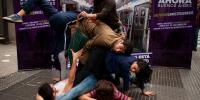
In 2017, the political party Ahora Buenos Aires (Now Buenos Aires) was running in the legislative election for the first time. It is not easy being a small left-wing party in the City of Buenos Aires, therefore imagination is an essential part of a campaign if you want to get the attention of the media and voters.
In May of 2011, tens of thousands of people crowded Puerta del Sol in the center of Madrid in the most visible manifestation of sit-in protests against austerity and corruption. 15-M was an expression of the devastating effects of the 2008 recession, which harshly affected the middle class and condemned millions of people to poverty because of the crash of the housing bubble (Altares, 2021).
A watermelon filter on TikTok is allowing users to raise funds to support civilians in Gaza, where more than 11,000 people have been killed since Israel began an offensive military attack on the Gaza Strip in October, after a Hamas attack killed 1,400 people in Israel and saw roughly 200 civilians taken hostage.
Artist Luke Jerram created a genderless sleeping figure made of glass lying on a piece of cardboard and exhibited in the streets of London. The artist said in an interview "For every person you see sleeping on the streets, there are many others sleeping in hostels, squats and other forms of unsatisfactory and insecure accommodation.
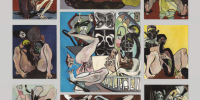
In recent years, a fashion for painting the human figure has preoccupied the art world, with an emphasis on race, gender and other urgent social issues. Yet another pressing topic in America has been curiously absent from art: abortion, which became all the more timely when the Supreme Court overturned Roe v. Wade in June.
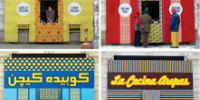
Conflict Kitchen is a restaurant that only serves cuisine from countries with which the United States is in conflict. Each Conflict Kitchen iteration is augmented by events, performances, publications, and discussions that seek to expand the engagement the public has with the culture, politics, and issues at stake within the focus region. The restaurant rotates identities in relation to current geopolitical events.
Huff Post Latino Politics
The Huffington Post
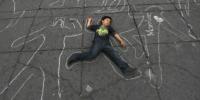
While drug-related deaths continue to escalate as the Mexican drug war wages on, Mexican youth have resorted to peaceful and artistic forms of protest against the violence.
Last Sunday, activists met on Mexico City's Zocalo Square in an effort to demonstrate against the war. They covered the public space with chalk outlines of human bodies.
CLEVELAND, Ohio – Dana Schutz, the acclaimed New York artist who trained at the Cleveland Institute of Art, famously stirred controversy at the 2017 Biennial at the Whitney Museum of American Art with “Open Casket,’’ her painting depicting Emmett Till’s body in its coffin.
Till, a black 14-year-old, was murdered and mutilated by white men in Mississippi in 1955 after having been falsely accused of flirting with a white woman.
2020 was the year of when protest music blared everywhere. For a long period, Black people struggled against police brutality and in the uproar of George Floyd's murder, BLM protests instantly swept over the country. Of the many protest music that was released that year, trumpeter Ambrose Akinmusire wrote a song that would spearhead raging sentiments towards racial injustice beyond just jazz.
A Colombian college student created this idea to improve Bogotas citizens experience when using the public transportation. According to one scientific study, the worst problem Bogota citizens had to deal within the public space was public transportation; this problem represented the principal cause of high percentages of stress and anger among citizens.
Republican climate sceptics face battle for re-election as green groups hit back: Activists plan targeted campaign to defeat 'Flat Earth Five' group of Republicans in congress who refuse to accept climate science
Benito Antonio Martínez Ocasio, better known to the world as Bad Bunny, has once again proven that his artistry goes far beyond reggaeton and trap. On January 5, 2025 — the eve of Puerto Rico’s cherished Three Kings Day — the Puerto Rican superstar released DeBÍ TiRAR MáS FOToS, an album that both celebrates his homeland and delivers a sobering message about its uncertain future.
In 2016, Zhou Zhenfeng, who was a student at a college in Hebei at the time, discovered that there were a lot of waste tires in the streets and alleys. Zhou Zhenfeng learned that tires are made of infusible or refractory polymer elastic materials. It takes hundreds of years for these materials to decompose in the soil to the extent that they do not affect the growth of plants.
After decades of fighting to preserve many of the old woods of Staten Island and years of fighting for the preservation of Pouch Camp, the Boy Scout camp and 100 wooded acres in the middle of the Greenbelt is officially saved!!