change
issue
region
medium
despondent apostate
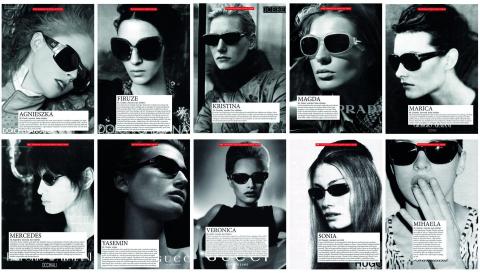
Croatian artist Sanja Iveković started Women’s House (Sunglasses) in 1998 in collaboration with a women’s shelter in Zagreb and later with women’s shelters elsewhere in Europe and Asia. Iveković organised workshops with women in these shelters to produce plaster casts of their faces, as well as to give them the space to write their life stories. Sanja superimposed testimonies from victims-survivors of GBV (domestic violence specifically) on advertisements for luxury sunglasses. The posters and plasters have been presented in indoor and outdoor exhibitions, and the posters have also been placed in billboards and newspapers, as a way of raising the visibility and public awareness of domestic violence.
In an interview, Sanja Iveković said, "The series produced for the show is a collaboration with the Federation for Women and Family Planning, titled Women’s House (Sunglasses) and is indeed a part of a bigger project. Women’s House deals with violence against women, an issue that was still a hidden issue in Croatia when I started to work on this topic. I myself learned about it at the Centre for Women’s Studies (founded in 1995) where I was teaching contemporary women’s art. Some of the courses at the Centre were taught by women-activists who established the Autonomous Women’s House – the first shelter for women victims of domestic violence in Eastern Europe. The House started in Zagreb in 1989 when a group of women squatted in an empty apartment and turned it into the shelter. I visited the shelter and it turned out to be an eye-opening experience for me. I decided to do an art project that would make this issue visible to the general public. I also wanted to develop a new type of work, one in which women who experienced violence were not just my artwork’s subjects but rather its active participants. It took me some time to find a method that would be easy, fast and cheap so that that the piece could be produced by the women in the shelter themselves. In the end I opted for a process that included a workshop in which we produced plaster casts of the women‘s faces, along with short life stories the wrote themselves. Then the „masks“ and texts were installed in accordance with specific exhibition spaces, either indoors or outdoors."