change
region
medium
issue
despondent apostate
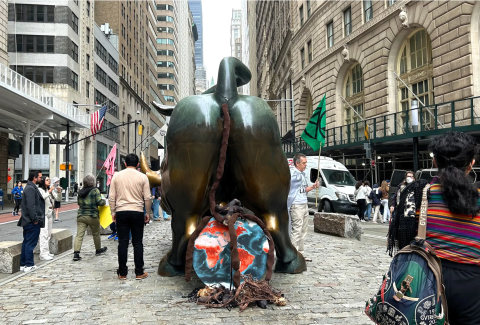
Climate activists took to the iconic “Charging Bull” sculpture in Manhattan’s Financial District on Earth Day today, April 22, to call out Wall Street’s “bullshit” in the face of a worsening environmental crisis — quite literally, by installing a display of fabric feces descending onto a rendering of planet Earth at the rear end of the 11-foot-tall bronze bull.
“Runaway capitalism is shitting on our planet, our lives, our bodies, our health, and everything we hold dear,” shouted one activist during the action.
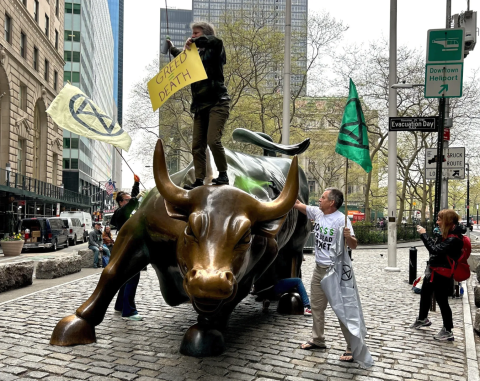
Protesters began tagging the landmark with the words “Greed = Death” in washable green chalk paint shortly after 8:30am. Police officers arrived at the scene half an hour later and demonstrators cleared the display. There were no arrests.
Organized by climate emergency group Extinction Rebellion, the demonstration comes amid Trump’s rollbacks on environmental protections and regulations, and in advance of anticipated attempts to revoke the tax-exempt statuses of nonprofit organizations deemed to be in opposition to the presidential agenda.
While carrying signs that read “No Profits On A Dead Planet,” demonstrators also called attention to the action’s timing and its location at the site of the 2011 Occupy Wall Street protest encampments. During those protests, the New York City Police Department (NYPD) corralled the “Charing Bull” statue with barricades for over seven weeks and monitored it 24 hours a day to protect it from vandalism.
“The richest 1% are colluding with our fascist government to destroy our Earth for their profits,” the demonstrator continued, citing a 2023 Oxfam report that revealed that the richest 1% of humanity accounts for more carbon emissions than the poorest 66%.
Some tourists who had traveled to the statue for a photo op watched in confusion and, in some cases, even humorously participated by holding up the demonstrators’ flags and posing in front of the protest. Other passersby shouted at the activists to leave the statue alone and vacate the area, while some curious daily commuters paused to take photos and listen in.
Aliyah Graves, a hybrid office worker who was on her way to work with an iced coffee in hand, told Hyperallergic that while she was not familiar with the climate emergency group, she immediately understood their message.
“I think a lot of people are fed up with how things are going,” Graves said. Referencing her own Gullah Geechee heritage, she pointed out the amplified impact of climate change on Indigenous communities and groups with cultural practices rooted in land stewardship.
“I think lawful disobedience is needed in a society, that’s what makes a democracy great,” Graves.
The Extinction Rebellion protest was one of several Earth Day demonstrations this morning on Wall Street. During the action, an unaffiliated billboard truck criticizing Elon Musk drove through the downtown Manhattan neighborhood’s streets. The climate group also tagged the Tesla showroom in downtown Manhattan in another environmental protest, during which the group said two of their members were taken into custody.