Tiny Pricks is a public art project created and curated by Diana Weymar. Contributors from around the world are stitching Donald Trump’s words into textiles, creating the material record of his presidency and of the movement against it. Tiny Pricks Project holds a creative space in a tumultuous political climate.
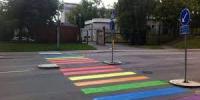
Swedish lesbian, gay, bisexual and transgender (LGBT) rights advocates offered their colorful stance on Russia's controversial anti-gay legislation over the weekend.
In the 1970s, inspired by the Black Power movement in the US, Aboriginal people were politically very active. In Sydney, Australia’s first Aboriginal legal and medical services were founded. Aboriginal people demanded land rights for the areas that they lived on since millennia.
Land rights were considered the key to economic independance, and land the base to generate resources and employment.
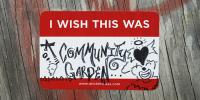
I Wish This Was began in New Orleans in November 2010. It was inspired by vacant storefronts. There are a lot of them where Candy lives in New Orleans. There are also a lot of people who need and want things. What if we could easily voice what we want, where we want it? How can we influence the businesses and services in our neighborhoods?
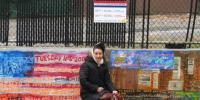
The "Democracy Wall" in the Carroll Gardens section of Brooklyn, New York was established in 2009. This wall is a long-term, community art activist project that is part wall mural, part past information archive.
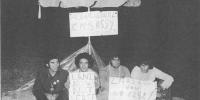
Brainstorm of ideas and collection of the group individual experiences and input.
Preparation and design of the action.
Interview of a member of local organization that is working with homeless.
Research of data,concrete stories.
Build up the scenario to establish the environment to raise awareness of the rising local issue of homeless, specifically female homeless and their challenges in daily life.
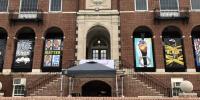
After researching several potential sites as far afield as Baltimore, Eisenbach and Ruppert “became attracted to the library because the plaza has never been used,” Eisenbach says, citing the fact that the library’s second-level entrance onto the plaza is locked.
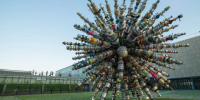
For one artist, the ugly and the beautiful are equivalent concepts. In 2018, designer and artist Choi Jeong Hwa featured an exhibition titled 'Alchemy' at The Artling where he uses recycled and non-biodegradable materials in his work that he has been collecting for 30 years, such as household trash, glass, and steel. 'Dandelion' is one of his masterpieces installed in the outdoors in Seoul, South Korea.
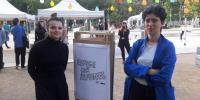
Greenpeace advocates displayed a banner outside of the Ministry of the Environment in Warsaw. The banner reads "I love primeval forests" to protest against tree felling in Bialowieza Forest.
Protesters dressed as construction workers wearing hard hats and scaling the Ministry of the Environment building on harnesses.
Two design students were awarded the Futurapolis prize last Wednesday for their project to adapt the Furan (underground river) , a response to the migration crisis.
New Zealander artist George Nuku has presented his latest work as an installation that imagines the state of the world's oceans 100 years in the future where plastics have totally changed the marine environment.
Maryland Hall, in partnership with the Banneker Douglass Museum and Maryland Commission on African American History and Culture, invited Maryland-based Black artists, whose work encapsulates activism and social justice and using the creative process to educate their audiences about diversity, equity and inclusion to send proposals to take one of six 5 ft.
A Richmond, VA.-based activist group called Indecline has recently installed a street art resistance installation of several hung clown figures dressed like the KKK from a tree in Richmond’s Bryan Park.
In the Si 8 Do project, Seville activists convened in a neglected barrio during the Euromediterranean Conference on Sustainable Cities, which was taking place in Seville.
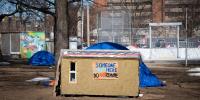
On his way to work on a construction site, Khaleel Seivwright surveyed the growing number of tents lining an intercity highway and in parks with increasing discomfort. How would these people survive Toronto’s damp, frigid winters, let alone the coronavirus, which had pushed so many out of overcrowded shelters?
He remembered the little shanty he had once built out of scrap wood while living on a commune in British Columbia.
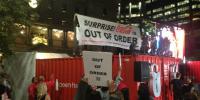
In March 2013 we started a grassroots boycott movement against Coca-Cola for exploiting legal loopholes to kill off container deposit recycling in the Northern Territory. We simply used the same successful strategy as the ANZ Out of Order action, putting out of order signs on Coca Cola vending machines and posting the photos on social media.
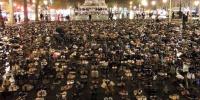
Thousands of empty shoes replace marchers at cancelled climate protest in Paris
After French authorities cancelled two climate protests in the wake of the Paris attacks, thousands of would-be marchers kept empty shoes in their place.
The moving installation coincides with the COP21, a climate summit of 195 UN nations in the French capital.
The protest was called by Avaaz
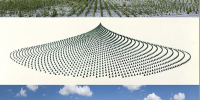
Denes's project "Tree Mountain-A Living Time Capsule" in Finland is a monumental earthwork involving the planting of 11,000 trees by 11,000 people on a reclaimed gravel pit. It's designed to grow over the next 400 years, serving as a testament to environmental stewardship and the potential for regeneration.
Five leaders of British political parties called for dramatic action to confront climate change in a televised debate on Thursday, just two weeks before the country’s general election.
A melting ice sculpture stole the show.
If you're a bibliophile you'll get a kick out of the car-turned-library that can be found in Buenos Aires, Argentina. Artist Raul Lemesoff took an old 1979 Ford Falcon, a popular mode of transport amongst the military forces of its time, and transformed it into a mobile library shaped like a tank.
#NYTIMES Why are there no U.S. anti-slavery monuments? http://antislaverymonument.org project is an answer.
Standing 60 feet tall, corten steel of two hollow chain links the upper one broken.
The protagonism of the body in the dramatization of marginalized groups is also central to Emilio García Wehbi's Proyecto Filoctetes, an urban intervention staged November 15, 2002, on the streets of Buenos Aires. The project consisted in placing twenty-five lifelike latex mannequins in central, highly trafficked locations around the city in varying positions of injury, physical distress, and abandonment.
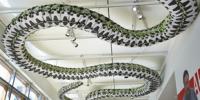
On May 12, 2008, a massive earthquake in China’s Sichuan province killed approximately 90,000 people. Ai Weiwei created this serpentine sculpture, made of backpacks, to commemorate the more than 5,000 school children who were killed when their shoddily constructed schools collapsed.
They are disparaged as “free-willed” women, “stubborn,” “picky,” “incomplete.”
But a video by an East Asian beauty brand that went viral over the past week has upended the conversation on China’s sheng nu, which translates literally into “leftover women” — those who happen to be over 27 and unmarried.
“People think that in Chinese society an unmarried woman is incomplete. You feel like an outsider,” says one young woman.