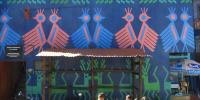
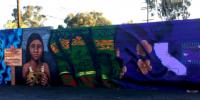
Nestled on the banks of Lake Atitlán in Guatemala, Santa Catarina Palopó is a small town brimming with vibrant colors and stunning natural views. Despite its natural beauty and cultural heritage, the community struggled with economic development and poverty for years until they had the opportunity to harness the power of art and transform the town.
An early representation of Nara’s strong stance against nuclear weapons, No Nukes is now synonymous with the antinuclear protest movement. The work is painted over a promotional poster for bossa nova musician Vinicius Cantuária’s Amor Brasileiro (1998) among other printed ephemera.
The Wuming Painting Collective, formed in Beijing during the Cultural Revolution (1966–1976), was a clandestine group of artists who defied the authoritarian control over art and expression. In a time when all art was harnessed as propaganda to glorify the state and Chairman Mao, Wuming artists turned their gaze toward everyday life, painting still lifes, street scenes, human figures, and most iconically, serene landscapes.
In her 2021 graduation project from the Central Academy of Fine Arts (CAFA), Chinese performance artist Zou Yaqi staged a provocative social experiment titled “21-Day Survival Challenge.” For three weeks, Zou assumed the persona of a wealthy socialite, using counterfeit luxury items, strategic self-presentation, and social engineering to access elite spaces in Beijing—such as five-star hotel lobbies, first-class airport lounges, and high-end restaurants
Eight years after his death, the annual August Wilson Monologue Competition provides high school students from around the country an opportunity to carry on the African-American playwright’s legacy. That legacy includes Pulitzer Prizes for “Fences” and “The Piano Lesson,” two installments of Wilson’s 10-play series set in his hometown of Pittsburgh that examined 20th-century black life through the personal and political struggles of everyday people.
The Bruce High Quality Foundation University (BHQFU) is an unaccredited, free collaborative school founded by the eponymous artist collective and presented by Creative Time.
On a drizzly, overcast afternoon, all is quiet at the intersection of Bartholomew and Prieur streets in New Orleans’ historic Ninth Ward. The quiet neighborhood around the Ellis Marsalis Center for Music (EMCM) feel worlds away from the historic French Quarter packed with jazz clubs, bars, restaurants, and markets.
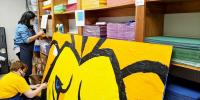
For the past 20 years, Great Bend school district art teachers have been letting their students collaborate on an art project at the Barton County Historical Society Museum. This year, they will ground their efforts in working together to make a mural. Their teachers are trying to instill the fact that art builds community, as it has here for the past two decades.
For weeks, 14 giant balloons had been mysteriously parked in front of the Sidra Medical and Research Center, a hulking steel, glass and white ceramic building devoted to women’s and children’s health that is to open on the outskirts of this city in 2015.
Multimedia
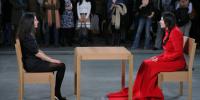
Marina Abramović is the synonym for performance art. Throughout their career, she has constantly pushed her way through endurance art and further pushed the boundaries of the artist's role in the audience. One of the most compelling and exciting works is "The Artist Is Present," which she presented at the Museum of Modern Art in New York.
"Myanmar has been engulfed in protest since February 1, when Burmese army general Min Aung Hlaing seized control of the government in a military coup, refusing to accept to the landslide election victory of the National League for Democracy and its leader, Aung San Suu Kyi.
In “Speech/Acts,” a group exhibition organized by Meg Onli at the Institute of Contemporary Art in Philadelphia, Kameelah Janan Rasheed and Tiona Nekkia McClodden stood out as artists who take up voices, histories, and experiences that can help audiences move forward and endure in the future.
Shirin Neshat’s Women of Allah is a photographic series exploring the complex identities of Muslim women in post-revolutionary Iran. Combining black-and-white portraits, Persian calligraphy, and symbolic elements such as guns and veils, Neshat interrogates themes of martyrdom, violence, femininity, and resistance.
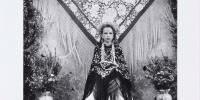
The artist I chose to focus on personally is the photographer Cristina Garcia Rodero. I used photos from her photography essay España Oculta, in which Rodero traveled to small villages in Spain to document the resident’s lives. Our group's main focus is on gender issues, and I personally wanted to focus on activism involving women and representation. Rodero uses photos of rituals and activities among those outside of the majority population.
Both shows are supported by funds from New York State Council on the Arts, New York City Department of Cultural Affairs in partnership with the City Council, and Materials for the Arts (MFTA).
"Printing Lost Culture of Ukraine" November 13 – December 15, 2023
Monday – Friday, 10 am – 7 pm, free admission
Ukraine House New York, 360 Merrick Road, 3rd Floor, Lynbrook, NY 11563
Indigenous people in Minneapolis supporting Black Lives Matter cite similar struggles
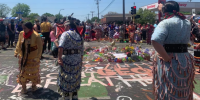
Jingle dress dancers held a ceremony at the intersection of 38th Street and Chicago Avenue in Minneapolis on Monday, the place where George Floyd was killed by police last week.
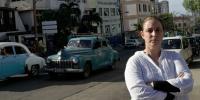
MEXICO CITY — Of the half-dozen pieces that form Tania Bruguera’s series “Tatlin’s Whisper,” the one that the Cuban government silenced may have resounded most.
Our City is a startup nonprofit based in Oakland and working with cities everywhere. They work with governments, cultural institutions, companies, community organizations, designers, and residents to produce
events, installations, and workshops that use public design to improve cities.
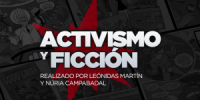
A television report written, directed and produced by Enmedio members Leónidas Martín and Xavier Artigas. Collective projects that see art as a kind of social relationship. Artistic interventions that target consumption, media guerrilla tactics, creative mobilisations and protest, critical projects brimming with humour and disobedience, new narratives capable of changing the existing symbols and codes.
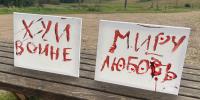
These two works on canvas were made with my own blood, using the severed distal phalanx of my index finger as the painting instrument. They are connected to my solo anti-war action in Copenhagen in September 2026.
Their central messages are “No to War!” and “Peace & Love!” The index finger—the finger used to pull a trigger—became the central symbol of my refusal to participate in aggression and the killing of other people.
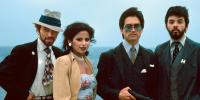
Beginning in the early 1970s, the Los Angeles-based multi-media arts collective Asco (from the Spanish word for nausea) created performances, street theater and conceptual art that satirized the emerging styles of Chicano art and pushed the boundaries of what it might encompass.
Cheril Linett is a female artist from Chile, with a background in performance art and stage performance, who primarily focuses her artwork on feminist issues in Chile, especially ones involving violence, murder, hate crime and different kinds of oppression and assault, but also creates artwork reflecting issues in other parts of Latin America.
Horror stories about treacherous boat journeys from Africa to the Mediterranean far too often make headline news. The men, women and children fleeing their homes to start a new life in Europe become faceless numbers in the media, and are ‘othered’ by conservative politicians for their own agenda.
(Honoring our Origins, Ourselves and our Dreams) is an all-womyn and womyn-identified crew from the northeast San Fernando Valley dedicated to creating awareness through public art.
On 6 January 2012, Metrópolis (TVE 2) broadcast "Activismo y Ficción", a report directed by Enmedio members Leónidas Martín and Núria Campabadal. It looks at a series of creative projects that lie somewhere between fiction and social activism.