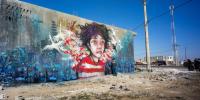
Following on from Ruben Shanchez's mural on the Syrain boader, we head back to the same subject with Awareness & Prevention Through Art (AptART) is a not-for-profit organisation that aims to give vulnerable children an artistic experience with an opportunity to express themselves as well as an outlet to build awareness and promote prevention about the issues that affect their lives.
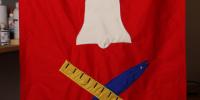
Trade School is a self-organised, alternative learning space that runs on barter. It was started in 2010 in New York’s Lower East Side by Rich Watts, Louise Ma, and Caroline Woolard of OurGoods.org, a creative barter network. Over 800 students participated in 76 single-session classes during 35 days. Anyone can teach a class, and students sign up by agreeing to meet the barter requests of teachers.
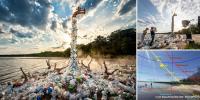
Benjamin Von Wong’s latest art-as-activism installation looks like something Photoshopped onto reality. A large brass-looking faucet, suspended in the air, pours a river of plastic out of its spout.
I Will What I Want is a campaign launched by Under Armour which speaks to women who do not wait for permission or affirmation in order to go after what they want. The campaign highlights various models and athletes who encourage women to tune out society's standards and pursue their dreams. The campaign began by highlighting Misty Copeland, a soloist at the American Ballet Theater.
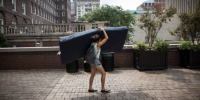
Mattress Performance (Carry That Weight) (2014–2015) was a work of endurance/performance art which Emma Sulkowicz conducted as a senior thesis during the final year of a visual arts degree at Columbia University in New York City.[1]
In May of 2011, tens of thousands of people crowded Puerta del Sol in the center of Madrid in the most visible manifestation of sit-in protests against austerity and corruption. 15-M was an expression of the devastating effects of the 2008 recession, which harshly affected the middle class and condemned millions of people to poverty because of the crash of the housing bubble (Altares, 2021).
Shackles. Cotton. The Big House.
Americans tend to think of slavery in terms of chattel slavery. Plantation Slavery. Slavery where human beings are bought, sold, and owned. The kind outlawed in the United States by the Emancipation Proclamation in 1863.
Slavery as a relic of the 19th Century.
“Six of us lived, worked, slept in a 10-by-10 (foot) room without a bed, bathroom, or clean water,” Nasreen Sheikh remembers.
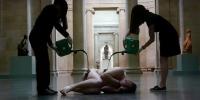
March 20, World Sleep Day is approaching, Chongqing Fuling wine town square placed 2 transparent sleep house, staff in the form of performance art to call on people to "put down the phone, sleep at ease". It is reported that the purpose of World Sleep Day is to make people pay attention to the importance of sleep and sleep quality, to remind people to pay attention to sleep health and quality.
José Bové, a sheep farmer/activist in Aveyron in the Midi-Pyrénées region of France, is a modern day Astérix, a mythical Gaul who drubbed foreign intruders centuries ago. In Bové's case, the intruder was McDonald's, the American fast food chain.
Is there a way to make sex ed, big, scary, nasty, icky, sex ed, fun again? In the Spring Quarter of of 2013, UCLA students in the Sex Squad, a performance troupe dedicated to injecting a dose of humor into high school sex education, set out to answer that question through a series of short videos.
Human rights activism relies on an ability to tell stories to diverse audiences that will inspire action toward justice. Distributing information through journalism, whether it be traditional or new media, is the standard method of raising awareness. Globalization and the movement of people means that activists and artists from affected communities may cooperate to mutual benefit and find new audiences in the process.
Without water, life would not exist. And yet, those of us in developed countries take it for granted; our shelves are stocked with hundreds of branded bottles, and it is freely given at restaurants, at schools, and even in parks. We seem to have an unslakable thirst for it; attained in excess, we throw it away like dirt—just as many developing countries liken its value to gold.
It’s not easy to stop the construction of natural gas pipelines, but several years ago the ecological artist and activist Aviva Rahmani came up with an ingenious idea: what if you could protect threatened landscapes by turning them into art?
Thousands of animal rights activists marched against a draft law on Sunday that would make changes to Turkey's Animal Protection Law No. 5199, seeking to introduce practices currently used in other countries such as collecting stray animals from the streets and euthanizing members of the “excess” population.
There are no whistles, no loud speakers, and no placards held up high in this quiet act of subversion. Pimsiri Petchnamrob stands silently in a mass of sharply dressed Bangkok commuters, her hands clutched around a copy of George Orwell's 1984.
Next to her a small group of young men and women, their faces sombre and their heads bowed low, also read books about fictional and real totalitarian worlds in silence.
"Operation Paydirt is a multidisciplinary, artist-driven project advancing a solution to the devastating problem of lead (Pb) contaminated soil that puts thousands of children at risk for severe learning disabilities and behavioral problems. The goals of the project are to raise awareness of the issues of lead and to create a model for making cities lead-safe across the United States.
Spanish organization the ANAR Foundation (Aid to Children and Adolescents at Risk) releases a campaign that takes advantage of the process of lenticular printing to send an offer of help to abused children without alerting their abusers, even if they’re walking together.
Lenticular printing is a process that allows for different photos to be seen depending on the angle the image is viewed from.