Shortly after the events of 9/11, a group of NYC women came together in protest of the Bush Administration's use of the terror attacks to justify war. Seeking out a new form of political protest, the women decided to respond to what they believed were the absurd reactions of Bush by attaching paper maché missile "dicks" and demonstrating in public.
Oakland-based artist-activists Melanie Cervantes and Jesus Barraza teamed up to form Dignidad Rebelde, a graphic arts collaboration working for social change. They believe that art can be an empowering reflection of
community struggles, dreams and visions, and following principles of
Xicanisma and Zapatismo, create work that translates people’s stories
The Dinner Party, an important icon of 1970s feminist art and a milestone in twentieth-century art, is presented as the centerpiece around which the Elizabeth A. Sackler Center for Feminist Art is organized. The Dinner Party comprises a massive ceremonial banquet, arranged on a triangular table with a total of thirty-nine place settings, each commemorating an important woman from history.
There have now been ten coordinated 40 Days for Life campaigns since 2007, mobilizing people of faith and conscience in 440 cities across the United States and Canada, plus cities in Argentina, Armenia, Australia, Belize, Denmark, England, Georgia, Germany, Ireland, Northern Ireland, Poland, Puerto Rico and Spain.During these unified efforts, participants witnessed countless blessings from God:
Creative Time, Social Practice Archive: In 1989 actress/writer Rhodessa Jones was conducting classes at the San Francisco County Jail. Working with female inmates, she developed material for a performance piece called Big Butt Girls, Hard-Headed Women based on their lives and shared experiences.
The work of South African artist Mary Sibande tells the tale of her alter-ego Sophie, a domestic worker who finds refuge in dreams where she emancipates herself from the ghoulish realism of an ordinary existence, cleaning other people's homes.
Exploring the construction of identity within post-apartheid South Africa, Sibande's work probes the stereotypical contextualisation of the black female body.
On Tuesday, May 8, in the midst of final exam week, a group of female first-year students performed a public art action at UC Berkeley to call attention to the UC Regents’ privatization of what was once the premier public university in the country.(See photos below)
We have learnt that Barbie’s body is literally unattainable, but in a role reversal, Pennsylvania-based artist Nikolay Lamm shows us what Barbie would look like if she had the body of a real woman.
Using the measurements of an average 19-year-old woman, Lamm created a 3D model, which he photographed and compared next to a standard Barbie doll.
According to the Daily Mail, it reported that Lamm’s 3D model looked “a lot more natural”.
In May, the horrific mass shooting in Isla Vista, CA, triggered national conversations about violent misogyny. After some Twitter users began using the hashtag #NotAllMen to defensively derail the conversation, the hugely popular hashtag #YesAllWomen emerged, getting tweeted over 1 million times within just a few days.
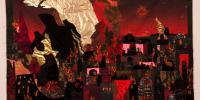
Mending Baghdad is a four-and-a-half-by-six-and-a-half-foot quilt memorializing Baghdad as it looked during the American bombing on the first nights of the Iraq war. The purpose of the project is to bring people together to do something symbolically curative for Iraq. The artist, Clare Wainwright, worked up the image in about two days, but left it deliberately unfinished.
Yumi Ishikawa, a Japanese actress, freelance writer, and part-time funeral parlor worker, started the #KuToo Movement because she feels it’s unfair she has to wear heels at work. She also feels that being required to wear heels is rooted in a cultural problem, one much deeper than physical discomfort.
A video collaboration betweenHayley Silverman and Emily Shinada. Using clips from a Japanese pornography film, the video highlights fears of interpersonal connection and explores the objectification of women. It was on view at Alogon Gallery for theWomen Get Fucked exhibition.
Artistic Activist, Charlotte Claire, is at the forefront of initiating revolutionary change in mental health care. Her project, The Babyfacedassassin, is dedicated to improving mental health care and inspiring people to care for their mental health.
Shake Girl is a massive collaborative effort between fifteen students and two instructors over the course of one quarter (Winter 2008). These students comprise the first edition of the Stanford Graphic Novel Project -- a group dedicated to acheiving this monumental task on an annual basis.
The bruised and beaten faces of these beautiful Hindu goddesses have an important point to make -- that despite the reverence for women that is a part of Hinduism, India's most populous religion, the country has become extremely unsafe for its female citizens.
A beauty contest for landmine victims challenges normal concepts of beauty. The search for beauty takes many forms. The traditional beauty pageant might be thought to be one of the less acceptable, concentrating as it does on conventional ideas of female perfection. Miss Landmine is a challenge to normal concepts of beauty. It is a beauty pageant held in Angola, a country ravaged by war and its aftermath, for women who have lost limbs from landmines.