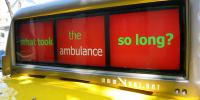
Taxi is a car with a digital advertising sign attached to the roof. Linked to a global positioning system, the message changes relative to the car's location, addressing specific neighbourhoods, addresses, and audiences. The technology can target an area as small as a square block. Haha solicits messages through email list serves and through direct contact with various groups throughout the city.
Artist Michael Landy catalogued, inventoried, and systemically destroyed all of his possessions for the 2001 public installation Break Down, commissioned by British arts organization Artangel. It took him three years just to itemize the 7,227 objects included in the project.
Spearheaded by Latitude Artist Community, Project Easy Access Lexington (PEAL) organized team 'Bricksquad' to help make the sidewalks and streets of downtown Lexington, KY more wheelchair accessible. Armed with only a canvas bag of few bricks, sand, and some tools the teams would make their way through the sidewalks restoring bricks as needed. The damage to the sidewalks was such that the gesture was symbolic more than effectual initially.
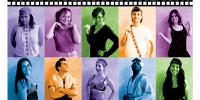
Is there a way to make sex ed, big, scary, nasty, icky, sex ed, fun again? In the Spring Quarter of of 2013, UCLA students in the Sex Squad, a performance troupe dedicated to injecting a dose of humor into high school sex education, set out to answer that question through a series of short videos.
alternating yellow and white chalk on black blank subway advertisement spaces.
"NO ONE VOTED FOR ELON"
"RISE AND RESIST"
"RESISTANCE IS CONTAGIOUS"
"WHO WILL SAVE US? WE WILL SAVE US"
found on the uptown C train platform at 50th street station. found on february 9, 2025.
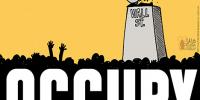
After collecting street art and memorabilia from "Occupy Wall Street" since the fall of 2011, the Smithsonian National Museum of American History has lent its collection of Occupy Wall Street posters to Wesleyan's Davison Art Center. The posters will make up an exhibition entitled “Artists Take Action: Protest Posters Today,” which is on display in the University's gallery from April 5 to May 26.
Zimmerman a composer who uses art, dance, tech, and even robots in his shows. You might call this interdisciplinary. Wagner called it total art, or gesamtkunstwerk.
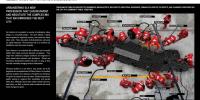
Whose job is it to create a city? Our intention is to jumpstart a new profession that can re-invent and negotiate the complex mix that encompasses a city. We have defined a radical new occupation to regenerate, pioneer, and sustain the future urban realm. These innovative multi-disciplinarian advocates are called Urbaneers. Their immense task is to manifest and facilitate the next expression of city across the globe.
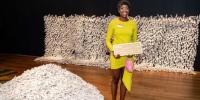
The purpose of this project was the permeate stock images with more depictions of Black people. Stock images are usually easily found and utilized, showcasing people doing everyday activities or scenes. To boost representation of Black people in this particular image field, were left out, so the artist chose to recreate popular stock images with Black models to showcase representation and shed light on the lack of diversity in these photos.
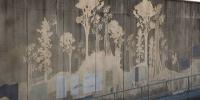
Reverse graffiti is form of street art that involves carving into the dirt and dust that surrounds us. Artists subtract from a surface in order to create a negative image within the positive, often quite dark layer of grime.
This weekend marks the one-year anniversary of Donald Trump's inauguration. It also marks the one-year anniversary of the Women's March his election inspired, the largest single-day protest in the nation's history.
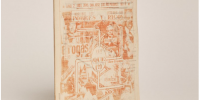
"Las Carpetas looks at the bureaucratic residue of a 40-year-long secret surveillance program that aimed to destroy the Puerto Rican Independence Movement. Through still-lives, archival appropriation, and investigation, Christopher Gregory-Rivera provides a counter-history to the way many understand this period of time and its aftermath.
“Mapping skin deep” is an audiovisual public installation consisting of portraits with testimonies from refugee/undocumented immigrants currently residing in Montreal and elsewhere. Their bodies have been scarred in post-production tracing the route they took from their homeland to Montreal, hence mapping them skin deep.
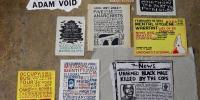
The prints exhibited June 2013 at Firestorm in Asheville NC, will comprise two separate bodies of work; Chelsea Ragan’s combination screen print / woodblock print / painting / drawings graphically detail police shootings of young black males from across the country, and Adam Void’s hand-painted screen prints state the facts of important national news stories that have been swept under the rug of mainstream corporate media.
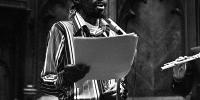
Julius Eastman was a Black and Queer avant garde, minimalist composer and performer from the 1960s-1980s. He used his platform to advocate for the rights and livelihoods of Black and queer people through his unique musical aesthetic and the controversial naming of his pieces, including "Gay Guerrilla," "Evil N-word" and "Crazy N-Word"
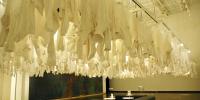
NORTHFIELD, Minn. — Exactly 1,281 white garments hang from the ceiling of the Perlman Teaching Museum’s Braucher Gallery. The collared shirts, knit sweaters, tights, and other items of clothing glow with an eerie luminosity.
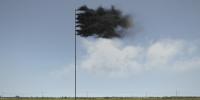
Western Flag depicts the site of the 'Lucas Gusher' - the world's first major oil find - in Spindletop, Texas in 1901, now barren and exhausted. The site is recreated as a digital simulation the center of which is marked by a flagpole spewing and endless stream of black smoke.
Highlights:
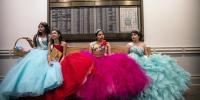
A handful of teens donned puffy quinceañera dresses to protest against the “sanctuary cities” ban.
The teens gave paper flowers to lawmakers who voted against SB 4 and flyers to those who voted in favor.
Texas teens took part in a quinceañera-themed protest on the south steps of the Capitol to voice their opposition to Senate Bill 4, the so-called sanctuary cities ban.
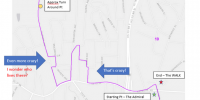
Runners and walkers planning to take part in a 5K race in Asheville early next month might do better with a compass — a well-tuned political compass, that is.
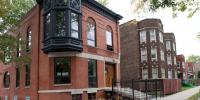
Black Cinema House hosts screenings and discussions of films by and about people of the African diaspora, and offers video classes to neighborhood youth, teaching the next generation to make their own films and tell their own stories.
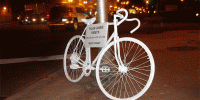
Ghostbikes.org is intended to be a site for the worldwide cycling
community where those lost on dangerous streets can
be remembered by their loved ones, members of their local communities,
and others from around the world. They also hope to inspire more people to
start installing ghost bikes in their communities and to initiate
changes that will make us all safer on the streets.