The Green Belt Movement (GBM) was founded by Professor Wangari Maathai in 1977 under the auspices of the National Council of Women of Kenya (NCWK) to respond to the needs of rural Kenyan women who reported that their streams were drying up, their food supply was less secure, and they had to walk further and further to get firewood for fuel and fencing.
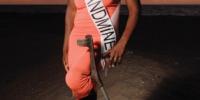
A beauty contest for landmine victims challenges normal concepts of beauty. The search for beauty takes many forms. The traditional beauty pageant might be thought to be one of the less acceptable, concentrating as it does on conventional ideas of female perfection. Miss Landmine is a challenge to normal concepts of beauty. It is a beauty pageant held in Angola, a country ravaged by war and its aftermath, for women who have lost limbs from landmines.
Fespaco is a meeting place put to good use to promote the development of black cinematography. From 1973, topics of discussion are introduced at each edition.
Established Cape Town based artist Brett Murray returns to Goodman Gallery Johannesburg with Hail to the Thief II. This body of satirical work continues his acerbic attacks on abuses of power, corruption and political dumbness seen in his 2010 Cape Town show Hail to the Thief.
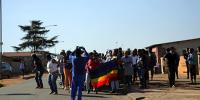
Toyi-toyi is a Southern African dance originally from Zimbabwe by Zimbabwe People's Revolutionary Army (ZIPRA) forces that has long been used in political protests in South Africa.
Toyi-toyi could begin as the stomping of feet and spontaneous chanting during protests that could include political slogans or songs, either improvised or previously created. Some sources claim that South Africans learned it from Zimbabweans.
Activist Boniface Mwangi on confronting corruption in his homeland, and director Sam Soko on recording his campaign
Kenyan director Sam Soko’s debut documentary feature, Softie, opens with the film’s protagonist, Boniface Mwangi, sourcing 1,000 litres of pigs’ blood. “I’ve found a van for you. When do you want it? When are you getting the blood?” Mwangi asks.
Godfrey Mwampembwa, popularly known as Gado, has been holding politicians accountable for nearly 30 years. Now, his concern has shifted to the coronavirus.
In a quiet office on the third floor of a building in Nairobi’s central business district, the cartoonist known by his pen name, Gado, was sketching a satire about the coronavirus.
At the age of just 30, Palesa Ngwenya is helping transform these areas through her position as development coordinator of Maboneng Township Arts Experience. “We turn homes in the townships into art galleries,” says the young South African woman, who grew up during apartheid. “It’s about showing people that you can use what you have to do things that can change your life."
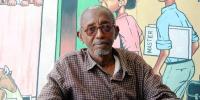
“I want to show the people how bad the troubles were," says artist Muhiyidin Sharif Ibrahim of Mogadishu, Somalia. "That’s the message we’re going to send to people.”
(Robyn Dixon, Los Angeles Times)
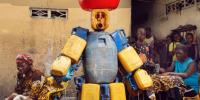
“So dramatic, so strong, so visual,” artist Stéphan Gladieu said of his first encounter with the revival of an ancestral folk art movement in Kinshasa, Democratic Republic of Congo. Kinshasa is the capital of Congo but also one of the many places American and European countries send their waste.
In her curatorial project Making Way, Ruth Simbao brought together works that complicated the idea of globalization’s effect on African nations, especially the idea that the new phase would usher in an almost frictionless movement of labor and capital across borders. Works by artists like Athi-Patra Ruga reflected on questions of how bodies moved through settler colonialist spaces.
The city of Douala in Cameroon had a huge problem associated with malfunctioning water drainage systems. This is due the fact that in many illegally constructed areas of the town, the sewers are without cover, and after heavy rainfall, this would generally lead to floods and related threats to public health.
SUNO is one of the few luxury fashion brands that has been born out of a social cause. Max Osterweis and designer Erin Beatty launched their first collection in the spring of 2009, " after post-election violence threatened to damage the economy and industry in Kenya."
While the clothes is mostly produced by local artisans in Kenya, Suno has since expanded its business to include production in Peru, India, and NY.
Kokumo, pronounced "koh-koo-mah", is a trans gender activist whose very name embodies her bold path of resistance. Taken from the West African dialect Yoruba, Kokumo means "this woman will not die." Kokumo chose her name in response to constantly being told that she would die of AIDS while growing up.
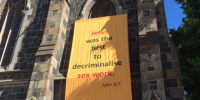
A big yellow banner hangs off the Central Methodist Church in Cape Town, South Africa proclaiming that *"Jesus was the first to decriminalise sex work - John 8:7"*
On April 15 in northern Nigeria, 200 school girls aged 15-18 were kidnapped by an extremist Muslim group called Boko Haram, whose name in the Hausa language means “Western education is a sin.” In hopes of viral pressure on Nigerian authorities to try to recover the girls, campaigns have started on the White House website, on Change.org and on Facebook to demand: “Bring Back Our Girls.” The campaigns quickly gained global attention, with Michelle Obama,
Not far from the Burkina Faso capital of Ouagadougou, approximately 30 kilometers, lies Operndorf Afrika, a village that’s governed by art and a global exchange of culture.
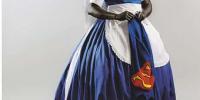
The work of South African artist Mary Sibande tells the tale of her alter-ego Sophie, a domestic worker who finds refuge in dreams where she emancipates herself from the ghoulish realism of an ordinary existence, cleaning other people's homes.
Exploring the construction of identity within post-apartheid South Africa, Sibande's work probes the stereotypical contextualisation of the black female body.
ONGOING ORGANIZATION:
CALLED: Iranti [pronounced írantì] is the Yoruba word for ‘memory’. Largely found in South West Nigeria and parts of Benin Republic, the Yoruba people consider memory a prized form of intelligence which determines how often one remembers what they see and hear.
VOA NEWS March 29, 2012 By Nico Colombant
WASHINGTON--A Sudanese artist from the restive Blue Nile region is using art and activism to promote the plight of people caught between borders and conflict.
In an audio montage of memories from refugees, the sounds of gunfire and explosions mix with crying babies. Narrator Michelle Orecchio describes how to reverse war's grip on so much of humanity.
Drama Queens Ghana's “MoonGirls” is an Afrofuturistic graphic novel series. Through an Afrofuturistic lens, “MoonGirls follows the adventures of 4 African "supersheroes" with varying superpowers to save the world from a diverse range of forces; from patriarchy, rape culture to pollution and global warming.
Photographer Thapelo Motsumi is one of many young South Africans who has worked with the Umuzi Photo Club to develop his artistic skills and engage his community. Now this “drop out” has had two exhibitions in London and has been entrusted with Mandela’s football jersey. By GREG NICOLSON.
As local rapper Naty says, a group of young people are intent on making their mark in Madagascar's cultural history. From gifted slam poet Caylah to inventive visual artist Temandrota and a crew of entrepreneurial skateboarders, a generation of young Madagascans are making space for creative projects.They are inspiring in their enthusiasm and hopeful for the future despite the poverty in their country and its colonial past.