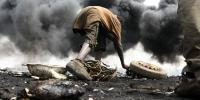
Over the course of 3 years, from 2006 until 2009, the production team behind the film Wasteland (2010), also known as "Lixo Extraordinário" followed Brazilian, Brooklyn-based mixed-media artist, Vik Muniz, as he traveled back to Brazil to create self portraits with the catadores (tr. garbage pickers) of Jardim Gramacho, one of the largest city dumps in the Americas.
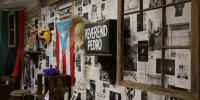
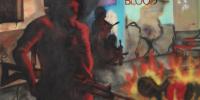
Spread over three institutions — the Bronx Museum of the Arts; El Museo del Barrio in East Harlem; and Loisaida Inc., a cultural center in the East Village — this show departs from straight political history by presenting the Young Lords as a cultural phenomenon as well as an ideological one, with a highly developed instinct for visual self-projection, right down to having an official party photographer, the gifted Hiram Maristany.
Alexandria "Lexi" Aniyah Rubio was looking forward to playing volleyball when she got to junior high. She dreamed of going to law school one day, and she loved astrology, butterflies, and the color yellow.
This installation of 13 photographic self-portraits explores European-American heritage, my family and their role in the history of racism, colonization, genocide, and classism. The ancestors, real and imagined, span over 2000 years from the Celtic Iron Age to the present day. The life size portraits are accompanied by audio diaries from the perspective of each character.
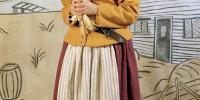
In July and August 2013, O Teatrão, a Coimbra based theatre company, presented the project Arruinados, comprising three theatre performances in three abandoned spaces (‘ruins’), one in each of three cities in the Centre region of Portugal located along the Mondego River:Coimbra, Montemoro Velho, and Figueira da Foz.
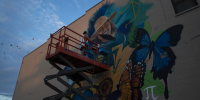
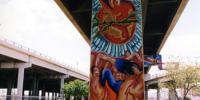
In El Paso more than 100 murals have been painted since the mid-1960s. The murals, located throughout the city's various corridors, often depict themes common to Chicano muralism, such as mestizo heritage or social problems, but they also tell unique stories about the "merging of ideas, cultures, and dreams" along the United States-Mexico border.
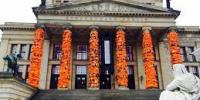
Chinese artist Ai Weiwei covered a Berlin landmark with thousands of refugee life jackets for his latest installation. The striking display was the activist's attempt to highlight the scale of migrants taking to the seas every day.
New York Times, DAVID FIRESTONE, Published: December 31, 1993
Your son tears the wrapping paper off his fierce new "Talking Duke" G. I. Joe doll and eagerly presses the talk button. Out comes a painfully chirpy voice that sounds astonishingly like Barbie's saying, "Let's go shopping!"
Does your son:
A) Furiously vaporize the doll with his own phaser rifle?
B) Go shopping with Joe?
Two pairs of dusty, pastel-orange roller skates. A ram's skull. Several meters of tangled, bright red rope. They aren't the sort of items you'd find in the great fashion houses of Europe or on North American catwalks.
But, for unconventional Chinese designer and performance artist Wan Yunfeng, they are perfect.
From his small apartment in eastern Beijing, Wan makes fashion that only he wears.
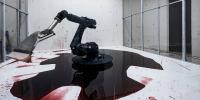
In 2016, the Guggenheim Museum commissioned its very first robotic artwork called Can’t Help Myself (Wannmann, 2016). The artwork is created by two of China’s most controversial artists Sun Yuan and Peng Yu and can be described as a robotic arm that has one specific, life-long duty: to prevent the deep-red, bloodlike liquid, which constantly oozes outwards, from straying too far (Weng, n.d.).
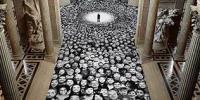
After winning the TED Prize on March 2, 2011, the French-artist JR launched the Inside Out Project, in his first TED Talk. Using his own artistic practice as inspiration, this participatory platform helps individuals and communities to make a statement by displaying large-scale black and white portraits in public spaces. Through their “Actions,” communities around the world have sparked collaborations and conversations.
In response to Spain's increasingly restrictive legislation limiting access to abortion in the country, a group of art activists known for their bold, disruptive flair are taking action.
The collective Ndaku Ya La Vie Est Belle, a group of Kinshasa street performers turn their bodies into living sculptures, and use them to political ends. Among the artists is Jared, who regularly takes to the streets dressed as Robot Annonce. The costume, made from broken radio parts, is designed to raise awareness of fake news. “People receive so much incorrect information and many inaccuracies are spread. I want to fight this,” says Jared.
Huff Post Latino Politics
The Huffington Post
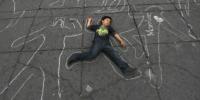
While drug-related deaths continue to escalate as the Mexican drug war wages on, Mexican youth have resorted to peaceful and artistic forms of protest against the violence.
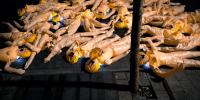
Last Sunday, activists met on Mexico City's Zocalo Square in an effort to demonstrate against the war. They covered the public space with chalk outlines of human bodies.
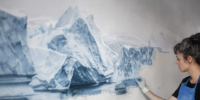
On this International Women’s Day, we wanted to celebrate the commitment of a very special human being. Her name is Zaria Forman, a leading artist in contemporary art with a cause. She is not only an exceptional human being; she is also an incredible American drawer who uses art to convey the emergency of climate change.
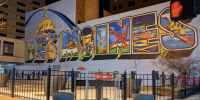
Caucus-goers in Des Moines will arrive to a disturbing sight on Monday, with dozens of chain-link cages appearing to hold migrant children cropping up across the city overnight.
In the 1980s, Holzer and Lady Pink used New York as a backdrop for their artworks: Holzer wheatpasted posters and slogans on walls throughout Manhattan, and Lady Pink spray-painted graffiti on buildings and subway cars. The two also collaborated on a series of paintings on canvas, such as this work, for which Holzer composed phrases and Lady Pink did the painting.
Located off the west coast of Scotland are the Outer Hebrides, an island chain where Finnish artists Pekka Niittyvirta and Timo Aho decided to install their piece, Lines. The installation is composed of lines of light wrapped around buildings or hovering on a grass field. At high tide, the lights turn on, illuminating the serene landscape, and marking the height of future sea-level rise on the low-lying archipelago.
TED TALK:
I consider it my life's mission to convey the urgency of climate change through my work. I've traveled north to the Arctic to the capture the unfolding story of polar melt, and south to the Equator to document the subsequent rising seas. Most recently, I visited the icy coast of Greenland and the low-lying islands of the Maldives, connecting two seemingly disparate but equally endangered parts of our planet.
Carlos Hernández Chávez is a Mexican-American muralist who brings the spirit of 20th-century Mexican muralism into modern New England. Chávez’s murals address key social justice themes, including immigration, workers’ rights, and cultural identity, challenging viewers to acknowledge and reflect on pressing societal issues.
The image is stark. And shocking.
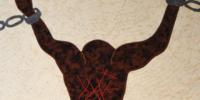
A black man, his ankles shackled, his head hanging away from the viewer, stands in relief on a field of white. Chains stretching to the image's borders on the left and right pull his arms taut. Fourteen crimson marks crosshatch his back. Within the dark fabric that frames "86 Lashes to Go," a small rectangle is labeled simply "salt."
Forensic Architecture's Cloud Studies is a project that investigates the impact of toxic clouds on colonised and oppressed communities. The clouds, originating from sources like tear gas, industrial emissions, chemical weapons, and forest fires, often go unaddressed due to doubt and denialism.
Dan Perjovschi is one of Romania’s foremost artistic voices. Although known as a talented multi-disciplinary artist in his home country, particularly for his early performance work, he is most widely known internationally for his massive drawing installations.