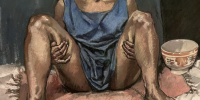
In 1998 Portuguese born artist Paula Rego created a series of work entitled Untitled. The Abortion Pastels. Rego created her work in response to a referendum to legalise abortion in Portugal, which was very narrowly defeated. Each canvas depicted the image of a woman undergoing an unsafe abortion. When the series was exhibited in the Portuguese capital, Lisbon, Rego recalled the whispered secrets of women in the gallery while looking at her artworks.
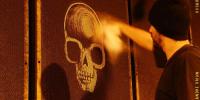
Visual artist Alexandre Orion removes soot in an artful manner to produce skulls in the tunnels of the polluted city of Sao Paulo. Orion does so in an attempt to create intervention, raise awarenes, and decrease pollution. "From the ocular cavities of so many dead, his work looks out on the living and interrogates people passing by; it quietly criticizes our omission, our comfortable acceptance of pollution." ( Jose De Souza Martins)
For the past five years, we’ve screened SIMA juried films in communities and classrooms across six continents and witnessed an increasing demand to use the inspirational force of documentary filmmaking to build a global digital community around today’s most pressing issues.
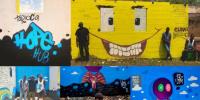
As part of the commemoration of this year’s World Art Day (April 15), Ghanaian-based Tapioca Foundation and Imposters Art Collective have embarked on a campaign to educate the public about environmental sustainability.
The project, which was launched in Ada in the Greater Accra Region, is intended to use art pieces to highlight issues relating to environmental protection and climate action to boost awareness in local communities.
At the New Orleans Swing Dance Festival the all African-American dance troupe The Rhythm Ambassadors were presented along side an African-American iteration of the Preservation Hall All-Star band with African-American vocalist Taryn Newborne to deliver the message that the African-American Lindy Hoppers were going to be protest until their rhythm is better presented...i.e.
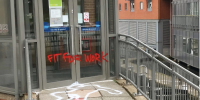
Graffiti art is particularly viewed as a powerful form of social protest, and the (illegal) act of defacing can be as important as the message itself. Artist Void One has been arrested on numerous occasions for his politically-charged interventions.
“I didn’t set out to make political art but art is a platform where I can vent my frustrations” – Void One.
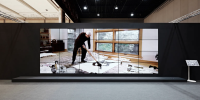
South Korean artist Do Ho Suh is internationally known for his ghostly, diaphanous architecture and fabric-made objects, which create imaginary spaces that are physically present yet impossible to inhabit. His large-scale, immersive, but impermanent installations serve as “acts of memorialization,” exploring themes of identity, home, and the tension between personal and public space.
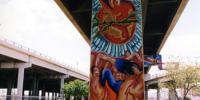
In El Paso more than 100 murals have been painted since the mid-1960s. The murals, located throughout the city's various corridors, often depict themes common to Chicano muralism, such as mestizo heritage or social problems, but they also tell unique stories about the "merging of ideas, cultures, and dreams" along the United States-Mexico border.
Rufina Bazlova is not afraid to surrender her art to activism. Born in Belarus, a former Soviet republic ruled by the authoritarian leader Aleksandr Lukashenko for 29 years now, Bazlova knows all too well that being apolitical is a privilege many Eastern Europeans cannot afford. 2020 was a pivotal year for Belarus, not only because of the COVID-19 pandemic but also the presidential elections, which declared Lukashenko president for the sixth time.
Play Safe is a documentary film series created and directed by NYU alum Eddie Einbinder. The film, much of which now appears for free on YouTube, was originally released in 2013 after being filmed between 2011 and 2012. It debuted at the International Harm Reduction conference in Vilnius, Lithuania in 2013.
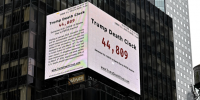
Donald Trump has been accused of personally causing the deaths of 40,000 Americans through his “reckless” handling of the Covid-19 pandemic, in a new website launched on Wednesday under the provocative title Trump Death Clock.
RACC Satellite Space in Garden City
1205 Franklin Avenue, 3rd Floor, Garden City, NY 11530
June 26, 10 am – July 28, 7 pm
Monday – Friday, 10 am – 7 pm, free admission
Please write to racc.ny@mail.ru or call (347) 662 1456
The artist is available for interviews
One of the oldest forms of human expression is art, so it’s no surprise that art is constantly used to critique another of humanity’s oldest practices, violence and war. In the world of art activism, the power of creativity and innovation has been used to create commentary about war since the beginning of time. Art that speaks out against the atrocities of violent conflict embodies empathy, care, and a plethora of other human emotions.
Anthony Papa was arrested for a drug crime and with no prior offenses was sentenced to 15 years to life in prison for violating New York's harsh drug laws. While in prison, Papa began to document his inner struggles via painting and ultimately earned a pardon from New York governor and has gone on to actively fight the drug war in his years since release.
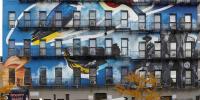
In a visually captivating public art venture, the Audonon Mural Project seeks to raise awareness for species of birds threatened by climate change in a rather unconventional way—street art. A collaboration between the National Audubon Society and Gitler &_____ Gallery, scatterings of stunning avian themed murals are cropping up throughout John James Audubon’s old Manhattan neighbourhood.
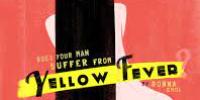
New York artist Donna Choi wanted to create a “weird, memorable way” to discuss fetishization of Asian women, so she put together a satirical series about how to diagnose Yellow Fever—the specific obsession many Western men have with Asian culture.
The over-the-top series is a discussion of race crafted for the attention span of the Internet.
I emailed with Choi about her thinking behind the Yellow Fever series.
Text taken from website:
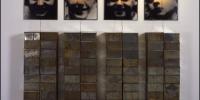
By appropriating mementos of other people’s lives and placing them in an art context, Boltanski explores the power of photography to transcend individual identity and to function instead as a witness to collective rituals and shared cultural memories.
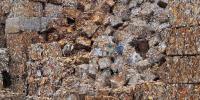
Artist Chris Jordan shows us an arresting view of what Western culture looks like. His supersized images picture some almost unimaginable statistics -- like the astonishing number of paper cups we use every single day.
https://www.ted.com/talks/chris_jordan_turning_powerful_stats_into_art?r...
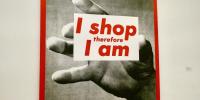
I Shop Therefore I Am (1987) is the work of Barbara Kruger . It became an iconic artwork, being reproduced on items such as shopping bags and other consumer products such as t-shirts. Kruger has often derived images from the mass media and pasted the words over them, particularly in Futura Bold . She then uses advertising to design her works.
The Milosevic regime ruled over Serbia and Yugoslavia for about 13 years. To maintain control, the Milosevic regime was infamous for arbitrary arrests, beatings, imprisonment and even murder of avid opponents.
"MASK" is an art exhibition that explores the uses and meanings of masks, and ones feelings about them. Masks throughout history have taken many forms and have served many purposes. They have been used in construction, scientific research, technical manufacturing, medicine, the theater, and warfare.
In Tunisia, a country gripped by economic uncertainty and still in the midst of rebuilding its identity after the Arab Spring, hip-hop culture is viewed as part of an ongoing dissident movement. Just a few events, such as the recent Mafia Wallitili Festival in the heart of downtown Tunis, offer the local hip-hop community an opportunity to share their values with the broader population.
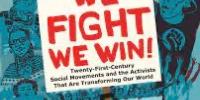
Greg Jobin-Leeds, a long-time social activist, collaborated with AgitArte, a collective of artists and organizers, to capture the stories of today’s social movements and the activists behind their success with the release of When We Fight, We Win: Twenty-First-Century Social Movements and the Activists That Are Transforming Our World.
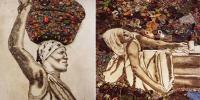
In 2008, my work as an artist took me to a gigantic landfill outside Rio de Janeiro called Jardim Gramacho. After operating for more than 30 years, the sanitary facility, once one of the largest in the world, had reached its maximum capacity and was on the eve of closing permanently.