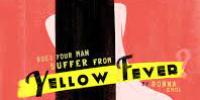
New York artist Donna Choi wanted to create a “weird, memorable way” to discuss fetishization of Asian women, so she put together a satirical series about how to diagnose Yellow Fever—the specific obsession many Western men have with Asian culture.
The over-the-top series is a discussion of race crafted for the attention span of the Internet.
I emailed with Choi about her thinking behind the Yellow Fever series.
The latest episode in Nicolas Heller's documentary web series "No Your City," as published by Gothamist, features the arguably pretentious, inarguably earnest street performer Kalan Sherrard, who was recently arrested during his peaceful anarchist puppet show. Functioning as a video manifesto for his peculiar ways, the clip is at least compelling.
Installed on the occasion of the 2016 U.S. presidential election, I want a president renders a poignant portrait of the cultural and political climate in the early 1990s in New York City with words that still resonate today.
On a freezing Friday in January, Khmer-American artist Kat Eng sits in front of retail giant H&M’s Time Square store working on a manual sewing machine. For eight hours, Eng stitches together U.S. dollar bills while wearing a surgical mask and bloodstained shirt. Her performance “</3 Less Than Three” protests the way fast fashion and consumer culture creates oppressive conditions for Khmer workers.
On the eve of International Women’s Day and the one-year anniversary of its SPDR®SSGA Gender Diversity Index ETF (ticker: SHE), State Street Global Advisors (SSGA), the asset management business of State Street Corporation (NYSE: STT) is calling on the more than 3,500 companies that SSGA invests on behalf of clients, representing more than $30 trillion in market capitalization1 to take intentional steps to increase the number of women on their corporate
In 1991, Gonzalez-Torres lost his partner Ross to AIDS (the artist would face the same fate in 1996). In a tragic and highly personal tribute to Ross, Gonzalez-Torres took a picture of his still-indented empty bed - an image of universal intimacy and loss - and placed it on two dozen commercial billboard spaces throughout New York.
A major exhibition by Ai Weiwei this autumn features a new series of monumental sculptural works in iron, cast from giant tree roots sourced in Brazil during research and production for last year’s survey exhibition, ‘Raiz’, at the Oscar Niemeyer-designed OCA Pavilion in Ibirapuera Park, São Paulo.
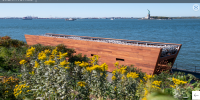
Moving Chains is a monumental 110-foot long kinetic sculpture that evokes the hull of a ship, built from steel and Sapele, a tree native to West Africa commonly referred to as African Mahogany. Inside of the sculpture, nine chains run overhead: rotating on a maritime sprocket system, eight of the chains represent the pace of the currents in New York Harbor, while a ninth central chain moves more quickly, mimicking the pace of a ship in transit.
"Brooke Shields is one of 200 famous faces that the artist Jonathan Horowitz identifies as vegetarian in head shots he has hung on the white-tile walls of a former meat locker in the south Village. Horowitz, 44, swore off meat at the age of 12, after his parents took him to a bullfight on a vacation in Mexico.
Taken from the website:
Dyke Action Machine! (DAM!) is a two-person public art project founded in 1991 by artist Carrie Moyer and photographer Sue Schaffner. Between 1991 and 2004 DAM! blitzed the streets of New York City with public art projects that combined Madison Avenue savvy with Situationist tactics.
This blogger documents all the cool things that are on their way to extinction in New York. A mix of preserving history and nostalgia through old school photography and new media. This website creates a nostalgic internet record of pre-internet New York.
The group of students from NYU took to the streets of Manhattan to shout back against sexual harassment and bring awareness to the Everyday Sexism project. Armed with business cards that said "#shoutingback" on one side, and "Real men don't catcall" on the other side, the group waited for men to yell at the women while they walked down the street.
David Opdyke’s wry, panoramic visions of an America perceptibly in the grips of climate crisis were born of an artistic crisis—of “needing to come up an idea by digging somewhere other than my own brain.” Having drawn on his imagination to conjure up the trenchant, ecologically-inflected critiques of American imperialism and late-stage capitalism that have defined his work for twenty years, he wondered what more he might, artistically speaking, say.
An Egyptian-born activist was arrested yesterday for spray-painting subway billboards that call enemies of Israel “savages” — amid a wave of vandalism unleashed on the inflammatory ads, which have divided the city.
Mona Eltahawy, a self-described “liberal Muslim,” strolled up to one of the signs at the crowded 1/2/3 train mezzanine at the Times Square station and sprayed pink paint on the ads.
Students dressed as Israeli soldiers stopped other students, ordered them to the ground, and blindfolded them in a demonstration that drew multiple campus groups to a standoff on College Walk Thursday afternoon.
The Columbia Students for Justice in Palestine set up mock checkpoints—to resemble those manned by the Israeli army in the West Bank—drawing crowds and counter-protests for several hours.
"Over 200 women, many dressed in bridal gowns, joined the Brides March through Manhattan on Tuesday, an annual event aiming to draw public spotlight on the often hidden scourge of domestic violence.
The US artist Nan Goldin has staged her first public protest since she launched her activist group PAIN (Prescription Addiction Intervention Now), shaming members of the Sackler family who have profited from the sale of Oxycontin and institutions that have accepted their philanthropy.
"The Uni Project aims to do one thing and do it well: temporarily
transform almost any available urban space into a public reading room
and venue for learning. We start with the conviction that books and
learning should be prominent, accessible, and part of what we expect at
street-level in our cities." (From site.)
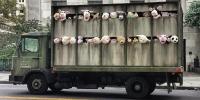
Sirens of the Lambs is created by the enigmatic street artist, Banksy. This piece was first spotted on the streets of New York City on October 10, 2013, it went viral on social media and people are posting and reposting about it. Sirens of the Lambs is a truck full of stuffed animals – plush cows, chickens, pigs, lambs, bears – that first appeared in the Meatpacking neighborhood of NYC.
In July 2015, the Empire State Building's famous light displays were used to draw attention endangered wildlife. Along with Cecil, whose death has sparked international outrage, a snow leopard, tigers, lemurs, and various snakes, birds and sea creatures were projected onto the building.
Plants growing through urban cracks and concrete remind us of the power of nature. Whether its a tree or a blade of grass pushing its way through cement, an underlying chaos( or natural order) lives just beneath the surface of physical and mental organizational structures created by man.
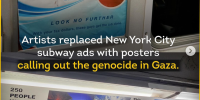
"Late last night, an autonomous group of activists placed posters throughout the subway system, blocking out advertisements with their own materials protesting Israel's bombing campaign in Gaza.
At the Eighth Avenue subway station, sewer alligators are not an urban legend.
Anyone who’s been through the 14th St./Eighth Ave. station has probably seen the bronze gator sculpture — and probably wondered what it means and why it’s there.
The underground gators — along with dozens of other whimsical creatures — are part of the permanent art installation housed at the intersection of the A,C,E, and L lines.
Butactually.com is a new kind of online dictionary created by a team of students at NYU Gallatin who seek to document, organize, and provide a platform for anyone to share new activist hashtags.