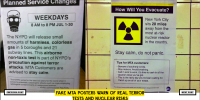
What would a chemical attack on NYC look like? How would poisonous gases spread, through the lines of the subway and above ground? These are some of the questions the NYPD and a team of researchers hope to answer this July, when they’ll disperse colorless, odorless, and apparently harmless gases called perflourocarbons around the city and track their movement.
"It
was important to me to present the whole story in a way that would
captivate people’s attention and make a memorable statement. Making
quilts seemed an ironic solution. Quilts act as a functional memory, an
historical record of difficult times. It
is during times of hardship that people have traditionally made quilts,
"The Uni Project aims to do one thing and do it well: temporarily
transform almost any available urban space into a public reading room
and venue for learning. We start with the conviction that books and
learning should be prominent, accessible, and part of what we expect at
street-level in our cities." (From site.)
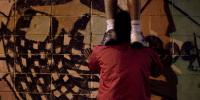
Kanami Kusakima, also known as the woman who dances in Washington Square Park with the long black hair and the paint, was happy to allow the Mayor's Office of NYC use her image as a promotional tool for a "post-coivd" New York. Yet, she has had multiple encounters with police who want to shut her performance down.
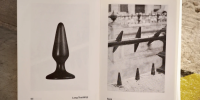
Hostile architecture—urban design features like ground spikes that deter the homeless from lying down or slanted benches that prevent lingering—inscribes exclusion into our streets. In response, a Chinese artist will launch the Free Butt Plug Catalogue, an art-activism project that documents fifteen such spikes and anti–loitering benches across London and pairs each with a commercially available butt plug of the same shape.
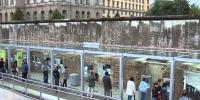
It was once the most feared address in Berlin, a place easy to enter but very hard to leave. Now the ruins of the former engine room of Nazi terror at Prinz Albrecht Strasse in Berlin have been preserved in a new exhibition space open to the public from tomorrow.
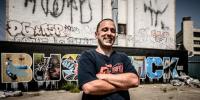
Conceived and curated by Bushwick native Joe Ficalora, the Bushwick Collective has evolved into an extraordinary open-air gallery since its first mural surfaced in 2011.
Attracting a wondrous array of local, national and international artists, it showcases first-rate street art -- from legendary Blek Le Rat stencils to huge collaborative walls by such world-renowned artists as Case Ma'Claim and Pixel Pancho.
This week, I got to make history. At 18 years of age, I received an honorary doctorate from the University of London for my work in climate justice, making me the current youngest holder of the award globally.
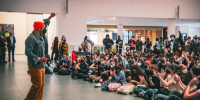
As the conflict between Israel and Hamas continues, hundreds of people gathered inside the Museum of Modern Art and outside of the Brooklyn Museum on Saturday for protests.
For this edition of ADE, Stichting NDSM-werf invited art- and activist group Tools for Action + Floor to use their terrain as a public practice space for RÆV REHEARSAL. They invite the public to rehearse new forms of assembly. With a Bluetooth speakers system, floating inflatable sculptures, and a minimalist techno beat, they move through the city like a radiating dancing swarm.
Shackles. Cotton. The Big House.
Americans tend to think of slavery in terms of chattel slavery. Plantation Slavery. Slavery where human beings are bought, sold, and owned. The kind outlawed in the United States by the Emancipation Proclamation in 1863.
Slavery as a relic of the 19th Century.
“Six of us lived, worked, slept in a 10-by-10 (foot) room without a bed, bathroom, or clean water,” Nasreen Sheikh remembers.
Brooklyn deli re-brands as artisanal emporium to protest rent hike
The owners of an imperiled Boerum Hill deli have staged an “artisanal takeover” of their 25-year-old corner store, re-branding products with yuppified names and jacking up prices to illustrate the kind of shop that could afford the 250-percent rent hike they say the store’s landlord is demanding.
An advertising agency creates a one-time action for traffic safety, then uses documentation to generate awards and free promotion for their company. Did traffic fatalities actually drop after this was done once? Their Press Release doesn't make mention.
From McCann's Press Release:
New York Times
January 28, 2012
By SIMON ROMERO
SÃO PAULO, Brazil — This mega-city’s authorities have waged war for years against what they call “visual pollution,” banning billboard advertising, demolishing abandoned skyscrapers and planning to raze concrete eyesores like the elevated highway known as the Big Worm.
Los Angeles is at a critical moment when it comes to art. Not because it's "underappreciated as a world art center" as The New York Times informed us in 2011. Or because it's a "burgeoning art capital" as The New York Times revised in 2014. No, it's because L.A. has actually moved past the "up-and-coming" stage into a fully integrated part of the art world.
The pro-democracy protests in Hong Kong have a new mascot: a roughly 12-foot-high figure of wood blocks holding a bright yellow umbrella in its outstretched right hand. The students call it Umbrella Man.
Umbrellas emerged as a symbol of the demonstrations after dozens of students wielded them on the night of Sept. 28 to fend off pepper spray as they jostled with the police.
On Nov. 6, the day after the presidential election, the artist Hank Willis Thomas was at his studio in Brooklyn. His production assistants were poring over tables strewed with blobby red white and blue silk-screen prints of the words “Fragile/ Democracy / Handle With Care” in capital letters.
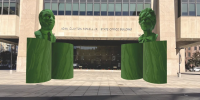
Digital art platform Kinfolk has launched its New York City-wide participatory exhibition Signature Series, the initiative’s largest public endeavour to date. The project places newly created augmented reality (AR) monuments by four New York artists—Pamela Council, Derrick Adams, Tourmaline and Hank Willis Thomas—into designated public spaces across the city.
Zhuang Huan invited more than 40 men - laborers, fishermen, construction workers––who had recently migrated to Beijing from other areas of China to participate. Zhang Huan said, “In order to find these workers, I visited many of the shacks where they live.”
Imagine affecting the global cultural Landscape through art and technology use. Imagine one-mile long installation in 100 city locations worldwide, each mile-long install is of 250 bronze plaques of different Peacemakers. Then imagine its own App that when any smartphone is pointed at one of the plaques an entire timeline biographical history of that peacemaker becomes available.
"is a conceptual documentary project in which I photographed every Mom and Pop-style cornershop on the island of Manhattan as quickly as possible, as I walked each block in the city ( CLICK FOR A MAP of my route). I fear these veritable microcosms of NYC will be swallowed in the presently swelling wave of corporate homogeny.