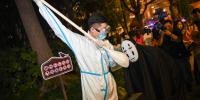
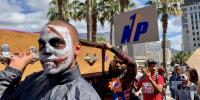
Several nights of Halloween celebration in Shanghai provided a vivid, if indirect, commentary this week on the malaise gripping the world’s second-largest economy.
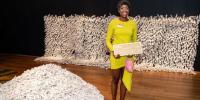
Wajiha Jendoubi is an actress and one of Tunisia's best-known comedians. To be a woman comedian in this North African nation can be a challenge, but the country's gender gap is narrowing for the first time in almost a decade and Wajiha sees Tunisia as a country that stands for women's rights and supports it.
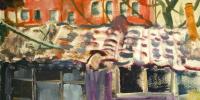
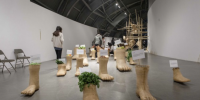
The Wuming Painting Collective, formed in Beijing during the Cultural Revolution (1966–1976), was a clandestine group of artists who defied the authoritarian control over art and expression. In a time when all art was harnessed as propaganda to glorify the state and Chairman Mao, Wuming artists turned their gaze toward everyday life, painting still lifes, street scenes, human figures, and most iconically, serene landscapes.
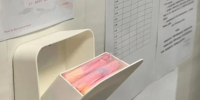
From October to December 2020, Chinese university students nationwide launched a viral movement to install “menstrual pad mutual aid boxes” in women’s restrooms—free, wall-mounted containers stocked with disposable pads on a take-one, replace-one basis. Nearly 250 campuses joined within weeks. Some sustained their boxes for over a year, while others saw them vanish after bureaucratic pushback, logistical hurdles, or dwindling volunteer resources.
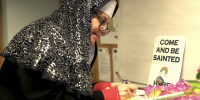
As she puts the finishing touches to her habit, Sister Clarita, a Mexican immigrant living in Los Angeles, tells me that there are more than 3,000 LGBT+ nuns around the world. They’re part of the Sisters of Perpetual Indulgence, an international network of activists who identify as secular nuns.
The Yes Men join Reclaim the City in their fight against unjust housing policy. On September 30, 2019, a horde of zombies attended a "#natsneverdie rally" at the Cape Town Civic Centre in order to celebrate Mayor Dan Plato and the Mayoral Committee and to support their policies, which are increasingly similar to those of the National Party under Apartheid.
The Bed-Stuy “aquarium” is back.
The neighborhood’s beloved sidewalk fish pond was resurrected this week — in an act of defiance that comes just five days after the city cemented over the original and left the neighborhood’s goldfish to die.
The opening lines of this week’s Staff Pick Premiere, “Battleground,” by Kwesi Thomas and Mark Bone examine how skin color has become just that…a battleground. The short captures the particular discomfort of having to argue for one’s value in a society that should care instead of question. Kwesi, a Black man, powerfully conveys these feelings to his co-director Mark, a white man, in the wake of George Floyd’s death last May.
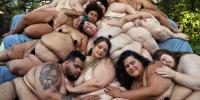
Yesterday, I procrastinated my way to watching the Savage X Fenty Show, and I was left in complete awe of Rihanna. She truly is a powerhouse, but on top of that, all her brands; Fenty Beauty, Savage X Fenty and Fenty have intentionally left no one behind.
‘Modern Family’ Finale: How Cameron and Mitchell Forever Changed Gay Families on TV
The groundbreaking ABC sitcom came to a conclusion this week, forever leaving its mark on the LGBTQ television landscape.
Jude Dry
Apr 10, 2020 5:00 pm
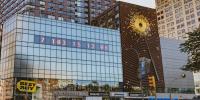
For more than 20 years, Metronome, which includes a 62-foot-wide 15-digit electronic clock that faces Union Square in Manhattan, has been one of the city’s most prominent and baffling public art projects.
Linha Vermelha was created in 2016 by the non-profit organization Academia Cidadã (Citizenship Academy). At that time there were fifteen active contracts for oil and gas drilling and we were inspired by the “Red Line Action” in Paris, during COP21 and decided to create this campaign.
Private Dinner Party: Clothing Not Allowed
The Füde Dinner Experience gathers those who want to meet, eat and drink — only after leaving their clothes at the door.
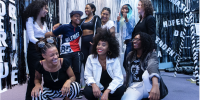
The purpose of this project was the permeate stock images with more depictions of Black people. Stock images are usually easily found and utilized, showcasing people doing everyday activities or scenes. To boost representation of Black people in this particular image field, were left out, so the artist chose to recreate popular stock images with Black models to showcase representation and shed light on the lack of diversity in these photos.
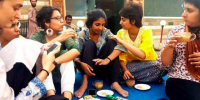
We are sitting at a dhaba – a roadside tea-shop in Pakistan often frequented by lower-to-middle income men. At our table: four women and camera crew. The reporter from ‘one of the most globally viewed’ [read: western], mainstream British outlets looks me in the eye: “So, how safe do you feel at the moment? We were just surrounded by a group of little boys [because of the cameras], do you think the situation can ever turn on you?"
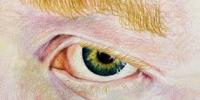
Through her work, South African art activist Athenkosi Kwinana aspires to deepen the understanding of Albinism in her native country, where she has faced discrimination in most aspects of her life from childhood days on. Working with both drawing and printmaking, Kwinana creates large self-portraits that aim to constructively reimagine the representation of Albinism in the country’s black communities and African contemporary art as whole.
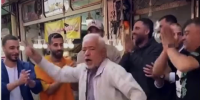
It all started when a 70-year-old fish market stall owner nicknamed “Booghy” was grooving in public, in violation of Iranian law.
A new form of protest against the government is rocking Iran: a viral dance craze set to an upbeat folk song where crowds clap and chant the rhythmic chorus, ‘oh, oh, oh, oh.’
D.C. Mayor Muriel E. Bowser renamed a street in front of the White House “Black Lives Matter Plaza” and had the slogan painted on the asphalt in massive yellow letters, a pointed salvo in her escalating dispute with President Trump over control of D.C. streets.
The Nanjing Yangtze River Bridge, completed in 1968, is one of China’s most iconic infrastructural projects and a potent symbol of national pride. Spanning over 6,700 meters across the Yangtze River, it was the first double-decked road-rail truss bridge designed and built entirely by Chinese engineers, without foreign assistance, during a time of intense geopolitical isolation.
Rooted in Native American and indigenous practices,[11] restorative justice is a set of principles and practices that aims to help communities heal from conflict and harm by developing a common understanding of the root causes and effects.[12] Restorative justice can occur in a variety of different contexts: in the workplace, at schools and within, or instead of, the criminal justice system.
In her 2021 graduation project from the Central Academy of Fine Arts (CAFA), Chinese performance artist Zou Yaqi staged a provocative social experiment titled “21-Day Survival Challenge.” For three weeks, Zou assumed the persona of a wealthy socialite, using counterfeit luxury items, strategic self-presentation, and social engineering to access elite spaces in Beijing—such as five-star hotel lobbies, first-class airport lounges, and high-end restaurants
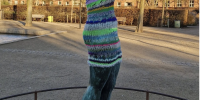
The yarn bombing started with Louise Moerup’s school run in central Copenhagen. On the walk through the park each morning, she and her 10-year-old son would often discuss a naked statue of the goddess Venus there and wonder why there weren’t more statues of real women instead.
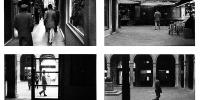
Sophie Calle's works discuss the issue of "privacy", the composition of an individual's identity at the social level, and the relationship between "private" and "public/group/society", including personal information, personal records, public surveillance, and other topics. An obvious feature of her works is the unique and extremely subjective criteria of judgment and reference for measurement.
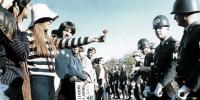
Flower power was a slogan used during the late 1960s and early 1970s as a symbol of passive resistance and nonviolence. It is rooted in the opposition movement to the Vietnam War. The expression was coined by the American Beat poet Allen Ginsberg in 1965 as a means to transform war protests into peaceful affirmative spectacles.