In March this year, less than 100 days since he took office again, Luis Castañeda Lossio, Mayor of Lima, announced that the Municipality would remove the street art murals painted on the walls of downtown Lima’s historical city streets. “Lima has to recover all the architectural quality it has. They have chosen us and we will comply with the obligation that the population has consigned us,” said the mayor.
This interactive, site-specific project is a comment on how we - constantly attached to mobile devices - neglect to observe the environment around us. Like ostriches, we willingly trap our heads, minds, and imagination in a fantasy world that is detached from reality.
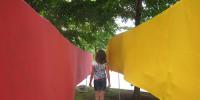
Three colorful fabric tunnels span a man-made grove of Elm trees in downtown Boston, defining an intimate courtyard where nature clashes with cartoonish representation.
This week's Swede of the Week is Tomas Gunnarsson, whose quest to find Sweden's "Sexist of the Year" has found a viral following across the country. He says Swedes who buy into the 'most equal country in the world' label are delusional.
Who was the most sexist person in Sweden in 2013?
National Public Radio (NPR):
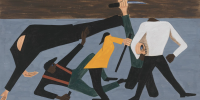
There's no historical marker outside Jacob Lawrence's childhood home in New York City's Harlem neighborhood.
But Khalil Gibran Muhammad, director of the Schomburg Center for Research in Black Culture, has an idea of what it might say: "Here lived one of the 20th century's most influential visual artists, a man named Jacob Lawrence, who was a child of southern migrants."
Brian Larney is an AI.tivist or American Indian artist. He is also an Artivist where he performs Artivism, a concept that includes art as a form of activism.
Dozens of moms organized a breastfeeding protest at an Australian mall after nursing mom Luci White was asked to leave the food court.
White says she was finishing up her lunch at Bendigo Marketplace, about 90 minutes outside Melbourne, when her 7-month-old son, Zaydd, started crying for milk. White started nursing him, but other patrons, an older man and a mom of two, started to complain.
In this solo work, Gómez-Peña tests brand new material dealing with radical citizenship and what he terms “imaginary activism,” combining live art, literature, theory, and pedagogy in a wonderfully strange mix. Not one solo performance is ever the same.
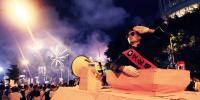
The Hong Kong 1 July protests are a surprising sight on the often chaotic stress. This day marks the transfer of Hong Kong from the United Kingdom to China (PRC) and is a public holiday it was originally thought to be a day of celebration. However, now it is mostly known for hundreds of thousands of people flooding the streets who protest for democracy, universal suffrage, and other political concerns.
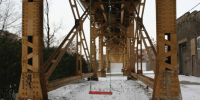
Abandoned buildings have become such a common sight that they often slip quietly into the backdrop of our cities like an accepted part of our landscape. Looking for Love Again is a participatory public installation that renews attention to an abandoned high-rise in downtown Fairbanks, Alaska to celebrate its past and future.
An erroneous tip called into law enforcement authorities in 2002 subjected Hasan Elahi to an intensive investigation by the FBI and after undergoing months of interrogations, he was finally cleared of suspicions. After this harrowing experience, Elahi conceived “Tracking Transience” and opened just about every aspect of his life to the public.
In 2007, Andrew Danziger had an architecture class assignment at the University of Texas at Austin to propose an urban intervention in Austin. The goal was to think about public art in unexpected ways. One classmate dreamed up a blank traffic sign; another suggested putting a bench at a bus stop that lacked one. Danziger hit on the idea of installing swings in surprising places, and then he went beyond the assignment by actually doing it.
In state capitals and street protests, women’s rights activists have been wearing red robes and white bonnets based on “The Handmaid's Tale,” the 1985 novel that is now a series on Hulu.
Silent, heads bowed, the activists in crimson robes and white bonnets have been appearing at demonstrations against gender discrimination and the infringement of reproductive and civil rights.
On September 5th, 1991, I put a giant condom over Jesse Helms’ house. Why? Because, as the condom said, “Helms is deadlier than a virus.” Senator Jesse Helms was one of the chief architects of AIDS-related stigma in the U.S. He fought against any federal spending on HIV research, treatment or prevention.
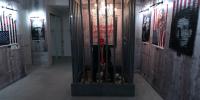
For one day, a group of artists known as the INDECLINE Artist Collective turned a hotel room in New York City's Trump International Hotel into a single jail cell for Donald Trump without the hotel's knowledge. The inside the jail cell was a Donald Trump impersonator in a suit and a "Make America Great Again" hat and at his feet were McDonald's food wrappers and live rats.
A New York blogger impersonating David Koch successfully prank called Wisconsin Gov. Scott Walker. David Koch is one of the two wealthy brothers who were big donors to his political campaign and GOP efforts generally.
Project Row Houses (PRH) is a neighborhood-based nonprofit art and cultural organization in Houston’s Northern Third Ward, one of the city’s oldest African-American communities. PRH began in 1993 as a result of discussions among African-American artists who wanted to establish a positive, creative presence in their own community.
In response to a memo from Afghanistan's education ministry, Ahmad Sarmast, the founder of Afghanistan's Institute of Music, began a Twitter campaign with the hashtag #IAmMySong. In response to the hashtag, Afghan girls have taken to Twitter with videos of themselves singing tagged with Sarmast's hashtag and spreading petitions against the ban. The ministry memo banned girls 12 years old and older from singing at school functions.
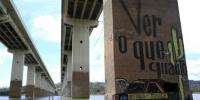
A grey minivan rattled through São Paulo’s hilly suburbs, loaded with spray cans, paint rollers, buckets and a ladder as five street artists drove to the Atibainha river, rap lyrics blaring from their speakers.
On the sweltering afternoon of 26 February, they painted colourful protest murals on the legs of a bridge that crosses one of São Paulo’s most important water sources, nestled in the Serra da Cantareira mountain range.
From the two shores of the Mediterranean, Zoukak theatre company and cultural association (Beirut) and Center for cultural decontamination CZKD (Belgrade) collaborates by sharing their experiences and knowledge in working within sociopolitical contexts in the field of art and culture.