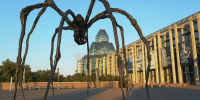
Through the use of mythical and archetypal iconography, Bourgeois translated her encounters into a very individualized symbolic imagery, employing things such as swirls, arachnids, cages, surgical equipment, and sewed appendages to represent the feminine mind, beauty, and mental agony.
Protesters left 7,000 pairs of shoes in front of the Capitol building Tuesday to symbolize the number of children killed by gun violence in the United States since the Sandy Hook Elementary School shooting in December 2012.
From 8:30 am to 2 pm, the shoes were displayed on the southeast lawn in the hope of sending a clear message to Congress: Reform gun control legislation or more children will be killed by gun violence.
Two weeks ago, the University released the final version of its diversity and inclusion action plan, which could not have been compiled without the exhaustive efforts of students throughout last semester.
If the way to one’s heart really is through the stomach, Rirkrit Tiravanija must have more than his share of admirers. Now at GAVIN BROWN, the Buenos Aires-born artist with a history of dishing out tasty edibles in his exhibitions invites viewers to enjoy a bowl of soup in his interactive show, Fear Eats the Soul.
Prison inmates in Mexico have suffered from coronavirus infections at a higher rate than the country as a whole, and pandemic lockdowns have reduced their already limited contact with the outside world.
But one group of women inmates at a prison west of Mexico City have managed to benefit, as the lockdown spurred a wave of professionals with time on their hands to donate online classes.
From Black Power to Migrants’ Power
BY Robin Cembalest POSTED 01/22/13
As ’60s activist art enters museums, a new generation is creating an iconography of protest for today
ART COLLECTIVE LUZINTERRUPTUS has created an installation made up of 100 glowing “radioactive” figures for the Dockville Festival in Hamburg.
The human-size figures appear to be wearing special white protective clothing and marching, heads down, across the landscape. The eerie structures contain a number of lights which make them appear to glow ominously in the dark.
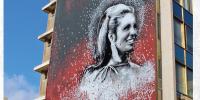
Yazan Halwani is a young Beiruti artist who paints murals of revered Lebanese and Arab figures on prominent walls in a bid to help overcome sectarianism in this fragmented city. “What I try to do,” he explains down a fuzzy line from Beirut, “is write the stories of the city, on its own walls – creating a memory for the city.”
The Tel Aviv Museum of Art is joining the countrywide judicial overhaul protests planned for Thursday, March 23, and will darken the halls and galleries of the museum, closing exhibits to the public and canceling planned tours and lectures.
The only exhibit that will be open to the public, for free, is the exhibit of Israeli art from the museum’s collection, “Material Imagination: Center of Gravity,” which has been open for a year.
The Democracy Machine! is a performative sculpture that gives participants the opportunity to experience the thrill of democracy in action, in a competitive game that challenges people to work together toward understanding a better society. Using the spectacle and play of performance drawn from Las Vegas Casinos, gambling machines and game shows, The Democracy Machine!
Mind Over Media is a crowdsourced educational platform that contains diverse examples of contemporary propaganda on a wide range of social, political, economic and environmental topics.
We all learn art in school. Every kid loves to draw at some point. People get fascinated with the details of their new camera, or spend free time writing poems. But eventually, there’s a not a teacher telling you how great your are, or the camera gets put away, or you just plain get busy and stop. Years could go by before you start again, if you ever do at all.
Emel Mathlouthi (Arabic: آمال المثلوثي) is a Tunisian singer-songwriter best known for her protest songs "Ya Tounes Ya Meskina" (Poor Tunisia) and "Kelmti Horra" (My Word is Free) which became anthems for the Tunisian revolution and the 2011 Egyptian revolution.
After Afghan artist Malina Suliman's father suffered a brutal attack in their hometown of Kandahar, the Suliman family fled to Mumbai, where they plan on staying until the end of March. Malina is a 23 year-old grafitti artist whose work can be seen throughout Kandahar, including a self-portrait of a skeleton in a burqah that provoked threats from local Taliban. The Suliman family suspects the attack on Mr.
MEXICO CITY — Of the half-dozen pieces that form Tania Bruguera’s series “Tatlin’s Whisper,” the one that the Cuban government silenced may have resounded most.
To call attention to bullying, the Singapore Coalition Against Bullying for Children and Youth has released a video that gets shorter each time it is viewed.
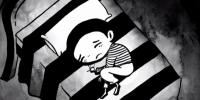
Hosted on a site called Share It To The End, the short animated video depicts a boy getting bullied at school and telling us he always feels alone and doesn’t feel safe anywhere.
China's underground hiphop became an art movement since early 2000s. With characteristics of self-expression, localization and social criticism, Chinese hip hop music quickly gained popularity among students and working-class Chinese. Some notable music groups from Beijing include Yin Ts'ang (隐藏) and In3er (阴三儿).
For over 60 years, Colombia has been facing war between guerrilla groups, the State, paramilitary groups and drug dealers. Hundreds of thousands of people have been killed, raped, displaced and threaten by this armed conflict. The common trait of this tragedy has been the people being in the middle, the people that still today pay the consequences.
Lady Gaga said something interesting about her song “Born This Way” during a March 2011 interview at Google headquarters. “What's so funny [is] when I put that song out, everybody was like, ‘Oh, the lyrics are so literal,’ and I'm like, ‘Yeah,’” she shared, almost with a fuck-you cadence. She wasn't angry—but you could tell how important the track was to her, and how she didn't want its message muddled.
ISLAMABAD —
A prominent female rights activist in Afghanistan lambasted the global community Saturday for failing to come up with a plan or agreement on how to help her crisis-ridden country since the Taliban took control of it 18 months ago.
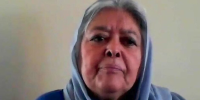
Mahbouba Seraj, a Nobel Peace Prize nominee, spoke virtually from the Afghan capital, Kabul, to a town hall at the Munich Security Conference on prospects for her country under Taliban rule.