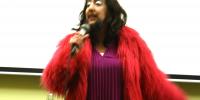
On September 5th, 1991, I put a giant condom over Jesse Helms’ house. Why? Because, as the condom said, “Helms is deadlier than a virus.” Senator Jesse Helms was one of the chief architects of AIDS-related stigma in the U.S. He fought against any federal spending on HIV research, treatment or prevention.
“Most people can’t imagine a futurist Africa,” says Ethiopian photographer Aïda Muluneh. She challenges this in her project, Water Life, exploring real-world issues with an otherworldly twist.
Muluneh went to Dallol, Afar, Ethiopia, an extreme landscape where it is dry and hot to capture the essence of water to life. Through her work, Muluneh highlights how water scarcity is mainly a burden on women.
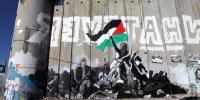
In June 2002, the Israeli Government decided to construct a physical barrier separating Israel and the West Bank. The declared purpose of this (as yet unfinished) 709 kilometers long barrier—which came to be known as Gader Ha’hafrada (The Separation Wall)—was to prevent the entry of Palestinian terrorists from the occupied territories into Israel in order to protect Israeli citizens.
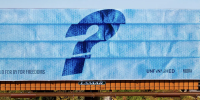
On Nov. 6, the day after the presidential election, the artist Hank Willis Thomas was at his studio in Brooklyn. His production assistants were poring over tables strewed with blobby red white and blue silk-screen prints of the words “Fragile/ Democracy / Handle With Care” in capital letters.
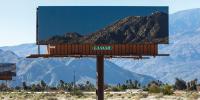
Visible Distance / Second Sight is an art installation by Jennifer Bolande for DesertX. The temporary artwork can be found along the Gene Autry Trail near Vista Chino (33°50’41.70”N 116°30’21.02”W), where a series of consecutive billboards have been replaced by perfectly aligned photos of the landscapes they are blocking.
From the DesertX project page:
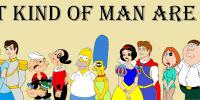
In a dark nod to International Women's Day, artist aleXsandro Palombo has turned to the world of cartoon characters to shed light on the horrors of domestic violence. His series, "No Violence Against Women," transforms iconic animated women into victims of abuse, resulting in a familiar yet ultimately disturbing collection of illustrations.
From Public Delivery:
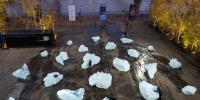
For Ice Watch (2014), he extracted 30 blocks of glacial ice from the waters of Greenland and in 2018 strategically placed them in front of Tate Modern in London . The ice was left here to melt. Ice Watch was to inspire public action against climate change, advocating for a rapid public response.
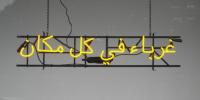
The Paris-based collective Claire Fontaine displays a neon sign that spells the words ‘Foreigners Everywhere’ in Arabic. Since this sign was installed strategically above the gallery’s wall-length window – facing in the street – in the edition of the show I saw, at Parsons in New York, it interacted not only with Parsons’ exhibition site but also with the urban environment beyond it.
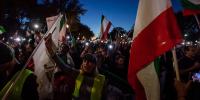
“Baraye,” the anthem of Iran’s “Woman, Life, Liberty” protest movement—a song woven together entirely from a Twitter hashtag trend in which Iranians express their investment in the current protests—continues to unite Iranians in their opposition to the Islamic Republic several weeks after it was first released online.
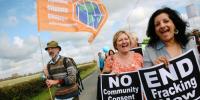
Camp Frack was a protest festival in Lancashire, UK, an area near industrial energy plants that produce shale gas. Around 150 activists from both Frack Off and Campaign against Climate Control (CCC) set up the festival, featuring food, music and conversation on environmentalism.
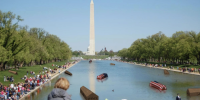
The U.S./Iraq War Memorial is an augmented reality public art project and memorial, dedicated to the thousands of individuals who have died on both sides of the conflict.
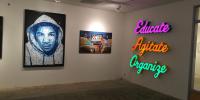
Last August, as protesters marched in Ferguson, Missouri, after the death of Michael Brown, the 18-year-old unarmed teen shot by a police officer, another group of activists began thinking about how to incorporate the creative community into the movement. The result is Manifest:Justice, a free pop-up art show taking place in Los Angeles.
Project IMPACT is an 8-week leadership-through-storytelling workshop for teen survivors of commercial sexual exploitation. The goal of Project IMPACT is to introduce survivors to the idea that sharing their stories is a powerful advocacy tool that can impact the legislative process and work to combat sex trafficking and commercial sexual exploitation.
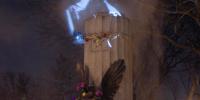
While most people slept, a trio of artists and some helpers installed a bust of NSA whistleblower Edward Snowden in Brooklyn on Monday April 6. They fused it to part of the Prison Ship Martyrs Monument, a memorial to Revolutionary War soldiers. By later that day, officials had removed the bust. But then a group called The Illuminator art collective replaced the missing bust with a hologram projection of Snowden.
Members of this organization begin the narrative process by examining city neighborhoods and commercial districts for compelling structures that appear to have fallen into disuse —“hidden gems” of the built environment. In varying states of repair, these buildings suggest only stories about the past, not the future.
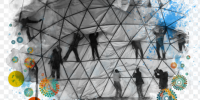
Surrounded by a jungle of tents and mud, the Good Chance Theatre was set up last year by British playwrights Joe Murphy and Joe Robertson. The refugee camp theatre has been derided by many, but for the thousands of migrants who have journeyed across the world to Calais, the small dome has been the first and only place into which they have been welcomed, and their voice valued.
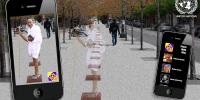
Imagine affecting the global cultural Landscape through art and technology use. Imagine one-mile long installation in 100 city locations worldwide, each mile-long install is of 250 bronze plaques of different Peacemakers. Then imagine its own App that when any smartphone is pointed at one of the plaques an entire timeline biographical history of that peacemaker becomes available.
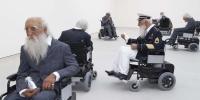
These thirteen life-like sculptures resemble familiar politicians, admirals, generals, bishops, and dictators. Portrayed as frail seniors, they sit dozing off and drooling in electric wheelchairs. They roll on a slow collision course, crashing into each other like bumper cars.
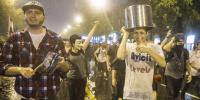
'Casseroles'protests, based on the tradition of 'cazerolazo,' consists of protesting by banging on pots and pans in the street. This took place in May of 2012 in Montreal and across Quebec, in response to the government's proposed tuition increases and the controversial "Bill 78" passed to control and dissuade dissent.