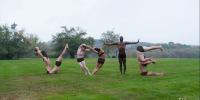
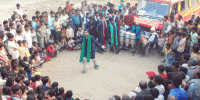
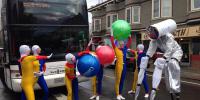
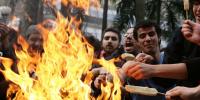
A group of protesters calling themselves the "Gmuni dancers" block a Google Bus from moving on 24th Street at Valencia Street on Tuesday April 1, 2014 in San Francisco, Calif.
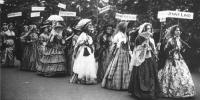
On June 17, 1911, a week before the coronation of King George V, women from diverse backgrounds united in costume and with installations over a shared political view - that of rallying the right for women to vote. Known as the Women's Coronation March, women thronged the streets between Blackfriars Bridge and Albert hall in a five-linked chain, dressed for the most part in white.
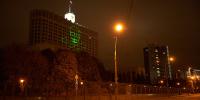
Voina art collective members covertly brought a large laser projector into the attic room of a hotel located across the street from the Russian White house (also called the Russian Parliament Building). From there they projected a large image of a skull and bross bones across the front of the white house building. Other group members on the ground then stormed the building gates and successfully entered the secure zone in front of the building.
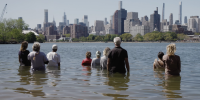
A site-specific, community-engaged process: Sarah and NYC collaborators gathered at the water’s edge every month from September 2020 (when the work was initially scheduled to take place but was postponed due to the pandemic) until September 2022, to build Kin To The Cove, a site-specific community-powered environmental public art process that connects local residents to the Cove and Water that surrounds NYC.
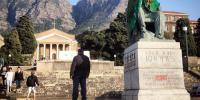
On August 14th 2014 several prominent statues within the city centre and the southern suburbs of Cape Town got redressed in green blankets, equipped with miner gear or carrying grocery bags. The statues – mainly of which represent colonial figures – were redressed in light of what has come to be known as the Marikana Massacre: the shooting of 34 miners by the local police force of Marikana, South Africa on August 16th, 2012.
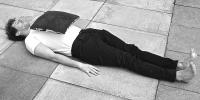
A short documentary about Artist Stephen Sheehan's performance called 'Weighed down by a cushion' performed at Liverpool One. The footage contains views from the public captured during the performance.
In April, 2011, Food and Water Watch partnered with Yes Lab to raise questions regarding drinking water around New York City. Yes Lab, an organization that collaborates with activist groups, aims to create successful media-related creative actions that help raise awareness regarding pertinent causes and create desirable action, often by staging interventions for the existing status quo by imitation and alteration.
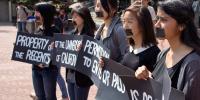
On Tuesday, May 8, in the midst of final exam week, a group of female first-year students performed a public art action at UC Berkeley to call attention to the UC Regents’ privatization of what was once the premier public university in the country.(See photos below)
The performance, “Lambrakis LivZ”, concerns the re-enactment of the political speech of Grigoris Lambrakis given in Athens in 1962. Grigoris Lambrakis was a peace-activist, assassinated by a paramilitary plot on June 1963 at Thessaloniki, Greece.
Art in Odd Places (AiOP) presents visual and performance art in unexpected public spaces. AiOP also produces an annual festival along 14th Street in Manhattan, NYC from Avenue C to the Hudson River each October.
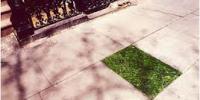
Turf the Turf hopes to inspire you to reconsider your front lawn by sharing existing examples of creative uses on a fun bike tour around the city of Kelowna. There are many options, such as xeriscaping (using native plants), front yard gardening or even installing original art that can display your creativity and offer you new ways to relate with your environment and your neighbourhood.
In São Paulo, just like in many other metropolitan regions, public transport is not as effective as it could be. Buses and trains usually run overcrowded, late and on limited hours, so that owning a car increases a lot one’s comfort. But not everybody can afford to have one, so a clear and recurrent class distinction occurs: public transport is mostly used by poor people.
The Pilobolus Dance company, famous for their beautiful aesthetics of shadow play formed out of the dancer's bodies, started the #PilobolusVOTEproject, encouraging people to form the words VOTE with whatever material they had around them, take a picture of it and to upload it on instagram with the hashtag #PilobolusVOTEproject.
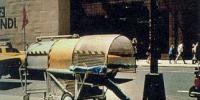
Together with a group of homeless New Yorkers, Wodiczko constructed the Homesless Vehicle as an instrument of survival for urban nomads. A modified shopping cart that facilitates refundable bottle and can collection, it also provides temporary shelter. As a house on wheels intended for New York City sidewalks, the Homeless Vehicle embodies Wodicko’s practice of ‘Interrogative Design’.
A new exhibition titled “Afrofuturism: A History of Black Futures” will debut at the National Museum of African American History and Culture (NMAAHC) to examine Afrofuturist expression and culture as it relates to music, activism, art, and more.
Have you ever wanted to see current or potential innovations for poverty or the environment without having to do a lot of researching or reading? Have you ever thought of an idea and wanted to tell the world about it and get feedback? Howitcouldbedifferent.org was founded for these purposes - to enable people to easily see, share, and suggest ideas in different categories.
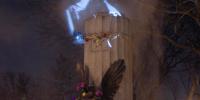
While most people slept, a trio of artists and some helpers installed a bust of NSA whistleblower Edward Snowden in Brooklyn on Monday April 6. They fused it to part of the Prison Ship Martyrs Monument, a memorial to Revolutionary War soldiers. By later that day, officials had removed the bust. But then a group called The Illuminator art collective replaced the missing bust with a hologram projection of Snowden.
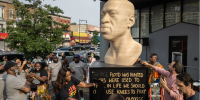
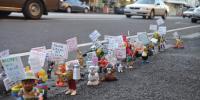
It was a quick turnaround for federal employers to recognize Juneteenth as a new federal holiday. But some cities were ready with new statues honoring George Floyd, whose killing by police in Minneapolis last year sparked a nationwide racial justice movement.
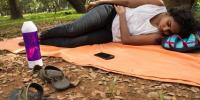
Meet To Sleep, a campaign started by Blank Noise, asks citizens from all across India to come to different public spaces like parks, and sleep there in order to take back free spaces without being afraid for their safety. The first meet was organised in November, 2014, in Bengaluru’s Cubbon Park. And since then there have been eleven meets across various cities including Jaipur, Pune, Mumbai, and Bengaluru.
Mukti Caravan, the Campaign on Wheels, is a mobile cultural group of former child bonded labourers. Started by the Bachpan Bachao Andolan (Save Childhood Movement), a movement started by now Nobel laureate Kailash Satyarthi, it involves activists visiting villages to create awareness about need for education, emphasizing on the need for improving access to education and quality of education, to completely eradicate child labour from the society.
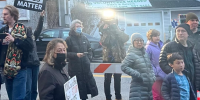
Some 70 or 80 local activists, politicians and other concerned citizens gathered outside Irvington Village Hall Sunday evening, two days after the release of gut-wrenching video of the murder of 29-year-old Tyre Nichols at the hands of policemen in Memphis.
First Inspired by a doll-sized action in Siberia, #occupysmallstreet staged its first little protest in Melbourne's City Square, as part of #F12, International Art + Occupy Day. Signs are made collectively, by regular Arts x Activism and members of the public (adults and children) who stop by and have something to add.
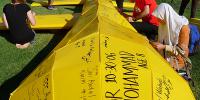
Media artist Joseph DeLappe announces the completion of “The Drone Project: A Participatory Memorial” on the campus of Fresno State University in California.
On July 4, 2012, several members of MicCheckWallSt, a subsidiary group of Seattle's larger Occupy Wall Street that formed in December, 2011, anonymously checked into a room at the historic Roosevelt Hotel in Downtown Seattle.