change
issue
region
medium
despondent apostate
“I sing because I genuinely think that if I don’t, I will die...The only thing that gives me relief is this.” - ganavya doraiswamy
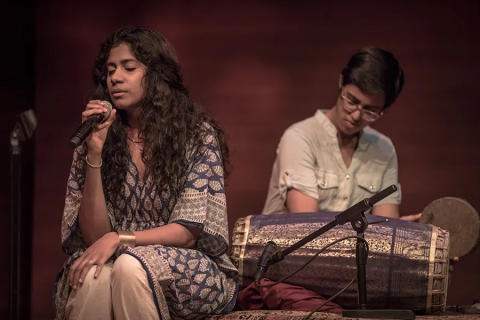
I've been fortunate to witness New York-born, Tamil Nadu-raised, Queer musician ganavya's work a handful of times over the last few years. I discovered her work through her collaboration(s) with her friend/mentor/teacher, esperanza spalding. spalding was a Harvard Music Department Professor of the Practice; she is also a Grammy Award-winning jazz virtuoso whose work interweaves through various combinations of instrumental music, improvisation, singing, composition, poetry, dance, therapeutic research, storytelling, teaching, regenerative agriculture, urban land & artist-sanctuary custodianship, and growing in love as a daughter, sister, cousin, niece, auntie, great-auntie, friend, while collaboratively decolonizing within and through her hometown community.
ganavya's artistic presence exemplifies the notion that ingrained practice and overall intentionality can, at times, manifest uncalculated activistic realizations. By design, she performs numerous activist functions. She attempts to utilize social media with a more community-based sensibility, personally engaging her audience/friends (she explains that she refuses to call her audience "followers" as prescribed by the social media platforms). Another quick example of her artistic activism is a song I witnessed in October 2024. She put a poem written by Khaliifah Ibn Rayford Daniels (Marcellus Williams) to music. She asked us all to join her in the poem's refrain,"There is so much, beauty, and comfort, in being in love, and just Being". It was incredibly powerful to watch a room full of strangers partake in the transmutation of Williams' memory from a most-likely-wrongfully-convicted murderer who was executed by the state, to Sufi poet whose words and thoughts filled the room with wonder and fellowship. Commonly during her performances, she briefly departs from singing and musicking to speak to/with the audience. She also shares her most difficult experiences at times, encouraging the audience that healing our world begins with our individual healing, and community-building.
In early November, 2024, I attended the Zoom meeting for ganavya's PhD dissertation colloquium. She briefly addressed many concepts, anecdotes, and experiences that had culminated in her dissertation work, [ ]: Archaeologies of the Ether, Affective Matrices, & Spi/ritual Technologies of Care. One of these anecdotes stood out to me as exceptionally powerful due to its happenstance reality through the multidisciplinary practice(s) she'd been approaching through her academic/artistic journey. She spoke of a conversation with Elder Wayne Shorter, not long before his passing. In this exchange, he advised her to become a Trojan Horse. She explained that while she conceptually understood what he was saying, at that moment she couldn't adequately relate it to her own lived experience.
On March 16, 2024, ganavya performed a few songs live for Gilles Peterson's BBC Radio 6. As a poet, ganavya's methodology often utilizes etymological excavations of meaning, and/or reframing concepts by creating conversations through homophonic extrapolation. One of the songs she performed was a poem she wrote to express her emotions about the genocide in Gaza. She'd been shadowbanned on Instagram, and like the rest of the world, was watching a mass censorship program perpetuate misinformation and cognitive dissonance. Without any knowledge she'd have such a massive platform some months later, she played her usual word games a few months after October 7, penning Sees Fire, which was conceptualized as she'd witnessed so many voices silenced and accounts banned across virtual spaces for using the word(s), "ceasefire". She chuckled to herself as she recounted the experience; the days after the performance, the song was rebroadcast across several iterations of BBC programming. Without meaning to, and by simply being herself, ganavya had reached millions of people across the world (specifically, the Western world, which was feverishly disallowing criticisms of Israel's actions) with a deeply affectual contemplation on loving and nurturing all children, especially those whose experience is one of abject horror. She now understood Elder Shorter's advice...
Below, is a recent NYT article that provides further context to ganavya's artistic activism.
-----------------------------------------------------------------------------------------------------------------------------------------------------------------
The Singer Whose Work Feels Like Prayer, written by Marcus Moore, for The New York Times. Published November 20, 2024
On her new LP, “Daughter of a Temple,” Ganavya is the central vocalist, composer and community builder for 30 artists who constitute a who’s who in jazz and experimental music. Before collaborating with 30 artists of various disciplines for her new album, Ganavya made a practice of kneeling to wash the feet of her guests. They’d often break down at the gesture.
“Everyone cried,” she recalled. “It comes back to a grammar of care. In the tradition that I was raised, you can’t actually pay your teacher enough for what they’re giving you. So you do things around the house because you understand that there’s no amount of money that you could ever give that would ever make this make sense.”
The 33-year-old vocalist, composer and bandleader was raised in the Hindu tradition of harikatha, a type of storytelling that blends music and poetry. A who’s who in jazz and experimental music — artists including Esperanza Spalding, Shabaka Hutchings, Immanuel Wilkins and Vijay Iyer — sat in over the course of a week in Houston to record “Daughter of a Temple,” her 48-minute set of meditative chants and devotional hymns released last week. The LP features one of Wayne Shorter’s last recordings, the track “Elders Wayne and Carolina,” on which he and his wife recite the Buddhist chant “Nam Myoho Renge Kyo.”
The album is an example of community building as art. Born Ganavya Doraiswamy in Flushing, Queens, and raised in Tamil Nadu, a state in South India, Ganavya came up in a creative family, where, as a child, she studied the harikatha along the Varkari pilgrimage route. She and her family would walk and sing poems called abhangs — nonstop devotional poems — for several days on end.
“By the time I was already born, the whole family on my father’s side were musicians; I was born into the eye of the storm already,” she said. “It was just what we did, it wasn’t a thing, it wasn’t a statement. We learned how to cook, do the laundry, and music.”
Ganavya, whose name means “one who was born to spread music,” and her family moved back to the United States when she was 14. They landed in Florida, where, she said, the lack of community compared to India was striking. “I had moved from a life where, for better or for worse, if you need something, you can call 10 people; you’re never alone,” she said between long pauses. “And then suddenly the field was empty. I didn’t know who my neighbors were.”
After earning a psychology degree from Florida International University and graduate degrees in contemporary performance (Berklee), ethnomusicology (University of California, Los Angeles), and creative practice and critical inquiry (Harvard), she set about her path to recorded music. Her career has encompassed a series of small feats — a feature here, an indie album there — that have recently nudged her onto larger stages.
She performed in London with Sault, the mysterious British soul collective, at a rare live show, in December 2023. Of her cover of Monsoon’s “Ever So Lonely,” The Guardian wrote, “Many wondered who this beguiling presence was, whose voice had a delicate emotive heft that could turn stoics into sobbing wrecks.” Since, she has steadily drawn growing crowds, appeared on late-night TV and drawn fans like Peter Gabriel and Brian Eno into her orbit.
Throughout an hour-long interview, Ganavya delved deeply into her process of making music that lands with broad groups of fans despite its potential for challenging listeners. A stick of incense burning, she accessed her emotions quickly and earnestly, all while fixing her hair incessantly — in a bun, then down, then swooped to one side, then in a bun again — her voice rarely rising above a whisper. She was reluctant to cast herself as a singular artist, emphasizing her place in an ecosystem of left-of-center artists crafting alternative music.
“I don’t even know what the norm is,” she said between sips of tea. “Maybe it’s just simple, as simple as washing your band members’ feet.”
Spalding, in a separate interview, pointed to musicians like Tyler, the Creator, Janelle Monáe and Thundercat as priming a new generation for music that blurs classifications. “Some of the younger contemporary musicians who are hybridizing all of their beloved influences, including jazz and gospel and funk, have made a lot of headroom for advanced listenership,” Spalding said. She added: “Is it world music? Is it jazz? I don’t think anybody really cares about any of that. As soon as you hear Ganavya’s voice, you want to hear it some more.”
Listeners are similarly lured to “Daughter of a Temple,” which has the air of an intimate field recording steeped in gospel, ambient and South Asian devotional music, not unlike Alice Coltrane’s ambient works of the late 1970s and early ’80s.
Though a bevy of Coltrane-referencing songs and albums have been released in the past five years, Ganavya’s album perhaps best captures the creative intimacy around Alice and John. The arrangement of the covers on “Daughter of a Temple” are just slightly off the originals, leaving the bones of the songs intact while reaching toward something new and inventive.
On “Om Namah Sivaya,” the noted jazz harpist Charles Overton plays while Ganavya’s parents sing emotively (her mother also cooked meals for the album’s collaborators). Iyer and Wilkins play a pensive ballad on “Om Supreme,” an Alice Coltrane cover, while an ensemble choir sings behind them. Then there’s “A Love Supreme,” a four-part epic dedicated in part to the trumpeter Wadada Leo Smith that features the theater director Peter Sellars reciting a meditative poem and the singer Ione. Over nearly 18 minutes, Ganavya and her band run through several different movements: Sellars’s hushed declarations of love, a cascading metronome of acoustic bass, harp, backing vocals and drums, then ending with a subtle chime that brings the album to a soft, rightful close.
“Her work is genre-bending, imbued with so much spirit and power,” Wilkins, the saxophonist and a frequent collaborator, wrote in a text message. “Ever since we met it’s felt like kindred spirits. It feels like prayer when we work together.”
After an afternoon interview with Ganavya, she took center stage at Brooklyn’s National Sawdust, wearing comfy black and white sneakers and a flowing white dress. Her hair pulled back, face stoic, she delivered a set above the soft strum of a harp and light flickers of piano. Between songs, she unwound long stories about her upbringing and the origins of her music with dry humor.
The crowd sat rapt for a set that demanded patience and stillness. There weren’t many phones out during the show’s 90 minutes, and despite her being the lone vocalist onstage, the audience’s attention didn’t waver. They listened, laughed and applauded in a communal performance that did not seem to adhere to time or form.
Ganavya said she is doing what she can to stay grounded in the work, the quiet, the spiritual practice, the collective. Everything else she’s figuring out in real time, onstage, behind that microphone, with listeners hanging onto her every word.
“Life has always felt like it was a series of miracles,” she said. “I firmly believe that there is only love, and it could be so much simpler. I sing because I genuinely think that if I don’t, I will die. The only thing that gives me relief is this. It’s the only thread I have back to that state of simple joy …”
She paused again: “Of singing with people.”