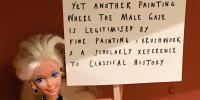
Museums and art galleries are not usually the sites of feminist political protest. Yet over the past couple of years, before the lockdown, gallery visitors all over the UK had noticed a small, determined activist whose modus operandi is “Small signs, big questions, fabulous wardrobe”.
Shortly after the close of this year’s International Women’s Day, China’s Twitter-like service Sina Weibo shut down Feminist Voices. With 180,000 followers, the group’s social media account was one of the most important advocacy channels for spreading information about women’s issues in China, but in an instant, it was gone. A few hours later, the private messaging app WeChat also shuttered an account for the group.
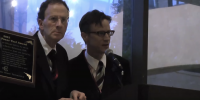
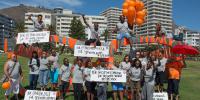
Two dozen rogue "delegates" disrupted the corporate-sponsored welcome gala for the high-stakes Trans-Pacific Partnership (TPP) trade negotiations yesterday with a fake award ceremony and "mic check." Other activists, meanwhile, replaced hundreds of rolls of toilet paper (TP) throughout the conference venue with more informative versions, and projected a message on the venue's facade.
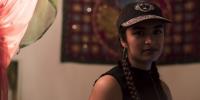
Khushboo Kataria Gulati lights an off-white candle and passes the flame to a switch of sage, casting a spell around the purple-lit room as she places paintbrush to canvas. The herbaceous smoke billows around her, time suspends and her paint strokes create a scene of three multicolored faces surrounded by plants.
"'Shake the Dust' is a feature documentary that tells the stories of break-dancers in struggling communities around the globe that, although separated by cultural boundaries and individual struggles, are intrinsically tied to one another through their passion for break-dancing and hip-hop culture.
The Guardian
By Tania Branigan
In the opaque world of Chinese censorship, a few red lines shine through the murk. One of the clearest is: no gossip about top political leaders, their families or internal party affairs.
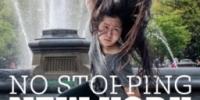
Kanami Kusakima, also known as the woman who dances in Washington Square Park with the long black hair and the paint, was happy to allow the Mayor's Office of NYC use her image as a promotional tool for a "post-coivd" New York. Yet, she has had multiple encounters with police who want to shut her performance down.
In 1996, filmmaker John Akomfrah created the character of the Data Thief as a narrative device to offer an insightful study of Afrofuturism in his film The Last Angel of History, which links Black musicians including George Clinton, Derrick May, and Sun Ra to Akomfrah’s thesis about the role of technological fantasy in Black artistry across genres and mediums.
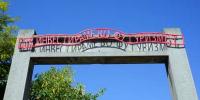
A site specific intervention аs part of the group exhibition Sculptural, organized and partly financed by the Museum of Contemporary Art, Skopje. The text INVEST IN FUTURISM is a quotation of a gaffe uttered by the Macedonian PM on public TV stating his plans to incorporate contemporary art in their right wing populist programme and the infamous project Skopje 2014.
From 1995 to 1997, Colombian families reunited in front of the TV to watch Quac: El Noticero, a comedy newletter performed by the comedian Jaime Garzon and the actor Diego Leon Hoyos.
It has been the only space in which the Colombian society was allowed to see a well made newsletter about the reality of the country and their politicians from a comedy perspective.
The “Perceiving Freedom” glasses sculpture on Cape Town’s Sea Point promenade looking towards Robben Island, commemorates late President Nelson Mandela and the values of freedom and equality.
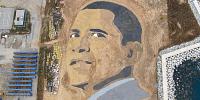
Jorge Rodríguez-Gerarda is a cuban Artist that was born in 1966. One of his projects was naed Expectations in which he did with sand and grave a massive image of Barack Obama, as a way to reflect all what this presidential candidate representated in terms of change.
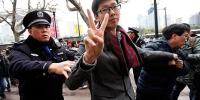
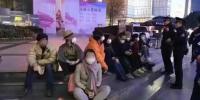
In the south-western city of Chengdu, by all accounts a city on the edge coping with heavy pollution but also with authorities scrambling to put a lid on simmering discontent. That night police detained a number of artists who managed to stage a silent demonstration, while wearing face masks.
Private Dinner Party: Clothing Not Allowed
The Füde Dinner Experience gathers those who want to meet, eat and drink — only after leaving their clothes at the door.
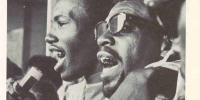
For some, October 14, 1968, was a clarion call to the future.
On that day, a group of 12 black students at UC Santa Barbara, tired of the unequal treatment and passive-aggressive racism they received as Black athletes — and as members of the campus community at large — barricaded themselves in the university’s North Hall.
When Bay Area activists Moms 4 Housing began their campaign, they were fighting gentrification and institutional poverty. Now, as California's housing crisis compounds during the COVID-19 pandemic, their work has taken on new significance.
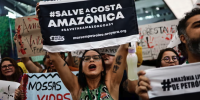
Thousands of Indigenous activists and environmentalists have converged in one of the Amazon’s biggest cities to voice their hopes and fears about the future of the world’s biggest rainforest.
The Brazilian city of Belém will this week host a two-day conclave bringing together the presidents of eight Amazon nations including Brazil, Colombia, Peru and Venezuela.
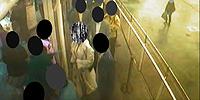
FACELESS was produced under the rules of the 'Manifesto for CCTV Filmmakers'. The manifesto states, amongst other things, that additional cameras are not permitted at filming locations, as the omnipresent existing video surveillance (CCTV) is already in operation.
Faces of the Movement is a daily-release photo project that highlights the stories of everyday people who have joined together to fight for justice against police brutality in the United States.