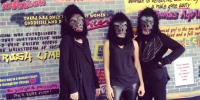
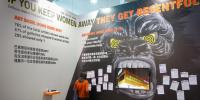
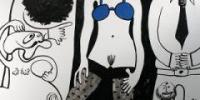
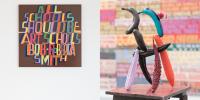
It’s women’s history month, and your favorite radical feminist avengers want you to go ape. The Guerrilla Girls have been making noise about gender and racial inequality in the art world since 1985. Fighting discrimination with a sense of humor and their signature faux fur, these masked feminists continue to challenge major museums to spotlight more women and artists of color.
Shackles. Cotton. The Big House.
Americans tend to think of slavery in terms of chattel slavery. Plantation Slavery. Slavery where human beings are bought, sold, and owned. The kind outlawed in the United States by the Emancipation Proclamation in 1863.
Slavery as a relic of the 19th Century.
“Six of us lived, worked, slept in a 10-by-10 (foot) room without a bed, bathroom, or clean water,” Nasreen Sheikh remembers.
For more than 30 years, the Guerrilla Girls have travelled the world exposing sexism and inequality in the art industry, and this week they proved Hong Kong was no exception.
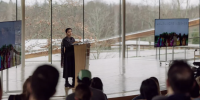
Three members of the anonymous feminist collective—calling themselves Frida Kahlo, Käthe Kollwitz and Zubeida Agha—spoke at the University of Hong Kong on Monday, dressed in their signature black outfits and gorilla masks.
The Origins of Totalitarianism:Donald Trump reads Hannah Arendt
AI video and sound. 2024, 24:30mins
YouTube link: https://youtu.be/RzWi51prZlA?si=hTUP4F-_nOSijbba
Zuoxiao Zuzhou is a Chinese singer whose accented, croaky voice is hardly ever in tune. But for his fans he's the voice of a generation — one of the very few voices who dare to speak out. After a collaboration, Cowboy Junkies member Michael Timmins called him "China's Leonard Cohen."
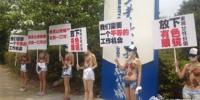
Female students from the Guangdong University of Technology in Guangzhou called for equal job opportunities and for people to "pay attention to the value of women" while protesting on the school's campus, shirtless and covered in body paint.
The photos, taken by ogling passersby, have been circulating on Weibo and naturally netizens stand divided on whether the semi-naked protests were empowering or counterproductive...
Last month Amina Tyler, a 19 year old Tunisian blogger, posted a nude photo of herself as a protest; she is now under death threat. In her defense, the Ukrainian group Femen [13] staged a global "topless jihad" [14] on April 4, causing widespread debate [15] about nude protests [16], freedom of expression, and Femen's politics. [17]
If you’ve spent a decent amount of time on Twitter, you’re probably familiar with the concept of K-pop fancams. The short clips of live performances, primarily by South Korean acts, often dominate replies on the app and are hated by many. This week, however, the social phenomenon has taken over in a different way: to fight for the rights of Black Lives Matter protesters seeking justice after the death of George Floyd.
With the support of the Amy Rossborough Foundation and several other Yale University affiliated departments, Tamara Leacock, while a senior at Yale University, designed a collection and produced a fashion show that explored through fashion, dance, and carnival an intimate portrait of HIV. The goal of the production was to display HIV in a setting that was intimate, personalized, and displayed with a human face.
Four prominent Australian artists – Aretha Brown, Claire Martin, Kaff-eine and Jane Gillings – will gather in Canberra this Sunday, to discuss their art, activism and ideas, marking the closing weekend of Kambri’s HERE I AM festival.
The Art Activism by Great Women Conference is a day-long event, involving artist talks, Q&A sessions, panel discussions, afternoon tea, wine tasting and networking.
Godfrey Mwampembwa, popularly known as Gado, has been holding politicians accountable for nearly 30 years. Now, his concern has shifted to the coronavirus.
In a quiet office on the third floor of a building in Nairobi’s central business district, the cartoonist known by his pen name, Gado, was sketching a satire about the coronavirus.
“What Is Missing?” is a multi-sited memorial created by Maya Lin to raise awareness through science-based artworks about the present sixth mass extinction of species, connect this loss of species to habitat degradation and loss, and emphasize that by protecting and restoring habitat, we can both reduce carbon emissions and protect species.
The image is stark. And shocking.
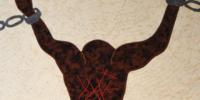
A black man, his ankles shackled, his head hanging away from the viewer, stands in relief on a field of white. Chains stretching to the image's borders on the left and right pull his arms taut. Fourteen crimson marks crosshatch his back. Within the dark fabric that frames "86 Lashes to Go," a small rectangle is labeled simply "salt."
This project consisted of an articulation between research, public policy and art. Corpovisionarios por Colombia was implementing a social change initiative in one of the poorest and most violents neighborhoods in Cali, Colombia. The demographic information showed that the most implicated population in the violence and murder cases were young men. They informed their masculinity through ideas of territory and its violent protection.
SACRAMENTO, Calif. (AP) — In director Adam McKay’s “Don’t Look Up,” a 2021 satire about two scientists who try in vain to warn the world about a planet-destroying comet, the scientists’ desperate plea for action ultimately doesn’t work.
But don’t take that as McKay’s view on the power of activism to change the course of the climate crisis, the existential threat his movie was really about.
Musicals for Change is a project aimed at educating elementary children to be active participants in the world through theater. Written by Diane Beckstead, these musicals promote uplifting messages about the importance of community, the arts, and helping each other, while raising support for worthy causes.
On the International Day of Education with students we have organized that creative action to ironizing the phenomenon of corruption in education.
We founded “University of Corrupted Sciences” as a symbol of all the issues that have characterized the education system in our transition years.
Bob and Roberta Smith has been at the forefront of activist art for 2 decades; so who better to ask about how art is responding to these politically bleak times?