Save Canada is a direct action that began in Ontario in fall 2013. In reaction to TransCanada's public relations tour of townships affected by the Keystone XL pipeline, Save Canada decided to infiltrate the meetings, which were being held as propaganda displays rather than honest conversations with the people.
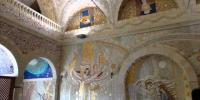
In 2009, clergy from El Oratorio Don Bosco in Italy moved to Polloc, a remote town in Peru near Cajamarca, and began to build a mid-sized cathedral. In conjunction to the construction, they opened up a workshop next to the construction site for the local youth to engage in art-making programming after school and on the weekends.
UK design students focusing on the use of design that moves beyond exclusivity, wealth, entitlement, and privilege, have created a coat that is also a shelter. The functional pocketed coat that converts into a tent and a sleeping bag, is intended for Syrian refugees. The students under the guidance of Dr.
The incident began when two clowns, Hannah Morgan and Louis Jargow, scaled the steel barricades protecting the landmark. The clowns began spanking and climbing the beast, traditional ways of coaxing a bull into anger in preparation for a Castilian corrida, or bullfight.
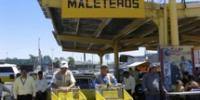
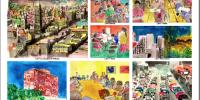
Malteros are the porters who transport luggage and goods between the border of the US and Mexico. Working with a group of maleteros in 2005, artist Mark Bradford collaborated on a system of maps and signs that placed the marginalized work of the unofficial maleteros alongside that of the sanctioned labor of policemen and taxi drivers.
Trickery and disguise, usually followed by revealing the truth, are often tactics used by liberal activism, like the Yes Men for example. When used by the right, however, it can have different implications. Pretending to be a CEO or billionaire in order to expose corporate greed and corruption is clearly different then pretending to be a minority. The use of disguise can manipulate and shed light on hierarchies of power.
“Baraye,” the anthem of Iran’s “Woman, Life, Liberty” protest movement—a song woven together entirely from a Twitter hashtag trend in which Iranians express their investment in the current protests—continues to unite Iranians in their opposition to the Islamic Republic several weeks after it was first released online.
For some, October 14, 1968, was a clarion call to the future.
On that day, a group of 12 black students at UC Santa Barbara, tired of the unequal treatment and passive-aggressive racism they received as Black athletes — and as members of the campus community at large — barricaded themselves in the university’s North Hall.
Opponents of military rule in Myanmar have marched, observed "flower strikes" and sought alternative ways to communicate after most users were cut off from the internet, undaunted by the bloody suppression of protests during the past two months.
The term “Afrofuturism” was coined in the 1990s by the cultural critic Mark Dery, who recognized a preoccupation with the future in the work of a number of black artists. Ever since, it has remained a term that is retrospectively applied to seemingly disparate artists, from Missy Elliot to Toni Morrison. What unites the movement is a shared fascination with the black experience, particularly in America.
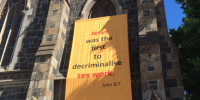
A big yellow banner hangs off the Central Methodist Church in Cape Town, South Africa proclaiming that *"Jesus was the first to decriminalise sex work - John 8:7"*
Strap into your scuba gear — this museum is worth it.
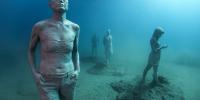
Installation began on Museo Atlantico — the latest project of underwater sculptor James deCaires Taylor — this week, 14 meters underwater in Lanzarote, one of the Spain’s Canary Islands off the coast of West Africa. Taylor, whose creations have spanned the waters from the Bahamas to London, calls it the first underwater contemporary art museum in Europe and the Atlantic Ocean.
Neighbors in modern cities have less and less communication, and they all go about their business as soon as they close the door. In Switzerland, a woman dies every week as a result of domestic violence, so in an effort to get everyone to act, the charity has put up an interactive billboard in a shopping mall that shows a man in a family doing violence to a woman.
The artist in close collaboration with AMI (Assembly of Indigenous Migrants of Mexico City) has created a series of monographs made by students, through ‘tequio’: a communal system of organisation expressed in collaborative practices, mandatory and unpaid work. The goal of the project is to offer information about the lifestyle and culture of these indigenous communities, which live in Mexico City.
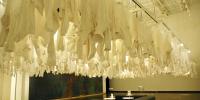
NORTHFIELD, Minn. — Exactly 1,281 white garments hang from the ceiling of the Perlman Teaching Museum’s Braucher Gallery. The collared shirts, knit sweaters, tights, and other items of clothing glow with an eerie luminosity.
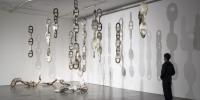
“I am a silkworm.” Liang Shaoji has repeatedly used this phrase to describe his work, underscoring his preoccupation with the materiality of silk and the technology of sericulture, or silk farming. For more than twenty-five years, Liang Shaoji has raised silkworms and trained them to spin silk onto different objects in his Nature series.
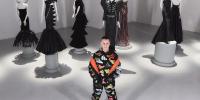
Jeremy Scott and Moschino may no longer be a thing but the designer is still plenty busy. Case in point, Scott's new partnership with Korean car manufacturer Hyundai, the latest in the latter's ongoing Re:Style upcycling program.
For Hyundai Re:Style 2023, Jeremy Scott has saved discarded Hyundai Motor Car parts from the junk pile, instead transforming them into wearable couture (car-ture?).