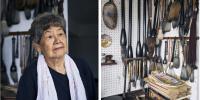
When Behnaz Babazadeh was young, her family moved from Afghanistan to the US. She loved almost everything about her new home — especially America’s amazing selection of candy — but she also loved wearing her familiar pink-flowered headscarf, which she’d grown used to wearing as part of her school uniform in her old home.
Black Lives Matter has pushed the national conversation on race—but the trauma and pain behind the fight against systemic racism can weigh heavily on black organizers and the communities they serve.
This was the case for Kleaver Cruz, a 27-year-old writer and community organizer at Black Lives Matter: NYC. A few days after Thanksgiving, he woke up deeply saddened, physically unable to move.
A television report written, directed and produced by Enmedio members Leónidas Martín and Xavier Artigas. Collective projects that see art as a kind of social relationship. Artistic interventions that target consumption, media guerrilla tactics, creative mobilisations and protest, critical projects brimming with humour and disobedience, new narratives capable of changing the existing symbols and codes.
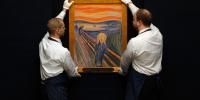
Amidst a crowd of protesters and oversized signs, Pat Walsh shouted, “What’s disgusting? Union busting?”
At a glance, Walsh, a woman with well-kept gray hair and an open
smile, didn’t strike one as the usual angry protester. But that night,
Walsh was fighting.
“My husband, John, has been locked out from Sotheby’s,” says Walsh.
“He’s been a worker for 30 years. I’m here to fight for him.” Currently,
In 2017 Ge Yulu became a national sensation in China. That year, he submitted his final project as a student at the Central Academy of Fine Arts in Beijing, revealing the unnamed road in Beijing that he had claimed in 2014 as his own. Because the Lu character in his name means road, he erected a sign for Geyu Road that blended seamlessly into the setting.
During a cold January morning in 2020, Animanaturalis, a nonprofit group focused on ending the suffering of animals across Spain and Latin America gathered to protest the use, production, and sale of fur in Spain. In a blog post on their website, the group discusses the horrid living conditions on fur farms as well as statistics and alternatives related to fur sales (Animanaturalis, n.d.).
Alex King describes Project Ukko in detail for Huck Magazine (March 17, 2016):
"Moritz Stefaner’s Project Ukko turns climate and wind data into an immersive art installation that allows viewers to explore the future of the planet."
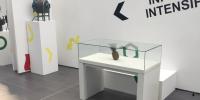
How did a pineapple become a postmodern masterpiece?
The aesthetic merits of tropical fruit inadvertently entered Britain’s national cultural conversation after two students jokingly placed a store-bought pineapple on an empty table at an art exhibition this month at Robert Gordon University in Aberdeen, a port city in northeastern Scotland.
Meet To Sleep, a campaign started by Blank Noise, asks citizens from all across India to come to different public spaces like parks, and sleep there in order to take back free spaces without being afraid for their safety. The first meet was organised in November, 2014, in Bengaluru’s Cubbon Park. And since then there have been eleven meets across various cities including Jaipur, Pune, Mumbai, and Bengaluru.
From 1993 to 1998, Spanish activist group Lesbianas Se Difunden (LSD) produced and published a collection of texts and visuals called Non-Grata (Snyder 10), using erotic images of the female body and sexual relationships to capture their audiences’ attention. Within these graphic publications would be calls for queer activism, female freedom, anti-capitalist critiques, and the overall necessity for protest (Snyder 10).
On Thursday, two climate protesters dressed in suits smeared paint on the case and pedestal of Edgar Degas’s sculpture Little Dancer Aged Fourteen sculpture at the National Gallery of Art in Washington, D.C.
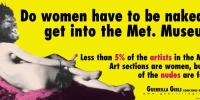
The Guerilla Girls are a group of feminist activist artists, who use facts, humor, and outrageous visuals to expose gender and ethnic bias and corruption in politics, art, film, and pop culture in their artworks. In 1989, they designed this billboard for the Public Art Fund (PAF) in New York, aimed to criticize the museum institutions for under-representing female artists and objectifying women.
This is the image confronting Greeks from an Athenian drain . "Hello, I live in the sewers of Athens," says the cockroach. "Yes, me too," says an Athenian walking past, apparently unfazed by the idea of an insect talking to him from a drain.
In São Paulo, just like in many other metropolitan regions, public transport is not as effective as it could be. Buses and trains usually run overcrowded, late and on limited hours, so that owning a car increases a lot one’s comfort. But not everybody can afford to have one, so a clear and recurrent class distinction occurs: public transport is mostly used by poor people.
FloodNet was a conceptual artwork and a tool for online collective action.
Developed by the collective Electronic Disturbance Theater (EDT), it took the form of a Java applet that allowed users to send useless requests or personalized messages to a remote web server in a coordinated fashion, thereby slowing it down and filling its error logs with words of protest and gibberish—a kind of virtual sit-in.
In 2008, Iceland was in turmoil. There was a systematic failure of its three main commercial banks. The Economist called the collapse the largest suffered by any country in history, relative to Iceland’s population size. In response to what was seen as government inertia, protests began to take place from around October of that year. However, the real fun began in January 2009.
The People’s Bank of Govanhill uses social and activist art practices to involve people in re-imagining the local economy, looking at how we can put feminist economics into practice in the local community.
On a recent eight-hour shift at a McDonald’s in Hong Kong, Luke Ching, 52, wiped tables, cleared trays of half-eaten fries, emptied cups of soda and milk tea and lugged bulging trash bags to the dumpster.
For him, the main goal of the part-time work was not making ends meet. It was research for his main pursuit: using art to advocate for better treatment of people in menial jobs in a city with one of the widest income gaps in the world.
The beacon flashed incessantly. On. Off. On again.
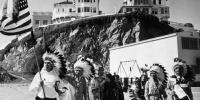
Like some sort of traffic light gone crazy, it pierced the thick nighttime mist hovering over San Francisco Bay. The light sent a message five miles across the dark waters from Ghirardelli Square to Alcatraz Island. There, cheers erupted as the light flashed the words, "Go Indians!"