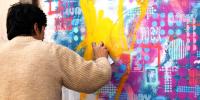
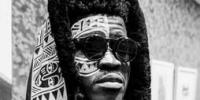
The story of an artist. Laolu Senbanjo grew up surrounded by the culture and mythology of the Yoruba, an ethnic group from the southwest of Nigeria, but he never imagined how it would influence the artist he is today. After a career as a human rights attorney, Senbanjo moved to New York City to pursue art full time. “With my art, I like to tell stories, I like to start a conversation,” says Senbanjo, but life as an artist in New York was tough.
A town in northwestern Syria has become the creative center of the revolt against President Bashar al-Assad. Since the beginning of the uprising, the residents of Kafr Anbel have drawn signs that skewer the Assad regime and express outrage that the world has not done more to stop the killing in Syria.
From Jezebel:
Marley Dias is an 11-year-old New Jersey resident who’s rounding up children’s books that feature black female leads so that she and her peers have more fictional characters to look up to.
The project, titled #1000BlackGirlBooks, started when Marley complained to her mother about reading too many books about white male protagonists in school.
In 2023, it is impossible to be an apolitical artist in Eastern Europe. As war rages on in Ukraine, art serves as a powerful and necessary tool, according the members of the Sunflower Solidary Community Center in Warsaw: Maria Beburia, Sebastian Cichocki, Kuba Depczyński, Taras Gembik, Yulia Krivich, Kaja Kusztra, Natalia Sielewicz, and Bogna Stefańska.
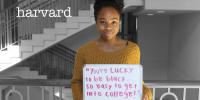
hat’s it like to be black at Harvard? Students at the Ivy League university are offering a picture of their experiences there with a play and a photo campaign called “I, Too, Am Harvard,” a nod to the famous Langston Hughes poem.
When Tracey Emin aired her dirty laundry in the 1999 Turner Prize exhibition at Tate Britain, she set a new standard for confessional art. She conceived of the installation, titled My Bed (1998), after a long, bedridden bender following a bad break-up. When Emin finally left her sheets, she examined the mess she’d created.
This action, to be released to the wider public this Friday, March 15th, was the design of t-shirts in support of British Charity, Comic Relief, an organization dedicated to bringing positive and lasting change to vulnerable youth communities in Europe (specifically in the U.K.) and various countries in Africa and, most critically, addressing the root causes of their poverty.
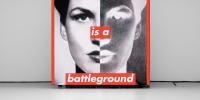
Untitled (Your Body is a Battleground) is an iconic 1989 silkscreen portrait made by artist, feminist and activist Barbara Kruger .
Though the poster was meant for the pro-choice march on April 9th, 1989, in DC, the portrait is now used mainly to voice the artist’s own opinion about gender inequality. The piece is much more relevant in today’s society, where it controls the way we view and treat women’s bodies.
"Work-from-home lawyers and museum staff convened by webinar on 11 and 12 March, for an annual conference on Legal Issues in Museum Administration, hosted by the non-profit American Law Institute with the support of the Smithsonian Institution. This year’s focus was decidedly shaped by the Covid-19 pandemic, which has squeezed museums financially and pushed ever more museum activity into the digital realm.
An oversized facsimile of Rush poppers, tipped over, pouring out its viscous contents: this example of underground gay iconography blown up to almost belligerent proportions perfectly represents the aims of Party Out of Bounds: Nightlife as Activism Since 1980, a new exhibition at La MaMa’s La Galleria. The group show, curated by Emily Colucci and Osman Can Yerebakan, gathers together works by a small yet distinct menagerie of queer artists.
#ChallengeAccepted, also known as the Challenge Accepted campaign, is an Instagram tagged challenge as well as an awareness campaign on empowering women involving sharing posts of black-and-white selfies.
Activists campaigning to change Lebanon's law on rape have staged a macabre protest on Beirut's famous sea front.
What appeared to be more than 30 white wedding dresses were hung from nooses, strung up between the palm trees.
Lebanese law currently allows a rapist to be exonerated if he marries his victim.
The activists are pressing to have the legislation abolished at an upcoming session of parliament.
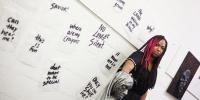
'White Walls Say Nothing’ is the first feature-length film of its kind to explore art and activism in the streets of Buenos Aires.
Buenos Aires is a complex, chaotic city. It has European style and a Latin American heart. It has oscillated between dictatorship and democracy for over a century, and its citizens have barely known political or economic stability.
Artist and activist Niki Lopez is a survivor. From age 11 to 25, she was trapped in a religious cult in Georgia, where she was separated from the rest of her family. The cult's leader sexually abused her. But in 2000, Lopez escaped and worked with the FBI to put him in prison. She was later given a humanitarian award from the FBI for her help in putting her abuser behind bars.
Out in Schools is a high school outreach initiative that has received acclaim from parents and educators across British Columbia since 2004. The Out in Schools program uses age-appropriate film and video presentations to engage youth and educators on issues related to homophobia and violence.
In 1989, playwright, actor, and activist Safdar Hashmi was fatally attacked by political thugs while performing a street play outside of Delhi. His death led to the founding of Sahmat, an influential artist collective that has taken a consistent stance against the threats of religious fundamentalism and sectarianism in India through a vibrant mix of high art and street culture.
Oh, to be a crow.
Maligned as scavengers that torment their dead brethren. Portrayed as aerial killers in the 1963 Alfred Hitchcock classic, “The Birds.”
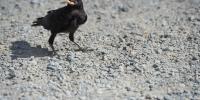
In France, though, the wily crow is getting a makeover. Puy du Fou, a historical theme park in the Loire region about four hours from Paris, has trained six crows to pick up cigarette butts and bits of trash and dump them in a box.
Mon Dieu! Are the pigeons of Paris next?
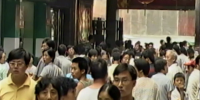
Shouting is one of Xu Zhen’s early works questioning the limits of individual expression. First exhibited at the 51st Venice Biennale in 2005, the video shows Xu hiding in crowds and performing a series of loud screams in Shanghai.
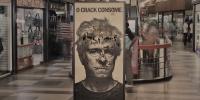
To show the harmful effects of cocaine on a drug addict, Brazilian advertising agency Talent created ‘living’ poster ads that are consumed by live mealworms over time.
Printed on dough, the ads initially show the faces of drug addicts.
However, as time passes, the mealworms slowly eat away at the posters, causing holes to form on the printed faces—highlighting the harmful effects of the drug.