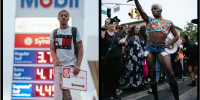
Acting on a tip from a disgruntled neighbor, two comedians dressed as drag queens confronted parking officers in broad daylight.
The pair wanted to know why the officers, who so ruthlessly enforced parking limits, had never so much as given a warning to the local fruit salesman, whose battered Ford Explorer sat illegally parked all day, every day, in the upper-class neighborhood of Polanco.
Sitting at a folding table in the basement of Trinity Episcopal Church in downtown Columbus, Monica Jacobo used a felt tip marker to write the words “No means no!” on a white bandana.
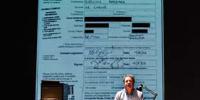
Theater as investigative reporting or investigative reporting as theater, however you cut it, Mark Thomas, a British TV actor/comedian and activist has created a fascinating show. It's by him and about him: how he ran stings that put some illegal arms traffickers out of business or in jail and how he was deceived and betrayed by a "comrade" who turned out to be a spy for BAE Systems, the UK's largest aerospace and weapons company.
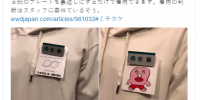
Female staff members at a new shop in Osaka, Japan are being encouraged to wear badges to indicate when they’re on their period to tackle the stigma surrounding menstruation in the country.
Women working at the Michi Kake store, which sells an array of female sexual and menstrual health products, do not have to take part in the scheme, but those that do will pin one of the “period badges” next to their regular name tags.
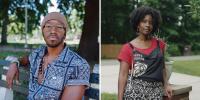
Through their podcast, The Dance Union, Melanie Greene and J. Bouey have been confronting racism in the dance world, and highlighting the experiences of Black artists, since 2018. Their episodes cover a variety of topics and issues, ranging from mental health and sexual harassment to advocating for fair pay.
Máximas de Seguridad, a survival manual written and illustrated by Jhafis Quintero creates a new voice for the voiceless, vulnerable and underprivileged groups in prisons and creates empathy for those that are labeled as dangerous by society. The manual aims to provide empathy and humanity in light of the public scrutiny that ex-prisoners endure in the transition to social reintegration.
Destin from the Youtube channel Smarter Every Day has started the "Hunstville Fighting Covid" website in order to mobilize and teach those who have 3D printers how to print Personal Protective Equipment to aid medical professionals fighting the COVID-19 epidemic.
There were still bloodstains outside the Midwood Mobil gas station on Friday night; a fresh sign taped to a lamppost read “A Hate Crime Happened Here.” This is the place where, less than a week prior, 28-year-old O’Shae Sibley, a gay Black dancer and choreographer, made a pit stop with friends after a Jersey beach day.
Emel Mathlouthi (Arabic: آمال المثلوثي) is a Tunisian singer-songwriter best known for her protest songs "Ya Tounes Ya Meskina" (Poor Tunisia) and "Kelmti Horra" (My Word is Free) which became anthems for the Tunisian revolution and the 2011 Egyptian revolution.
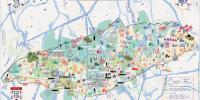
The ZAD (zone à défendre, or “zone to defend”) in Western France is 4000 acres of wetland, farmland and forest that was originally intended to be built into an airport in 1965 but is now an autonomous territory occupied by 40 different collectives looking to reclaim the land. There are around 200 people living permanently on the zone, in addition to some 2,000 people coming and going.
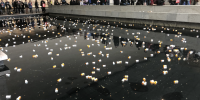
This afternoon, in the Sackler Wing of the Metropolitan Museum of Art in New York, a mother and daughter threw coins into its reflecting pool while a couple posed for engagement photos in front of the Temple of Dendur, the man in red pants and a gray blazer, the woman in a black jumpsuit. A long line snaked out of the temple. It was tranquil, most people speaking in a whisper. That grand space has such an effect on people.
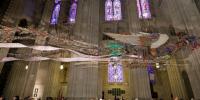
Xu Bing, the internationally acclaimed Chinese artist, has brought his “Phoenix” installation to the majestic nave of the Cathedral Church of St. John the Divine on Manhattan's Upper West Side. The two phoenixes, both Feng, the male, and Huang, the female, faced the decoratively carved bronze doors of the Cathedral, as if poised to take flight in the middle of the night.
In the wake of the amount of police brutality that has been occurring since the dawn of the damn police, an institution that began as a way to find escaped slaves, across the United States, #manisfestjustice chooses to make its explicit artistic mission to demand that power take responsibility, and to provide avenues to community empowerment in the meantime.
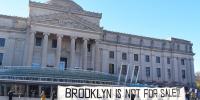
The Brooklyn Anti-Gentrification Network is a grassroots movement and campaign to prevent the displacement of low-to-middle income people, elders, families and mom-and-pop businesses from Brooklyn. They say, “Not 1 more person displaced! Not 1 more luxury development, until we have affordable housing for all!”
Anti-Fur advocates have been protesting through demonstrations for decades, throwing red paint on women wearing fur coats, passing out leaflets and sporting the slogan “Fur Is Dead” on t-shirts and stickers and spray-painting it on buildings in cities throughout the globe.
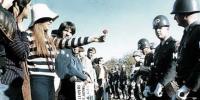
Flower power was a slogan used during the late 1960s and early 1970s as a symbol of passive resistance and nonviolence. It is rooted in the opposition movement to the Vietnam War. The expression was coined by the American Beat poet Allen Ginsberg in 1965 as a means to transform war protests into peaceful affirmative spectacles.
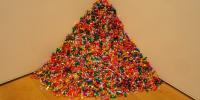
Artist: Félix González-Torres
Media: Candies in variously coloured wrappers, endless supply, ideal weight of 175 lb
Date & Location: 1991
Where can I find this item?: Art Institute of Chicago, Contemporary Art, Gallery 293
Source: Wikimedia Commons (Creative Commons)
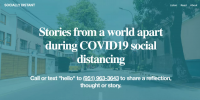
How it works:
1. Call or text “hello” to (951) 963-3643 to share your experience. Make sure you’re in a quiet place. Maximum recording time is 10 minutes.
2. Please start by telling us where you’re calling from. Perhaps you can even paint a picture of your surroundings for anyone who listens. Then share what you want to say.
3. Hang up when you’re finished.
In 2008, an earthquake devastated Sichuan province in China, claiming the lives of more than 69,000 people. Following accusations from parents that substandard construction caused the collapse of schools across in the region, the artist Ai Weiwei set upon a political investigation that would name every missing student and call the government to account for their deaths.
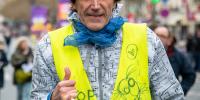
A human tide swept through Paris last month for the type of event France knows only too well — a protest. Union leaders led the march, awash in a multicolored sea of flags. Demonstrators shouted fiery slogans. Clashes with the police erupted.
And, as in every protest, there was Jean-Baptiste Reddé.