The post (r)evolutionary exercises are the outcome of a meeting/friendship/project that started in summer 2010, when we took part in "Goings on" seminar in Beirut, Lebanon. In this seminar, curated by Cecilia Andersson, Scandinavian and Middle east art groups were invited to meet and learn about each others practices. That's what we did, we got along really well, and we started at once to think of ways to do something together again.
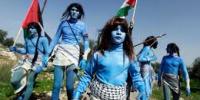
Bil'in is a Palestinian village located 12 kilometres west of the city of Ramallah in the central West Bank. In 2005, the Israeli government began constructing the security barrier in the Bil’in area, and since then approximately 55 percent of Bil’in’s former land has been used for the construction of the Modi’in Illit settlement.
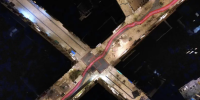
The "Day of Disruption" kicked off earlier than planned early on Thursday morning when dozens of Israeli artists painted a red line on the road to Israel's High Court of Justice in Jerusalem.
Acknowledging that sexual harassment is a serious problem in Egypt, the volunteer based organization HarassMap has created a series of strategies -both on site and online- to stamp out the social acceptability of sexual harassment in the country.
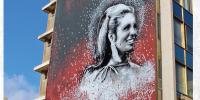
Yazan Halwani is a young Beiruti artist who paints murals of revered Lebanese and Arab figures on prominent walls in a bid to help overcome sectarianism in this fragmented city. “What I try to do,” he explains down a fuzzy line from Beirut, “is write the stories of the city, on its own walls – creating a memory for the city.”
Najah al-Bukai cannot forget.
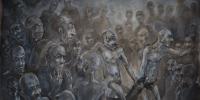
As an accomplished artist in Syria before the war, Mr. Bukai had long thought his photographic memory was his greatest asset, allowing him to recreate scenes on his sketch pads and canvases days, months and even years after he witnessed them. But now, after he has survived two stretches in the Syrian government’s notorious detention centers, his sharp memories only serve to haunt him.
Being a Kuwaiti citizen makes you feel like you belong to Kuwait, as nationality is a legal relationship between a person and a state. But what if you are a “halfie” and are finding it hard to answer the question “Where are you from?” Those whose fathers are Kuwaiti are automatically considered Kuwaitis but those whose moms are Kuwaiti and fathers are not, they are not granted the nationality, even if they are born here.
On your doorstep, or in their neighbourhood hotel, or the local tea shop, the media bring to you a world full of troubles. But along with that, they’ve had some consideration for your funny bone and give you a daily dose of laughter by publishing the work of some of the finest cartoonists in the country. “
On May 5 – World Cartoonist Day – here’s bringing you a glimpse of your favourite illustrators and what keeps them going.
EP Unny
Activists campaigning to change Lebanon's law on rape have staged a macabre protest on Beirut's famous sea front.
What appeared to be more than 30 white wedding dresses were hung from nooses, strung up between the palm trees.
Lebanese law currently allows a rapist to be exonerated if he marries his victim.
The activists are pressing to have the legislation abolished at an upcoming session of parliament.
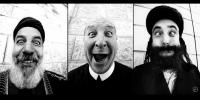
In 2007, anonymous French photographer JR embarked on the Face2Face project - the largest unauthorized photo exhibition ever conceived. JR and his collaborator Marco engaged Israelis and Palestinians employed in the same profession to be photographed making funny faces. They then enlarged the photos to grand proportions and wheat pasted juxtaposed portraits onto both sides of the security Separation Wall and in surrounding cities.
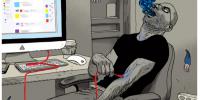
Asaf Hanuka is a cartoonist and illustrator based in Tel Aviv, Israel. His illustrations span the themes of technology, revolution, war, Judaism, and depictions of family life and the individual in modern day society.
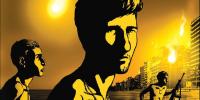
He had served in the army, either as a full-time soldier or as a reservist, for 22 years when he finally decided he wanted out. In 2003, Ari Folman, who had just turned 40, asked his commanders in the Israel Defence Forces to release him from the obligation to do a month's military service every year. They agreed - "so long as you go to the army therapist and talk about everything you went through".
Bashar al-Assad snores, his head twitching on a large white pillow. Suddenly, he wakes up. “The people want to overthrow me!” he screams, the pompom on his nightcap bouncing.
The Islamic Republic has always frowned upon dance but recently even a simple choreographed or ‘synchronized movement’ – as the regime calls it – has become an act of protest.
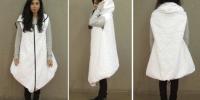
UK design students focusing on the use of design that moves beyond exclusivity, wealth, entitlement, and privilege, have created a coat that is also a shelter. The functional pocketed coat that converts into a tent and a sleeping bag, is intended for Syrian refugees. The students under the guidance of Dr.
A Lebanese Olympic skier whose topless calendar prompted calls for a ministerial inquiry has unwittingly sparked a social media campaign backing her, with supporters stripping off in solidarity.
Three years ago, Jackie Chamoun posed for a calendar photo shoot. Behind-the-scenes footage recently was posted online, and Lebanon's sports and youth minister reportedly ordered an investigation.
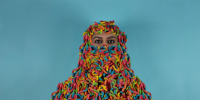
When Behnaz Babazadeh was young, her family moved from Afghanistan to the US. She loved almost everything about her new home — especially America’s amazing selection of candy — but she also loved wearing her familiar pink-flowered headscarf, which she’d grown used to wearing as part of her school uniform in her old home.
Shirin Neshat’s Women of Allah is a photographic series exploring the complex identities of Muslim women in post-revolutionary Iran. Combining black-and-white portraits, Persian calligraphy, and symbolic elements such as guns and veils, Neshat interrogates themes of martyrdom, violence, femininity, and resistance.
The development of the Nights from the oriental oral and literary traditions of the Middle Ages into a classical work for Western readers is a fascinating one. The notebook of a Jewish book dealer from Cairo around the year 1150 contains the first documentary evidence for the Arabic title. The oldest preserved manuscripts, comprising a core corpus of about 270 nights, appear to date from the 15th century.
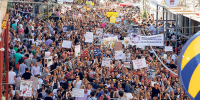
Thousands of animal rights activists marched against a draft law on Sunday that would make changes to Turkey's Animal Protection Law No. 5199, seeking to introduce practices currently used in other countries such as collecting stray animals from the streets and euthanizing members of the “excess” population.
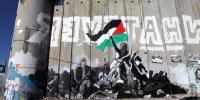
In June 2002, the Israeli Government decided to construct a physical barrier separating Israel and the West Bank. The declared purpose of this (as yet unfinished) 709 kilometers long barrier—which came to be known as Gader Ha’hafrada (The Separation Wall)—was to prevent the entry of Palestinian terrorists from the occupied territories into Israel in order to protect Israeli citizens.
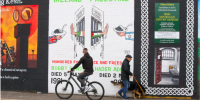
Palestinian and Israeli flags flutter in pro-Irish and pro-UK neighbourhoods in Northern Ireland, tapping into its own history of conflict and division that still affects everyday life despite a 1998 peace deal that largely ended violence.
The Trials of Spring is a major documentary event that chronicles the stories of nine women who played central roles in the Arab Spring uprisings and their aftermaths in Egypt, Tunisia, Libya, Syria, Bahrain and Yemen. It includes a feature-length documentary, six short films, articles by award-winning journalists, and a robust social media conversation about women and their unwavering quest for social justice and freedom.