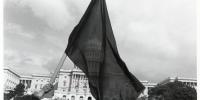
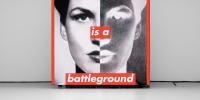
Untitled (Your Body is a Battleground) is an iconic 1989 silkscreen portrait made by artist, feminist and activist Barbara Kruger .
Though the poster was meant for the pro-choice march on April 9th, 1989, in DC, the portrait is now used mainly to voice the artist’s own opinion about gender inequality. The piece is much more relevant in today’s society, where it controls the way we view and treat women’s bodies.
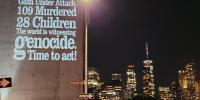
As the death toll from Israel’s attacks on the besieged Gaza Strip continues to rise, a guerrilla projection on May 13, 2021 illuminated a building in Brooklyn’s Dumbo neighborhood with messages of solidarity with Palestinians.
In 2011, a video displaying fashion designer and former lead designer at Dior, John Galliano, shouting anti-Semitic remarks, went viral on the internet, leading to his subsequent dismissal from Dior and the subsequent defamation of his career. Nonetheless, Parsons at the New School extended Galliano an offer to teach a specialized design seminar, which was scheduled to begin this year.
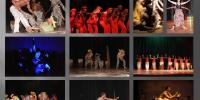
The Uganda National Contemporary Ballet (UNCB) presented a new powerful and moving production advocating for the child soldiers all over the world at the National Theatre in Kampala.
The Center for a Stateless Society (C4SS) is an anarchist think-tank and media center. Its mission is to explain and defend the idea of vibrant social cooperation without aggression, oppression, or centralized authority.
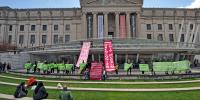
On Sunday, April 29, dozens of protesters occupied the Beaux-Arts Court at the Brooklyn Museum as they reiterated demands for a decolonization commission, about which the art institution has remained silent. The calls for the commission come after the criticisms that followed the appointment of two white curators to the museum, including in the field of African art.
An anti-Nazi organization called Exit-Deutschland targeted a right-wing Rock Festival in a city called Gera. They got in contact to the festival organizers by using a fictitious name, and they distributed 250 trojan t-shirts with a writing “Hardcore Rebels” during the festival. When the recipients of the shirts went back home and washed them.
The coronavirus outbreak has prompted climate activists to abandon public demonstrations, one of their most powerful tools for raising public awareness, and shift to online protests.
This week, for example, organizers of the Fridays for Future protests are advising people to stay off the streets and post photos and messages on social media in a wave of digital strikes.
In early 2016, I began paying attention to reports about the incredible number of unarmed black people being killed by the police. The posts on social media deeply disturbed me, but one in particular brought me to tears: the killing of Alton Sterling in my hometown Baton Rouge, La. This could have happened to any of my family members who still live in the area. I felt furious, hurt and hopeless.
Our project aims to show people that joy can be an act of resistance and resilience in the face of global justice issues when harnessed in the right way. The sharing of joy can also act as a connector in a society that continues to grow more polarised through the division of social media and mainstream media.
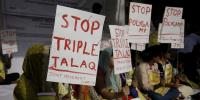
The egregious practice that some Muslim men employ to divorce their wives instantaneously and without their consent, merely by uttering the word talaq (divorce) three times, has finally been declared unconstitutional and illegal by the Indian Supreme Court. The country’s ruling Bhartiya Janata Party (BJP) party claims that the ban is a victory for its administration, which had been advocating its abolition since it came to power in 2014.
A young and beautiful girl posted a piece of paper selfie every day on Instagram, the most popular social network at the moment. In just over 4 months, with 184 selfies, her fans quickly rose to 90,000. In the photo, she is sometimes sweet and lovely, sometimes sexy and attractive, and sometimes turned into a healthy and positive "organic girl"... Now there are nearly 150,000 people around the world who follow her every day.
On this International Women’s Day, we wanted to celebrate the commitment of a very special human being. Her name is Zaria Forman, a leading artist in contemporary art with a cause. She is not only an exceptional human being; she is also an incredible American drawer who uses art to convey the emergency of climate change.
Sophie Calle's works discuss the issue of "privacy", the composition of an individual's identity at the social level, and the relationship between "private" and "public/group/society", including personal information, personal records, public surveillance, and other topics. An obvious feature of her works is the unique and extremely subjective criteria of judgment and reference for measurement.
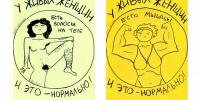
"My body is not pornography" — that is the slogan written under many of the social media posts inspired by Yulia Tsvetkova. Women are posting pictures of themselves showing off their curves, body hair and scars, along with feminist art and pictures of everyday objects that look like vaginas — like fruits or flowers.
Hair Nah (https://hairnah.com/) is a game created by Momo Pixel, a Black woman who wanted to represent how it feels for people to touch her hair without consent. The game is fun but also impactful, especially with the mechanic of "getting tired" of smacking away hands.
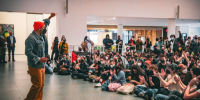
As the conflict between Israel and Hamas continues, hundreds of people gathered inside the Museum of Modern Art and outside of the Brooklyn Museum on Saturday for protests.
Zheng Xi 郑熹, a Ph.D. candidate with a focus on gender studies at Zhejiang University in Hangzhou. Zheng has launched a campaign asking city governments around China to display anti-sexual-harassment logos, complete with a groper’s “salty-pig hand” visual (etymological context here), alongside other commonly displayed public safety logos on places like subway trains and buses.