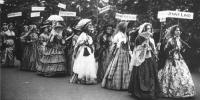
On June 17, 1911, a week before the coronation of King George V, women from diverse backgrounds united in costume and with installations over a shared political view - that of rallying the right for women to vote. Known as the Women's Coronation March, women thronged the streets between Blackfriars Bridge and Albert hall in a five-linked chain, dressed for the most part in white.
In the Ukraine, a country where females are victims of sexual trafficking and gender oppression, a new tribe of empowered women is emerging. Calling themselves the “Asgarda”, the women seek complete autonomy from men. Residing in the Carpathian Mountains, the tribe is comprised of 150 women of varying ages, primarily students, led by 30 year-old Katerina Tarnouska.
Regina Galindo is a Guatemalan performance artist that uses her body as a means to explore many of the human rights violations in Guatemala. In one of her performances, " no perdemos nada con nacer," or " we don't lose anything by being born," the artist "disposes" of herself in a plastic bag.
On Saturday June 27 th the Abortion drone flies for the first time packages of abortion pills from Frankfurt an der Oder in Germany to Słubice in Poland.
In 2012, VOW Media worked with young girls - who have been victimized by, or are at the risk of falling victim to “loverboys”, as well as girls who have gone through severe traumatic experiences, such as repeated emotional, physical and/or sexual abuse – in a series of workshops where they learned how to utilize different forms of media to create their very own self-portrait with photography, radio, and video.
Have you ever wanted to see current or potential innovations for poverty or the environment without having to do a lot of researching or reading? Have you ever thought of an idea and wanted to tell the world about it and get feedback? Howitcouldbedifferent.org was founded for these purposes - to enable people to easily see, share, and suggest ideas in different categories.
By Nora Fakim, BBC News
Several hundred women's rights activists have demonstrated outside Morocco's parliament to demand the repeal of a law on sexual violence.
Morocco's penal code allows a rapist to marry his victim if she is a minor as a way of avoiding prosecution.
A 16-year-old girl, Amina Filali, killed herself a week ago after being severely beaten during a forced marriage to her rapist.
The One Billion Rising campaign is a global movement that's using dance to combat gender violence worldwide. Initiated by "Vagina Monologues" creator and women's activist Eve Ensler, the campaign will see cities across the world hold dance parties on Valentine's Day to raise awareness about gender violence and rape.
"Every year Playboy releases the ultimate guide to campus life: our infamous party school list. Over the years, it has been brought to our attention that some of our long-standing party picks have a not-so-toast-worthy, rape-ridden side to their campus life."
Maha ElNabawi
Amid the bleak backdrop of a revolution-riddled Egypt, a beacon of positivity shone on downtown Cairo Friday during the launch of one of the most exciting, social-conscious street art collaborations to happen this year.
The Trials of Spring is a major documentary event that chronicles the stories of nine women who played central roles in the Arab Spring uprisings and their aftermaths in Egypt, Tunisia, Libya, Syria, Bahrain and Yemen. It includes a feature-length documentary, six short films, articles by award-winning journalists, and a robust social media conversation about women and their unwavering quest for social justice and freedom.
In 2013, a group of ten women incarcerated at York Correctional Institution in Connecticut, calling themselves “Women of York,” created this work of art inspired by Judy Chicago’s The Dinner Party. The installation includes six entry banners and ten place settings arranged on a triangular table, each dedicated to a woman of personal significance to the artist.
A press release from the non-profit organization - Women on Waves - regarding the intention of the creation of the Diesel for Women hoax website, pointing out the mistreatment of women workers in the fashion industry. This blurb and included images are taken directly from the Diesel for Women website:"BY Women on waves on February 4, 2012
By Maha ElNabawi
It was a landmark day when prominent women’s rights activist Doria Shafiq bravely led a march of 1,500 women to storm the gates of Parliament on 19 February 1951. After several hours of unrelenting protest, Shafiq was finally received inside the office, where the council agreed to consider the demands of Egyptian women.
On March 10, 1914, Mary Richardson slashed Velasquez's "Rokeby Venus" with a small axe during public hours at the National Gallery in London. A militant suffragette protesting the force-feeding of imprisoned suffragettes in prison (and the Cat and Mouse Act which released the starving women only until they were slightly healthier only to imprison them again), Richardson released this statement after her arrest:
“Stop hitting me,” “Please help,” and “Abuse is wrong” were just a few phrases painted and scribbled onto T-shirts by victims of sexual and domestic abuse to express how it felt to go through that pain.
The shirts are part of the Clothesline Project and were on display at Lane College on Wednesday.
India Ink [Blog]
The New York Times Global Edition
April 4, 2012
By Neha Thirani
The women of Gurgaon, angered by the recent incidents of violent crimes against women in the outsourcing boom town, are calling for a “Girlcott.”
They call themselves feminist masked avengers in the tradition of Robin Hood, Wonder Woman and Batman. They wear costume gorilla masks to remain anonymous, and they are devoted to fighting sexism and racism within the visual art world internationally.
The satirical website was launched at noon on Monday, December 3. According to the site, “PINK loves CONSENT is our newest collection of flirty, sexy and powerful statements that remind people to practice CONSENT. CONSENT is a verbal agreement about how and when people are comfortable having sex.”
The Dinner Party, an important icon of 1970s feminist art and a milestone in twentieth-century art, is presented as the centerpiece around which the Elizabeth A. Sackler Center for Feminist Art is organized. The Dinner Party comprises a massive ceremonial banquet, arranged on a triangular table with a total of thirty-nine place settings, each commemorating an important woman from history.