Occupy Men’s Toilets 3 Favorite 

The “Occupy Men’s Toilets” movement, initiated by Chinese feminist activists including Li Tingting (Li Maizi) and Wu Rongrong, emerged in 2012 as a creative, non-violent protest against gender inequality in access to public facilities. Inspired partly by global “Occupy” movements and grounded in the lived experience of Chinese women, this campaign targeted the structural disparities in toilet design and urban planning, which disproportionately impacted women in public spaces.

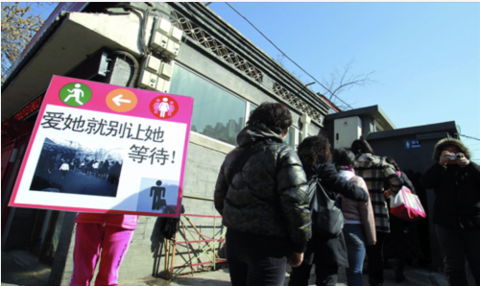
In cities like Guangzhou and Beijing, female activists entered men’s restrooms—usually with signs like “Don’t let her wait if you love her”—and politely asked male users to yield space to waiting women. Rather than attempting to permanently take over the facilities, activists timed their actions, occupying men’s restrooms for three out of every ten minutes. Their goal was not to “invade” but to highlight the invisible gendered labor of waiting and to propose a more equitable distribution of restroom resources.

The protest sparked significant public discussion and even policy response. In Guangzhou, local authorities adjusted toilet construction ratios to 1.5:1 in favor of women—an institutional acknowledgment of the problem. The movement garnered wide public support, media coverage (including from state-run outlets like China Daily), and endorsements from feminist scholars and public health advocates, who pointed out the physical and psychological toll of long wait times on women.

What made the campaign particularly resonant was its strategic simplicity and symbolic clarity: everyday acts like using the restroom became sites of feminist resistance, calling attention to the material inequalities inscribed in public infrastructure. It also marked a critical moment in the rise of contemporary Chinese feminist activism, prefiguring the more politically repressed actions of the Feminist Five three years later.

In hindsight, “Occupy Men’s Toilets” stands as a rare example of grassroots feminist direct action in China that yielded tangible, short-term policy changes, while also exposing deeper structural and cultural biases about gender, space, and bodily autonomy.

Posted by Katherine on

Staff rating: 

0

Effectiveness

How does this project help?

Timeframe For change

The long-term goal of the Occupy Men’s Toilets movement is to challenge and transform the gendered logic embedded in urban infrastructure, policy, and everyday public life. By addressing something as seemingly mundane as restroom access, the campaign foregrounds how urban planning reproduces systemic gender inequality—turning bodily needs into political demands. More broadly, the movement seeks to redefine gender equity not just in terms of legal rights, but in the physical design of public space, institutional responsiveness, and social attitudes. It aims to push for structural reform in urban development, including updated building codes that reflect gendered time-use differences in restrooms, as well as greater representation of women’s needs in policymaking processes. Ultimately, the campaign envisions a society where gender-based disparities in everyday experiences—no matter how “small”—are seen as worthy of public debate, collective action, and political response.

Notes

The Occupy Men’s Toilets movement was unusually effective for a grassroots feminist action in China, particularly in the following ways: • Policy Impact: In Guangzhou, local authorities responded swiftly by adjusting restroom construction guidelines to increase the ratio of women’s stalls to men’s (from 1:1 to 1.5:1), directly addressing the protesters’ demands. • Public Awareness: The campaign succeeded in drawing widespread media attention, including from state-run outlets like China Daily and Global Times. It shifted a private inconvenience into a public discourse on gender justice, sparking national conversations around gender, space, and bodily autonomy. • Symbolic Power: It reframed feminist protest as everyday resistance, using humor, politeness, and accessible symbolism (e.g. “Don’t let her wait if you love her”) to disarm criticism and build broad support. • Legacy: The movement served as a precedent and inspiration for later feminist actions in China—most notably the Feminist Five in 2015. It demonstrated that feminist activism could achieve visibility and even short-term victories within the Chinese political context, despite increasing censorship and repression. That said, while effective in immediate impact and awareness-building, the deeper structural change in urban policy and gendered design remains limited and inconsistent across regions. Moreover, subsequent crackdowns on feminist activism have narrowed the space for similar public interventions, pushing activists toward more dispersed or digital forms of resistance. Nonetheless, the Occupy Men’s Toilets action remains a landmark case of tactical feminist success, achieving both practical improvements and symbolic disruption within an otherwise tightly monitored social landscape.