change
region
medium
issue
despondent apostate
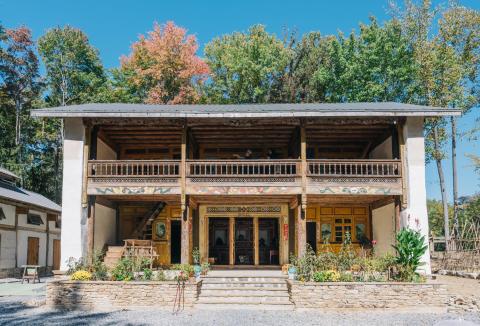
The China Folk House project grew out of the Sidwell Friends School China Fieldwork Semester, a program which had ran for five years (2014 – 2018) that took students to Yunnan Province, China, for an integrated semester of experiential learning based at the Linden Center in Xizhou. While leading students on a trip to the Three Parallel Rivers region in northwest Yunnan, John Flower visited the town of Cizhong, along the upper reaches of the Mekong River, and went to the small riverside hamlet of Ximalaza, where about 30 homes would be inundated by the reservoir of the new Wunonglong hydropower dam project. As the group wandered down toward the river, the walled gate of a house suddenly opened, and the surprised owner, Mr. Zhang Jianhua, invited the team all in for tea and a look around his home. John admired the craftsmanship of house, “it’s so lovely, what a pity it will be lost to the dam! I wish I could just take it home with me,” to which Mr. Zhang replied, “Ok, let’s do it!”
That started the idea of trying to save the house by dismantling it and moving it to a new home in America—an appealing idea because the team had used houses to great effect as a teaching tool for students to learn about Chinese culture. The symbols, the family histories, the political movements, the community identity, values, and historical change are all inscribed in houses. Cizhong was such an interesting community, with multiple ethnic groups and a vibrant Catholic community, that a house from Cizhong would be an incredibly rich text of everyday life.
In summer 2017, a Venture Grant from Sidwell Friends School paid for John and his colleague Steve Steinbach to travel to China to study and document the house for a three-week period. Steve’s daughter Ali Steinbach and another former student of John’s, Nikhil Chaudhuri, also found funds from their universities (Harvard and Stanford) enabling them to join the study trip. John paid for his friend Marty Fair to join the team, knowing his carpentry expertise would be a great help if they did end up taking down the house. Finally, and crucially, Yang Wendou was hired to join them as a tour leader. At the end of two weeks studying the house through interviews and physical documentation, John and Pam used their personal funds to buy the house and furnishings, take it down, and ship it to Baltimore—saving the structure and its stories, but not knowing exactly where or how it would be resurrected.
With more support from various sources, the non-profit project has developed to be a site of experiential learning, people-to-people exchange, environmental stewardship, and community engagement.